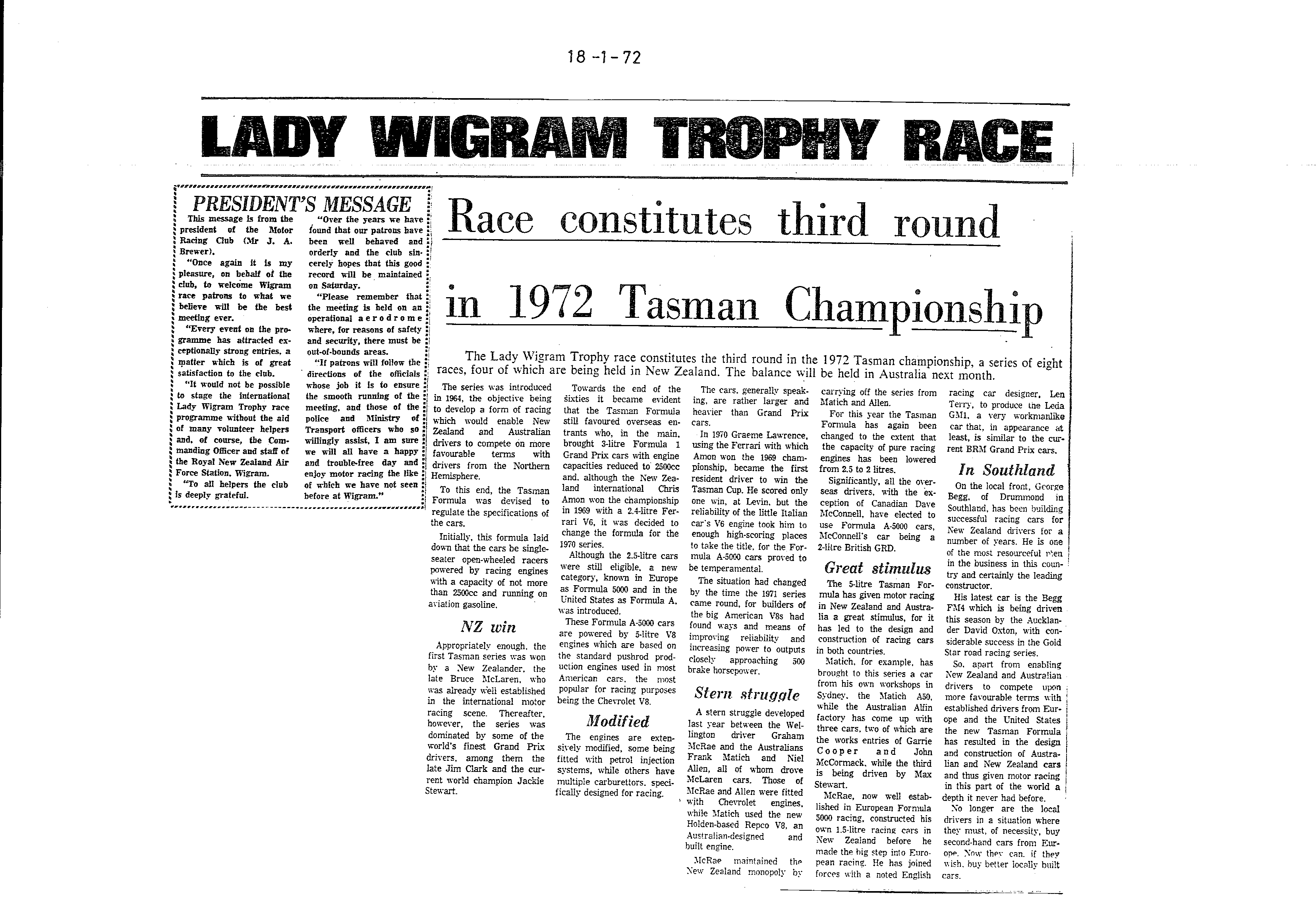
featurePresident's message
Programme-style message from Motor Racing Club president J. A. Brewer welcoming patrons to the 1972 Lady Wigram meeting, thanking volunteers and the RNZAF station, and asking spectators to follow officials' directions because the event is held on an operational aerodrome.
Facts
- Every event on the 1972 Wigram programme had attracted exceptionally strong entries, according to club president J. A. Brewer.
featureLady Wigram Trophy race constitutes third round of 1972 Tasman championship
History of the Tasman series (begun 1964): from McLaren's first title and the dominance of Clark and Stewart, through the 1970 switch to Formula A-5000 and Lawrence's 1970 title, to McRae's 1971 title over Matich and Allen. For 1972 pure racing engines drop from 2.5 to 2 litres, but nearly all the overseas drivers use 5-litre cars, many locally built such as the Matich A50, Elfin, Leda GM1 and Begg FM4.
Facts
- The Tasman series was introduced in 1964 so NZ and Australian drivers could compete on more favourable terms with Northern Hemisphere drivers; the 1972 series had eight races, four in NZ.
- In 1970 the Tasman Formula was changed to allow Formula A-5000 cars with 5-litre pushrod V8s, the Chevrolet V8 being the most popular.
- By 1971 American V8s reached outputs approaching 500 brake horsepower.
- For 1972 the capacity limit for pure racing engines in the Tasman Formula was lowered from 2.5 to 2 litres.
- The 1972 Lady Wigram Trophy was round three of the 1972 Tasman championship.
Read the OCR text
18-1-72
LADY
WIGRAM
TROPHY
RACE
PRESIDENT'S MESSAGE
president of the Motor This message is from the found that our patrons have "Over the years we have Race
Racing Club (Mr J. A. been well benaved and
Brewer). orderly and the club sin-
"Once again it is my cerely hopes that this good
pleasure, on behall of the record will be maintained
club, to melcome Wigram on Saturday.
race patrons to shat we "Please remember that
meeting ever. believe will be the best operational a e rodrome the meeting is held on an in 19
"Every event on the pro- where, for reasons of safety
gramme has attracted ex- and security, there must be
ceptionally strong entries, a out-of-bounds areas.
matter which is of great "If patrons will follow the The Lady Wigra
satisfaction to the club. directions of the officials races, four of which a
"It would not be possible whose job it is to ensure The series was introduced
to stage the international the smooth running of the in 1964, the objective being
Lady Wigram Trophy race meeting, and those of the to develop a form of racing
programme without the aid police and Ministry of which would enable New
• of many folunteer helpers Transport officers who so Zealand and Australian
i and, of course, the Com- willingiy assist, I am sure drivers to compete on more
manding Officer and staff of we will all have a happy favourable terms with
* the Royal New Zealand Air and trouble-free day and drivers from the Northern
Force Station, Wigram. enjoy motor racing the like Hemisphere.
"To all helpers the club of which we have not seen
: is deeply grateful. before at Wigram." To this end, the Tasman
Formula was devised to
regulate the specifications of
the cars.
Initially, this formula laid
down that the cars be singleseater open-wheeled racers
powered by racing engines
with a capacity of not more
than 2500cc and running on
aviation gasoline.
NZ win
Appropriately enough, the
first Tasman series was won
br a New Zealander, the
late Bruce McLaren, who
was already well established
in the international motor
racing scene. Thereafter,
however, the series was
dominated by some of the
world's finest Grand Prix
drivers, among them the
late Jim Clark and the current world champion Jackie
Stewart.
constitutes
third
round
72 Tas
am Trophy race constitu
are being held in New Z
Towards the end of the
sixties it became evident
that the Tasman Formula
still favoured overseas entrants who, in the main,
brought 3-litre Formula 1
Grand Prix cars with engine
capacities reduced to 2500cc
and. although the New Zealand international Chris
Amon won the championship
in 1969 with a 2.4litre Ferrari V6, it was decided to
change the formula for the
1970 series.
Although the 2.5-litre cars
were stil eligible, a new
category, known in Europe
as Formula 5000 and in the
United States as Formula A.
was introduced.
These Formula A-5000 cars
are powered by 5-litre V8
engines which are based on
the standard pushrod production engines used in most
American cars, the most
popular for racing purposes
being the Chevrolet V8.
Modified
The engines are extensively modified, some being
fitted with petrol injection
systems, while others have
multiple carburettors. specifically designed for racing.
man Cl
lamp
ionship
tes the third round in the 1972 Tasman championship, a series of eight
Lealand. The balance will be held in Australia next month.
The cars, generally speaking, are rather larger and
heavier than Grand Prix
cars.
In 1970 Graeme Lawrence,
using the Ferrari with which
Amon won the 1969 championship, became the first
resident driver to win the
Tasman Cup. He scored only
one win, at Levin, but the
reliability of the little Italian
car's V6 engine took him to
enough high-scoring places
to take the title, for the Formula A-5000 cars proved to
be temperamental.
The situation had changed
by the time the 1971 series
came round, for builders of
the big American V8s had
found wars and means of
improving reliability and
increasing power to outputs
closely approaching 500
brake horsepower.
Stern struggle
A stern struggle developed
last year between the Wellington driver Graham
McRae and the Australians
Frank Matich • and Niel
Alien, all of whom drove
McLaren cars. Those of
NIcRae and Allen were fitted
with Chevrolet engines.
while Matich used the new
Holden-based Repco V8, an
Australian-designed and
built engine.
McRae maintained thr
¡ew Zealand monopoly by
carrying off the series from
Matich and Allen.
for this year the Tasman
Formula has again been
changed to the extent that
the capacity of pure racing
engines has been lowered
from 2.5 to 2 litres.
Significantly, all the overseas drivers, with the exception of Canadian Dave
McConnell, have elected to
use Formula A-5000 cars,
McConnell's car being a
2-litre British GRD.
Great stimulus
The 5-utre Tasman Formula has giver motor racing
in New Zealand and Australia a great stimulus, for it
has led to the design and
construction of racing cars
in both countries.
Matich, for example, has
brought to this series a car
from his own workshops in
Sydney. the Matich A50,
while the Australian Alfin
factory has come up with
three cars, two of which are
the works entries of Garrie
Cooper and John
McCormack. while the third
is being driven by Max
Stewart.
McRae, now well established in European Formula
5000 racing, constructed his
own 1.5 litre racing cars in
New Zealand before he
made the hig step into European racing. He has joined
forces with a noted English
racing car designer. Len
Terry, to produce the Leda
GAll, a very workmanlike
car that, in appearance at
least, is similar to the current BRM Grand Prix cars.
In Southland
On the local front, George
Begg, of Drummond in
Southland, has been building
successful racing cars for
New Zealand drivers for a
number of years. He is one
of the most resourceful rien
in the business in this country and certainly the leading
constructor.
His latest car is the Begg
Fil4 which is being driven
this season by the Aucklander David Oxton, with considerable success in the Gold
Star road racing series.
So. apart from enabling
New Zealand and Australian
drivers to compete upon
more favourable terms with
established drivers from Europe and the United States
the new Tasman Formula
has resulted in the design
and construction of Australian and New Zealand cars
and thus given motor racing
in this part of the world a
depth it never had before.
No longer are the local
drivers in a situation where
they must, of necessity, buy
second-hand cars from Europe. Inw ther can. if they
wish. buy better locally built
Summaries and tables are machine-read from the scan and may contain errors: the scan is the record.