featureBirthday present set Coopers on road to fame
History of the Cooper car company: Charles Cooper built a tiny racing car for his son John's eighth birthday, later building 500cc cars and the 1950s Cooper-Climax. Coopers won the 1959 constructors' championship and took Jack Brabham to the world title, with cars costing far less than BRMs, Vanwalls or Ferraris.
Facts
- Cooper cars won 14 of 16 events they entered in 1948.
- Coopers won the world constructors' championship in 1959 with the 2.5-litre Cooper-Climax and took Jack Brabham to his world title.
newsRoutes to the circuit
More than 100 members of the Papanui Returned Services' Association under C. McIver will man the gates at Wigram for the 1960 Lady Wigram Trophy. McIver was one of two men who made representations to the Government in 1948 that led to Wigram being made available for motor racing.
Facts
- Wigram was made available for motor racing following representations to the Government in 1948.
newsGrandfather v son-in-law
W. Darrell, who had raced at Wigram for eight years in a Zephyr-engined special, will race against his son-in-law Brian Briggs, in a Mercury-engined car, in the Motor Racing Club's 42-mile championship at Wigram on Saturday.
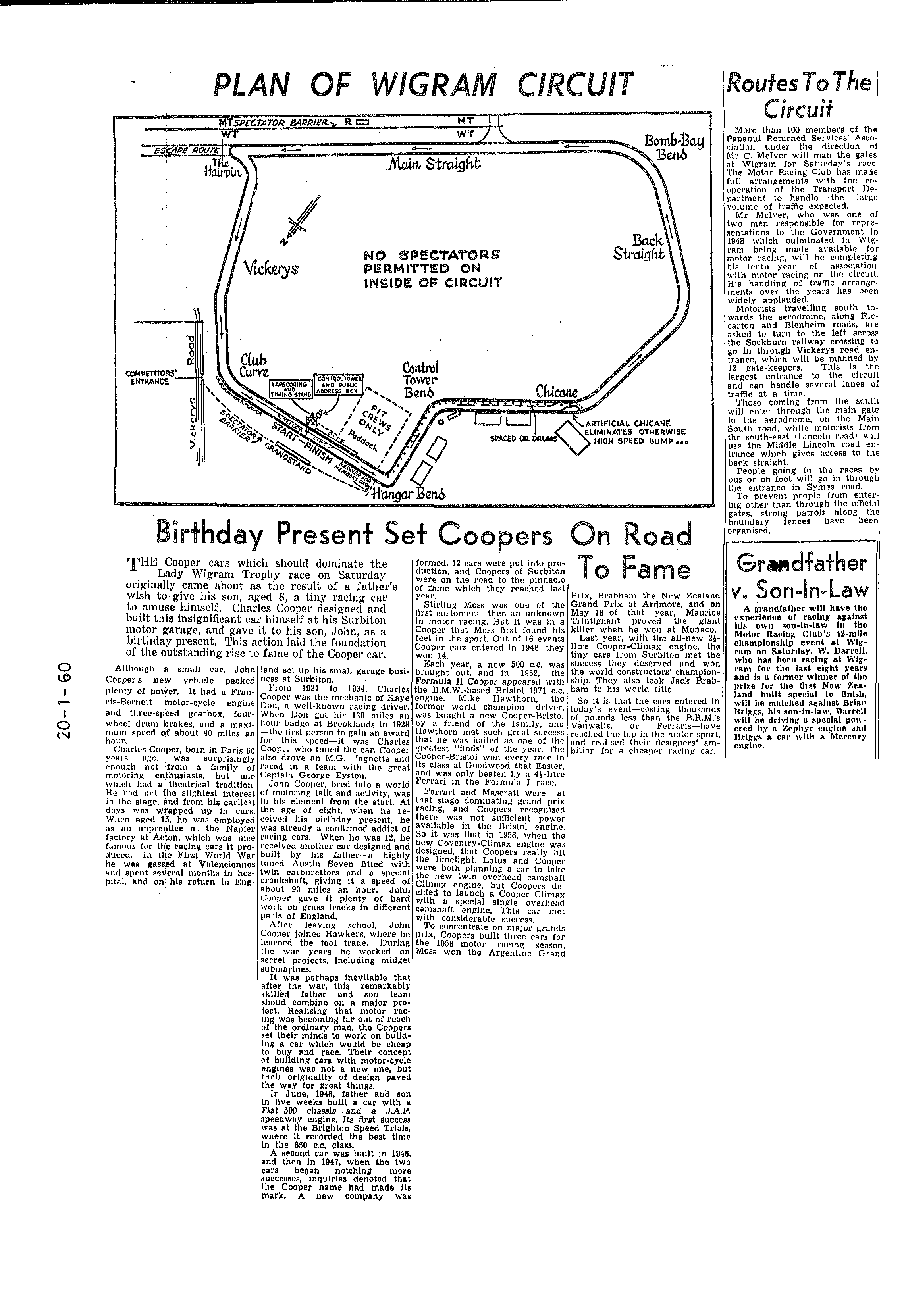
otherPlan of Wigram circuit
Plan of the Wigram circuit marking the Main Straight, Hangar Bend, Hairpin, Back Straight, Bomb-Bay bend, Vickerys Road, Club Control Tower, paddock and grandstand.
Read the OCR text
PLAN
OF WIGRAM
CIRCUIT
MiSPECTATOR BARRIERS RE MT
WT WT
ESCAPE ROUTE Bomb-Bay
Вено
The Main Straight
Hairpin
Back
NO SPECTATORS Straight
Vickerys PERMITTED ON
INSIDE OF CIRCUIT
Club Control
COMPETITORS® Curre
ENTRANCE CONTROL TOWER Tower®
LAPSCORING AND DUBUK
AND BOnd Chicane
TIMING STAND ADDRESS 80X
JickeD ONLY CREWS * ARTIFICIAL CHICANE ELIMINATES OTHERWISE
Paddock SPACED OIL DRUMS HIGH SPEED BUMP •e•
GRANDSTAND START -FINISH BARRIER.
MEMBERS
Hangar Bend
Birthday Present Set Coopers
THE Cy Wigram • cars which should dominate the
Lady Wigram Trophy race on Saturday
originally came about as the result of a father's
wish to give his son, aged 8, a tiny racing car
to amuse himself. Charles Cooper designed and
built this insignificant car himself at his Surbiton
motor garage, and gave it to his son, John, as a
birthday present. This action laid the foundation
of the outstanding rise to fame of the Cooper car.
Although a small car, John land set up his small garage busi-
Cooper's vehicle packed ness at Surbiton.
plenty of power, It had a Fran- to 1934, Charles
cis-Barnelt motor-cycle engine Cooper was the mechanic of Kaye
Don, a well-known racing driver.
and three-speed gearbox, four- When Don got his 130 miles an
wheel drum brakes, and a maxi- hour badge at Brooklands in 1928
mum speed of about 40 mlles an -Ihe first person to gain an award
nour. for this speed-it Charles
Charles Cooper, born in Paris 60 Coope. who tuned the car, Cooper
years surprisingly also drove an M.G. Tagnetle and
cnough not from a family of raced in a team with the great one Captain George Eyston.
moloring enthusiasts,
which had a theatrical tradition. John Cooper, bred Into a world
He had net the slightest interest of moloring lalk and activity, was
in the stage, and from his earllest in his element from the start. At
days was wrapped up in cars., the age of eight, when he re-
When aged 15, he was employed ceived his birthday present, he
as an apprentice at the Napler was already a confirmed addict of
factory at Acton, which was unce racing cars. When he was 12, he
famous for the racing cars it pro- received another car designed and
duced. In the First World Warl built by father-a highly
he was gassed at Valenciennes tuned Austin Seven fitted with
and spent several months in hos- twin carburettors and a special
pital, and on his return to Eng crankshalt, giving it a speed of
about 90 hour.
Cooper gave it plenty of hard
work on grass tracks in different
parts of England.
leaving
Cooper joined Hawkers, where he
learned the tool trade. During
the war years he worked on
secret projects, Including midget
submarines.
It was perhaps inevitable that
after the war, this remarkably
son team
shoud combine on a major pro-
Ject. Realising that motor racing was becoming tar out of reach
of the ordinary man, the Coopers
set their minds to work on butldin buy a face their ccep and race. Their concept
of bullding cars with motor-cycle
engines was not a new one, but
their originality of design paved
the way for great things.
In June, 1948, father and • 80n
in five weeks built a car with a
Flat 300 chassis. and a J.A.P
speedway engine, its Arst success
was at the Brighton Speed Irlals,
where it recorded the best time
in the 850 c.c. class.
A second car was built in 1946,
and then in 1947, when the two
cars began notching more
successes, inqutries denoted that
the Cooper name had made its
mark. A new company was
formed, 12 cars were put into production, and Coopers of Surbiton
were on the road to the pinnacle
of tame which they reached last
year.
Stirling Moss was one of the
Arst customers-then an unknown
in motor racing. But it was in a
Cooper that Moss Arst found his
feet in the sport. Out of 16 events
Cooper cars entered in 1948, they
won 14.
Bach year, a new 500 c.c. was
brought out, and in 1952, the
Formula Il Cooper appeared with
the B.M.W.-based Bristol 1971 c.c.
engine. Mike Hawthorn, the
former world champion driver,
was bought a new Cooper-Bristol
by a friend of the family, and
Hawthorn met such great success
that he was hailed as one of the
greatest "finds" of the year. The
Cooper-Bristol won every race in
its class at Goodwood that Easter,
and was only beaten by a 42-litre
terrari in the Formula 1 race.
Ferrari and Maserati were at
that stage dominating grand prix
racing, and Coopers recognised
there was not sufficient power
available in the Bristol engine.
So it was that in 1956, when the
new Coventry-Climax engine was
designed, that Coopers really hit
the limelight. Lotus and • Cooper
were both planning a car to take
the new twin overhead camshaft
Climax engine, but Coopers decided to launch a Cooper Climax
with a special single overhead
camshaft engine. This car met
with considerable success.
To concentrate on major grands
prix, Coopers built three cars for
the 1958 motor racing season.
Moss won the Argentine Grand
On Road
Fame
Prix, Brabham the New Zealand
Grand Prix at Ardmore, and on
May 18 of that year, Maurice
Trintignant proved the giant
killer when he won at Monaco.
Last year, with the all-new 24-
Iltre Cooper-Climax engine, the
tiny cars from Surblton met the
success they deserved and won
the world constructors' champion.
ship. They also took Jack Brabham to his world title.
So it is that the cars entered in
today's event-costing thousands
of, pounds less than the B.R.M.'s
Vanwalls, or Ferraris-have
reached the top in the motor sport,
and realised their designers' ambitinn for a cheaper racing car.
Routes To The
Circuit
More than 100 members of the
Papanul Returned Services' Association under the direction of
Mr C. Melver will man the gates
at Wigram for Saturday's race
The Motor Racing Club has made
full arrangements with the cooperation of the Transport Department to handle • the large
volume of traffic expected.
Mr Meiver, who was one of
two men responsible for representations to the Government in
1948 which oulminated Wig"
being made available for
motor racing, will be completing
his lentil year of association
with motor racing on the circuit.
His handling of traffic arrangements over the years has been
widely applauder
Motorists travelling south towards the aerodrome, along Ric-
Blenheim roads,
asked to turn to the left across
the Sockburn railway crossing to
go in through Vickerys road entrance, which will be manned by
gate-keepers. This is the
largest entrance to the circuit
and can handle several lanes of
traffic at a time.
Those coming from the
will enter through the main gate
lo the aerodrome, on the Main
South road, while motorists from
the south-past (lincoln road) will
use the Middle Lincoln road entrance which gives access to the
back straight.
People going to the races by
bus or on foot will go in through
tbe entrance in Symes road.
To prevent people from entering other than through the official
gates, strong patrols the
boundary fences
organised.
Grandfather
v. Son-In-Law
A grandfather will have the
experience of racing against
hia own son-in-law in the
Motor Racing Club's 42-mlie
championship event at Wigram on Saturday. W. Darrell,
who has been racing at Wigram for the last eight years
and is & former winner of the
prize for the first New Zealand bullt special lo finish,
will be matched against Brian
Briggs, his son-in-law, Darrell
will he driving a speola! ponered by a Zephyr engine and
Briges a car with a Mercury
engine.
Summaries and tables are machine-read from the scan and may contain errors: the scan is the record.