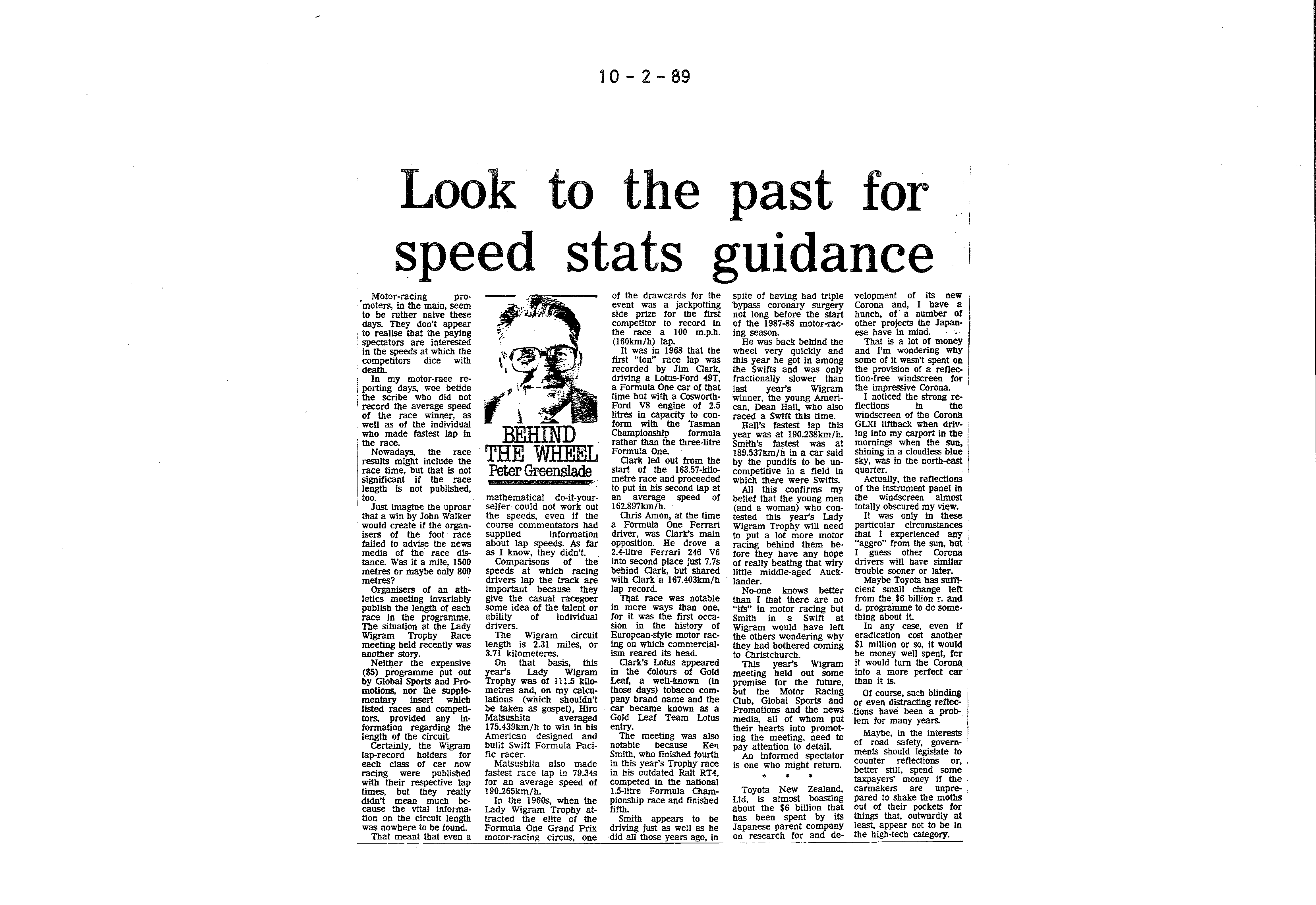
feature · The Press · Peter GreensladeLook to the past for speed guidance
Greenslade's Behind the Wheel column criticises the 1989 Lady Wigram Trophy programme for omitting the circuit length, making speeds impossible to work out. Using a 3.71km lap, he calculates Hiro Matsushita averaged 175.439km/h over the 111.5km race. He compares it with Jim Clark's 1968 race, the first 100mph lap, and praises Ken Smith's pace in an outdated Ralt RT4.
Lap times
- Hiro Matsushita (Swift): 190.265 km/h fastest race lap
- Dean Hall (Swift): 190.238 km/h fastest race lap
- Ken Smith (Ralt RT4): 189.537 km/h fastest race lap
- Hiro Matsushita (Swift): 175.439 km/h other
- Jim Clark (Lotus 49 Cosworth): 162.897 km/h other
- Jim Clark (Lotus 49 Cosworth): 167.403 km/h lap record
- Chris Amon (Ferrari 246): 167.403 km/h lap record
Facts
- The Wigram circuit length was given as 2.31 miles (3.71 km) in 1989; the 1989 Lady Wigram Trophy race was 111.5 km.
- Hiro Matsushita averaged about 175.4 km/h to win the 1989 Lady Wigram Trophy in a Swift.
- In the 1960s the Lady Wigram meeting offered a side prize for the first 100mph (160 km/h) lap in the race; it was first achieved by Jim Clark in 1968.
- The 1968 Lady Wigram Trophy was 163.57 km; Clark's Gold Leaf Team Lotus was the first commercially sponsored livery in European-style racing.
- Ken Smith was fourth in the 1989 Lady Wigram Trophy race, and Dean Hall's fastest lap that year was 190.238 km/h versus Smith's 189.537 km/h.
other · The Press · Peter GreensladeCorona windscreen reflections
Greenslade complains that the new Toyota Corona GLXi liftback has strong dashboard reflections in the windscreen when the sun is in the north-east, despite Toyota's reported $6 billion research spend.
Read the OCR text
10-2-89
Look to
speed s1
Motor-racing promoters, in the main, seem
to be rather naive these
days. They don't appear
to realise that the paying
spectators are interested
in the speeds at which the
competitors dice with
death.
In my motor-race reporting days, woe betide
the scribe who did not
record the average speed
of the race winner, as
well as of the individual
who made fastest lap in
the race.
race
resuits might include the
race time, but that is not
significant if the race
• length is not published,
t00.
Just imagine the uproar
that a win by John Walker
would create if the organisers of the foot race
failed to advise the news
media of the race distance. Was it a mile, 1500
metres or maybe only 800
metres?
Organisers of an athletics meeting invariably
publish the length of each
race in the programme.
The situation at the Lady
Wigram Trophy Race
meeting held recently was
another story.
Neither the expensive
($5) programme put out
by Global Sports and Promotions, nor the supplementary insert which
listed races and competitors, provided any information regarding the
length of the circuit
Certainly, the Wigram
lap-record holders for
each class of car now
racing were published
with their respective lap
times, but they really
didn't mean much because the vital information on the circuit length
was nowhere to be found.
That meant that even a
BEHIND
THE WHEEL
Peter Greenslade
mathematical do-it-yourselfer could not work out
the speeds, even if the
course commentators had
supplied information
about lap speeds. As far
as I know, they didn't
Comparisons of the
speeds at which racing
drivers lap the track are
important because they
give the casual racegoer
some idea of the talent or
ability of individual
drivers.
The Wigram circuit
length is 2.31 miles, or
3.71 kilometeres.
On that basis, this
year's Lady Wigram
Trophy was of 111.5 kilometres and, on my calculations (which shouldn't
be taken as gospel), Hiro
Matsushita averaged
175.439km/h to win in his
American designed and
built Swift Formula Pacific racer.
Matsushita also made
fastest race lap in 79.34s
for an average speed of
190.265km/h.
In the 1960s, when the
Lady Wigram Trophy attracted the elite of the
Formula One Grand Prix
motor-racing circus, one
the past
cats
guida
of the drawcards for the
event was a jackpotting
side prize for the first
competitor to record in
the race a 100 m.p.h.
(160km/h) lap.
It was in 1968 that the
first "ton" race lap was
recorded by Jim Clark,
driving a Lotus-rora 491,
a Formula One car of that
time but with a Cosworth-
Ford V8 engine of 2.5
litres in capacity to conform with the Tasman
Championship formula
rather than the three-litre
Formula One.
Clark led out from the
start of the 163.57-kilometre race and proceeded
to put in his second lap at
average speed of
162.897km/h.
Chris Amon, at the time
a Formula One Ferrari
driver, was Clark's main
opposition. He drove a
2.4-litre Ferrari 246 V6
into second place just 7.7s
behind Clark, but shared
with Clark a 167.403km/h
lap record.
That race was notable
in more ways than one,
for it was the first occasion in the history of
European-style motor racing on which commercialism reared its head.
Clark's Lotus appeared
in the čolours of Gold
Leaf, a well-known (in
those days) tobacco company brand name and the
car became known as a
Gold Leaf Team Lotus
entry.
The meeting was also
notable because Ken
Smith, who finished fourth
in this year's Trophy race
in his outdated Rait RT4,
competed in the national
1.5-litre Formula Championship race and finished
fifth.
Smith appears to be
driving just as well as he
•did at those years ago, in
spite of having had triple
bypass coronary surgery
not long before the start
of the 1987-88 motor-racing season.
He was back behind the
wheel very quickly and
this year he got in among
the Swifts and was only
fractionally Slower than
last year's Wigram
winner, the young Amencan, Dean Hall, who aiso
raced a Swift this time.
Hall's fastest lap this
year was at 190.238km/h.
Smith's fastest was at
189.537km/h in a car said
by the pundits to be uncompetitive in a field in
which there were Swifts.
All this confirms my
belief that the young men
(and a woman) who contested this years Lady
Wigram Trophy will need
to put a lot more motor
racing behind them before they have any hope
of really beating that wiry
little middie-aged Aucklander.
No-one knows better
than I that there are no
"ifs" in motor racing but
Smith in a Swift at
Wigram would have left
the others wondering why
they had bothered coming
to Christchurch.
This year's Wigram
meeting held out some
promise for the future,
but the Motor Racing
Club, Global Sports and
Promotions and the news
media, all of whom put
their hearts into promoting the meeting, need to
pay attention to detail.
An informed spectator
is one who might return.
Toyota New Zealand,
Ltd, is almost boasting
about the $6 billion that
has been spent by its
Japanese parent company
on research for and de-
for
nce
velopment of its new
Corona and, I have g
hunch, of a number of
other projects the Japanese have in mind.
That is a lot of money
and I'm wondering why
some of it wasn't spent on
the provision of a reflection-free windscreen for
the impressive Corona.
I noticed the strong reflections
windscreen of the Corona
GLXi liftback when driv
ing into my carport in the
mornings when the sun,
shining in a cloudless blue
sky, was in the north-east
quarter.
Actually, the reflections
of the instrument panel in
the windscreen almost
totally obscured my view.
It was only in these
particular circumstances
that I experienced any
"aggro" from the sun, bat
I guess other Corona
drivers will have similar
trouble sooner or later.
Maybe Toyota has sufficient small change left
from the $6 billion r. and
d. programme to do something about it.
in any case, even if
eradication cost another
$1 million or so, it would
be money well spent, for
it would turn the Corona
into a more perfect car
than it is.
Of course, such blinding
or even distracting reflections have been a prob
lem for many years.
Maybe, in the interests
of road safety, governments should legislate to
counter reflections оГ,
better still, spend some
taxpayers' money if the
carmakers are unpre
pared to shake the moths
out of their pockets for
things that, outwardiy at
least, appear not to be in
the high-tech category.
Summaries and tables are machine-read from the scan and may contain errors: the scan is the record.