feature · The Press · George TannerLogos and colours of money
Tanner recalls that on 19 January 1968 Jim Clark arrived at Wigram with his Lotus 49T Cosworth in the red, white and gold Gold Leaf livery, the first time the car appeared in the new sponsor's colours. He traces tobacco sponsorship of Lotus through John Player Special, Martini-Rossi, Essex, to Camel, and its world championships.
Lap times
- Jim Clark (Lotus 49T Cosworth): practice
Facts
- Jim Clark's Lotus 49T appeared in the new red, white and gold Gold Leaf colours at Wigram practice on 19 January 1968, a month before the sole Lotus entry at the Spanish Grand Prix used the same scheme.
- In 1972 Lotus cars became black John Player Specials; Lotus-Player's titles came in 1968 (Graham Hill), 1970 (Jochen Rindt), 1972 (Fittipaldi) and 1978 (Andretti).
Photos
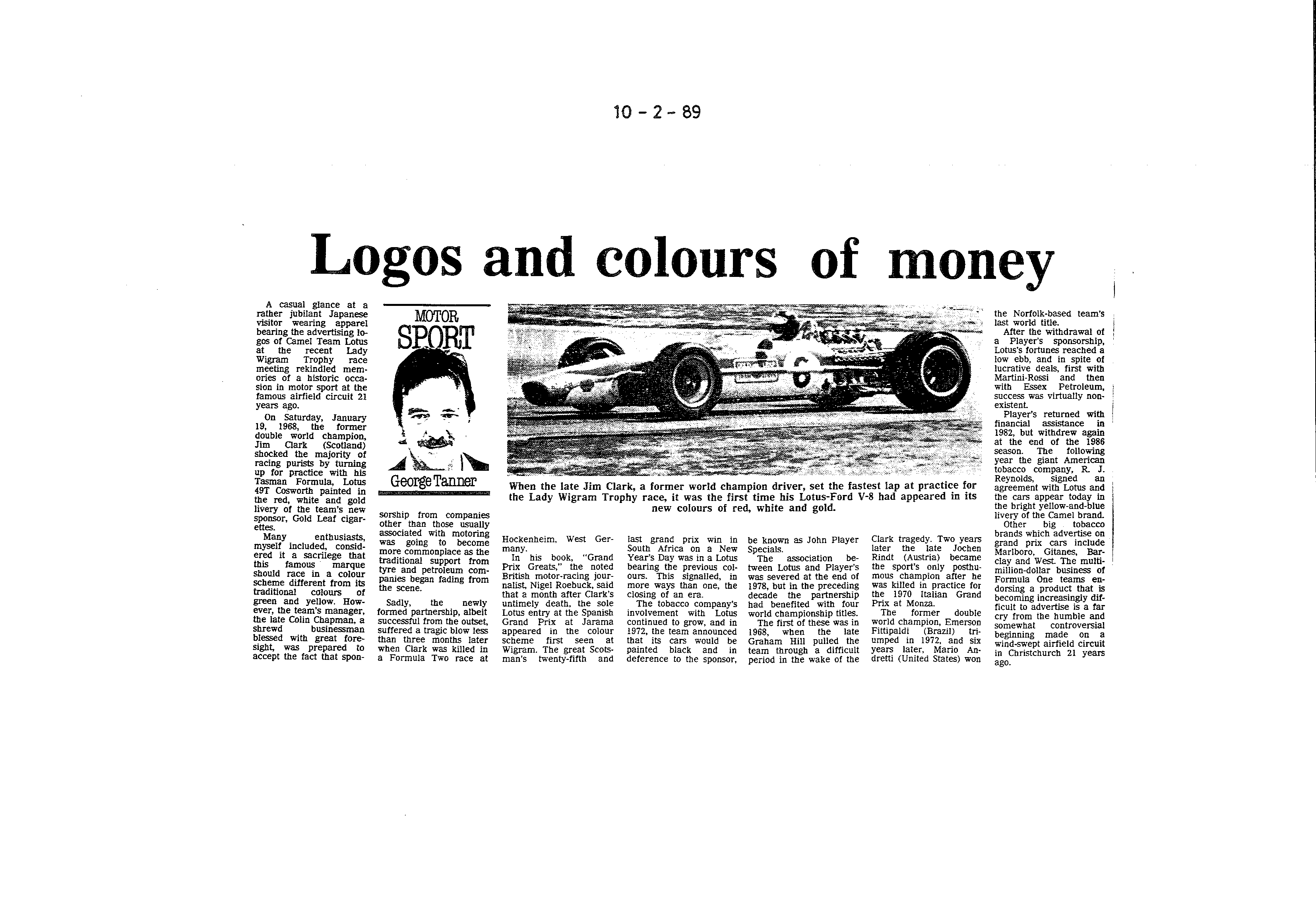
- When the late Jim Clark, a former world champion driver, set the fastest lap at practice for the Lady Wigram Trophy race, it was the first time his Lotus-Ford V-8 had appeared in its new colours of red, white and gold.
Read the OCR text
10-2-89
Logos
ana
colours
of m
oney
A casual glance at a
rather jubilant Japanese
visitor wearing apparel
bearing the advertising logos of Camel Team Lotus
at the recent Lady
Wigram Trophy race
meeting rekindled memories of a historic occasion in motor sport at the
famous airfield circuit 21
years ago.
On Saturday, January
19, 1968, the former
double world champion,
Jim Clark (Scotland)
shocked the majority of
racing purists by turning
up for practice with his
Lasman Formula, Lotus
49T Cosworth painted in
the red, white and gold
livery of the team's new
sponsor, Gold Leaf cigarettes.
Many enthusiasts,
myself included, consid
ered it a sacrilege that
this famous marque
should race in a colour
scheme different from its
traditional colours of
green and yellow. However, the team's manager,
the late Colin Chapman, a
Shrewd businessman
blessed with great fore
accept the fact are spon-
MOTOR
SPORT
George Tanner
sorship from companies
other than those usually
associated with motoring
was going to become
more commonplace as the
traditional support from
tyre and petroleum companies began fading from
the scene.
Sadly, the newly
formed partnership, albeit
successful from the outset,
suffered a tragic blow less
than three months later
when Clark was killed in
a Formula Two race at
When the late Jim Clark, a former world champion driver, set the fastest lap at practice for
the Lady Wigram Trophy race, it was the first time his Lotus-Ford V-8 had appeared in its
new colours of red, white and gold.
Hockenheim, West Germany.
In his book, "Grand
Prix Greats," the noted
British motor-racing journalist, Nigel Roebuck, said
that a month after Clark's
untimely death, the sole
Lotus entry at the Spanish
Grand Prix at Jarama
appeared in the colour
scheme first seen at
Wigram. The great Scotsman's twenty-fifth and
last grand prix win in
South Africa on a New
Year's Day was in a Lotus
bearing the previous colours. This signalled, in
more ways than one, the
closing of an era.
The tobacco company's
involvement with Lotus
continued to grow, and in
1972, the team announced
that its cars would be
painted black and in
deference to the sponsor,
be known as John Player
Specials.
The association between Lotus and Player's
was severed at the end of
1978, but in the preceding
decade the partnership
had benefited with four
world championship titles.
The first of these was in
1968, when the late
Graham Hill pulled the
team through a difficult
period in the wake of the
Clark tragedy. Two years
later the late Jochen
Rindt (Austria) became
the sport's only posthumous champion after he
was killed in practice for
the 1970 Italian Grand
Prix at Monza.
The former double
world champion, Emerson
Fittipaldi (Brazil) inumped in 1972, and six
years later, Mario Andretti (United States) won
the Norfolk-based team's
last world title.
After the withdrawal of
Player's sponsorship,
Lotus's fortunes reached a
low ebb, and in spite of
lucrative deals, first with
Martini-Rossi and then
with Essex Petroleum,
success was virtually nonexistent.
Player's returned with
financial assistance
1982, but withdrew again
at the end of the 1986
season. The following
year the giant American
tobacco company, R. J.
Reynolds, signed an
agreement with Lotus and
the cars appear today in
the bright yellow-and-blue
livery of the Camel brand.
Other big tobacco
brands which advertise on
grand prix cars include
Marlboro, Gitanes, Barclay and . West. The multimillion-dollar business of
Formula One teams endorsing a product that is
becoming increasingly difficult to advertise is a far
cry from the humble and
somewhat controversial
beginning made on a
wind-swept airfield circuit
in Christchurch 21 years
ago.
Summaries and tables are machine-read from the scan and may contain errors: the scan is the record.