Read the OCR text
23-1-82
Long,
The first New Zealand car
road racing championship
was held over a course of 105
miles on the sealed runways
at the R.N.Z.A.F. Station.
Wigram. on saturday, Februагу 26. 1949. The winner of
that event was a Wellington
driver, Maurice Proctor, in a
Riley.
Between 20.000 and 30.000
spectators. many of whom
did not pay the admission
fee, saw the 22 starters roar
away around the 2.1-mile
circuit at the drop of the
Union Jack.
Pole position for the event
went to F. B. Bennet, driving an Invicta with Hec
Green recording the second
fastest speed at the wheel of
a Wolseley special. R. F
Christie. in an M.G.. and
Proctor were next on the
grid. and behind them was
the only woman in the race.
Sybil Lupp from Dunedin at
the wheel of an M.G.
One of the highlights of the
event was the race-long duel
between Ron Roycroft's tiny
blue Austin and Green's red
Wolseley Special.
There was one mishap in
the race, when an M.G
driven by G. Parker, flipped
lap 21. throwing the
driver clear from his car. He
was lucky to escape with
only scratches and shock
The fore headap they ted paid
when the flag came down to
signal Proctor's win. it was
Bennett, from Christchurch,
in second place. Sybil Lupp
drove well to finish in fifth
place.
The race lasted 95 minutes
and the winner's average
speed was 65.67 m.p.h. The
fastest lap for the race was
12 m.p.h. by Bennett. The
first Wigram race was run
by the Canterbury Car Club.
but the following year the
event was organised and run
by the break-away group
calling itself the Motor Racing Club Incorporated. It has
excit
• run the event ever since.
With the exception of 1955.
when the aerodrome was
being resealed. air force
operations have been suspended for one week-end
every January to allow
motor-racing to take place at
Wigram. The former Labour
M.P.. Mr Jock Mathison. then
patron of the club. had an
act passed through Parliament, giving Govenment ap
proval for the race meeting
to be held annually.
In 1954, the event took on
an international flavóur. with
drivers from overseas coming here to take on the New
Zealanders who. until then.
had no overseas competition
against which to measure
their skills. For the next
three years, the main race at
Wigram was dominated by
Englishman. Peter
Whitehead at the wheel of
his fabulous Ferrari.
So it was not until 1963
before a New. Zealand driver
again won the Lady Wigram
Trophy. which was given to
club by Lady Agnes
Vernon Wigram in the early
1950s. was originally
owned by the Christie family.
who were personal friends of
Sir Henry and Lady Wigram
through their aviation connections. The Lady Wigram
Trophy is one of the most
prestigious trophies in New
Zealand sport; it is to a
racing driver what the Ranfurly Shield is to a rugby
player. Sir Henry Wigram
owned one of the first cars in
Canterbury and Lady
Wigram was one of the first
women drivers in the province. She died in her Park
Terrace home, at the age of
95. in 1957. 23 years after her
husband. a former Mayor of
Christchurch.
The after Lady
Wigram's a death. many
overseas and New Zealand
drivers battled it out for the
trophy bearing the name of
an equally brave and cour-
ing hi
ageous woman.
Apart from Whitehead.
there were men including
Ron Flockhart. Jack Brabham. Stirling Moss. John Surtees. Roy Salvadori. Archie
Scott Brown. who raced to
victory with ine handicap of
only having one arm. and
New Zealand's then top
young hoperul. Bruce
McLaren.
Many will argue that those
years of Wigram were the
best. In some ways, they are
probably right.
Who. for example. could
ever forget the high-pitched
wall of Ron Flockhart's.
B.R.M. exhaust note as it
echoed off the hangar walls
and around the control tower
bend as the dark green car
headed for victory in 1959?
Who could ever forget the
performance of Jack Brabhain in the 1961 rain-soaked
event. That year it rained so
hard that the main race was
shortened by 50 miles •as
conditions got worse.
The same sear. the Scottish wonder-boy. Jim Clark,
had perhaps the biggest spin
ever seen at Wigram.
Lotus Eighteen spun off the
back straight and skidded for
what seemed forever. before
getting bogged down in the
soaking grass, unable to restart. Clark always listed that
incident as one of the most
frightening in his career.
Wigram had never seen
weather conditions like that
before and. thankfully, they
have never been like it since.
In fact, since that year conditions have always been
pleasant for motor-racing
though sometimes it has
been rather too hot. The
1960s had drivers like
McLaren, Brabham and Scotland's all-time great. Jim
Clark. dominating the event.
Other drivers who appeared
in those years were Lorenzo
Bandini from Italy. Phil Hill
from the United States. Jo
Bonnier from Sweden. Tony
story
By GEOR
Maggs of South Africa.
Timmy Mayer from the
United States. plus some topline Australian drivers. including Frank Gardner, and
Kevin Bartlett.
In the mid-sixties, a newcomer to motor-racing.
Jackie Siewart from Scotlana, also appeared, teamed
with the Englishman. Richard Attwood. to give the
already established drivers
some powerful opposition.
The 1968 race was the last
appearance of Clark. one of
the most popular drivers
Wigram
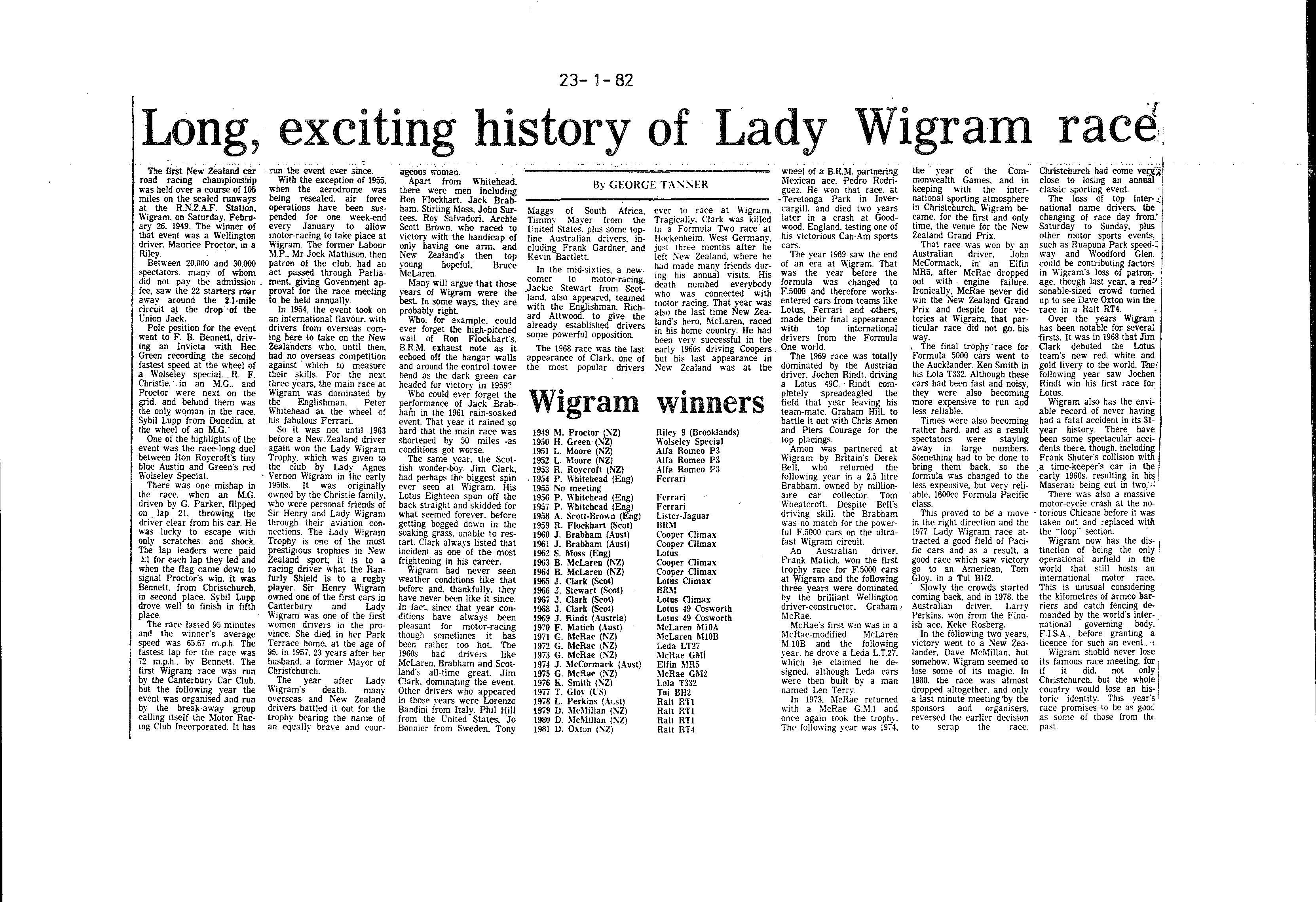
1919 M. Proctor (NZ)
1950H. Green (NZ)
1951 L. Moore (N2)
1952 L. Moore (NZ)
1953 R. Royeroft (NZ)
1954 P. Whitehead (Eng)
1955 No meeting
1956 P. Whitehead (Eng)
1957 P. Whitehead (Eng)
1958 A. Scott-Brown (Eng)
1959 R. Flockhart (Scot)
1960 J . Brabham (Aust)
1961 J. Brabham (Aust)
1962 S. Moss (Eng)
1963 B. McLaren (NZ)
1964 B. McLaren (NZ)
1965 J. Clark (Scot)
1966 J. Stewart (Scot)
1967 J. Clark (Scot)
1968 J. Clark (Scot)
1969 J. Rindt (Austria)
1970 F. Matich (Aust)
1971 G. MicRae (NZ)
1972 G. McRae (NZ)
1973 G. McRae (NZ)
1974 J. McCormack (Aust)
1975 G. McRae (NZ)
1976 k. Smith (NZ)
1977 T. Gloy (L'S)
1978 L. Perkins (ALst)
1979 D. MeNtillan (NZ)
1980 D. Nichfillan (NZ)
1981 D. Oxton (NZ)
of La
GE TANNER
ever to race at Wigram.
Tragically. Clark was killed
in a Formula Two race at
Hockenheim. West Germany:
just three months after he
left New Zealand. where he
had made many friends during his annual visits. His
death numbed everybody
who was connected with
motor racing. That year was
also the last time New Zealand's hero. McLaren, raced
in his home country. He had
been very successful in the
early 1960s driving Coopers
but his last appearance in
New Zealand was at the
winners
Riley 9 (Brooklands)
Wolseley Special
Alfa Romeo P3
Alfa Romeo P3
Alfa Romeo P3
Ferrari
Ferrari
Ferrari
Lister-Jaguar
BRM
Cooper Climax
Cooper Climax
Lotus
Cooper Climax
Cooper Climax
Lotus Climax
BRNI
Lotus Climax
Lotus 49 Cosworth
Lotus 49 Cosworth
McLaren Mi0A
McLaren M10B
Leda LT27
McRae GMÌ
Elfin MR5
McRae GM2
Lola T332
Tui BH2
Ralt RT1
Ralt RT1
Ralt RT1
Ralt RT4
dy Wi
wheel of a B.R.M. partnering
Mexican ace. Pedro Rodriguez. He won that race. at
-Teretonga Park in Invercargill. and died two years
later in a crash at Goodwood. England. testing one of
his victorious Can-Am sports
cars.
The year 1969 saw the end
of an era at Wigram. That
was the vear before the
formula was changed to
F.5000 and therefore worksentered cars from teams like
Lotus, Ferrari and others,
made their final appearance
with top international
drivers from the Formula
One world.
The 1969 race was totally
dominated by the Austriar
driver. Jochen Rindt. driving
a Lotus 49C. - Rindt completely spreadeagled the
field that year leaving his
team-mate. Graham Hill, to
battle it out with Chris Amon
and Piers Courage for the
top placings.
Amon was partnered at
Wigram by Britain's Derek
Bell. who returned the
following year in a 25 litre
Brabham. owned by millionaire car collector. Tom
Wheateroft. Despite Bell's
driving skill. the Brabham
was no match for the powerful F.5000 cars on the ultrafast Wigram circuit.
An Australian driver.
Frank Matich. won the first
trophy race for F.5000 cars
at Wigram and the following
three years were dominated
by the brilliant Wellington
driver-constructor. Graham
McRae.
McRae's first win was in a
McRae-modified McLaren
M.10B and the following
year. he drove a Leda L.T.27,
which he claimed he designed. although Leda cars
were then built by a man
named Len Terry.
In 1973. McRae returned
with a McRae G.M.l and
once again took the trophy:
The following vear was 1974.
gram
the year of the Commonwealth Games. and in
keeping with the international sporting atmosphere
in Christchurch. Wigram became. for the first and only
time, the venue for the New
Zealand Grand Prix.
That race was won by an
Australian driver. John
McCormack, in an Elfin
MR5, after MicRae dropped
out with engine failure.
Ironically, McRae never did
win the New Zealand Grand
Prix and despite four vietories at Wigram, that particular race did not go. his
way.
The final trophy race for
Formula 5000 cars went to
the Aucklander, Ken Smith in
his Lola T332. Although these
cars had been fast and noisy,
they were also becoming
more expensive to run and
less reliable.
Times were also becoming
rather hard. and as a result
spectators were staying
away in large numbers.
Something had to be done to
bring them back, so the
formula was changed to the
less expensive. but very reliable. 1600cc Formula Pacific
class.
This proved to be a move
in the right direction and the
1911 Lady Wigram race attracted a good field of Pacifie cars and as a resuit, a
good race which saw victory
go to an American, Tom
Gloy, in a Tui BH2.
Slowly the crowds started
coming back, and in 1978, the
Australian driver. Larry
Perkins. won from the Finnish ace. Keke Rosberg.
ish In the ! victory went to a New Zea- In the following two years,
lander, Dave McMillan. but
somehow. Wigram seemed to
lose some of its magic. In
1980. the race was almost
dropped altogether. and only
a last minute meeting by the
sponsors and organisers.
reversed the earlier decision
to scrap the race
race
Ceristchurch nad come vec?
close to losing an annual
classic sporting event.
The loss of top inter-:
national name drivers. the
changing of race day from.
Saturday to Sunday. plus
other motor sports events,
such as Ruapuna Park speed-way Woodford Gien,
could be contributing factors
in Wigram's loss of patronage, though last year, a rea?
sonable-sized crowd turned
up to see Dave Oxton win the
race in a Ralt RT4.
Over the years wigram
has been notable for several
firsts. It was in 1968 that Jim
Clark debuted the Lotus
team's new red, white and
gold livery to the world. The!
following year saw Jochen
Rindt win his first race for
Lotus.
Wigram also has the enviable record of never having
had a fatal accident in its 31year history. There have
been some spectacular acedents there. though, including
Frank Shuter's collision with
a time-keeper's car in the
early 1960s, resulting in his
Maserati being cut in two*
There was also a massive
motor-cycle crash at the notorious Chicane before it was
taken out and replaced with
Nigram now has ine dis- !
tinction of being the only !
operational airfield in the
world that still hosts an
international motor race.
This is unusual considering.
the kilometres of armco barriers and catch fencing demanded by the world's internatonal governing body,
F.LS.A., before granting a
licence for such an event..!
Wigram should never lose
its famous race meeting. for
it did. nol only
Christchurch. but the whole
country would lose an historic identity. This year's
race promises to be as guoi
as some of those from the
past.
Summaries and tables are machine-read from the scan and may contain errors: the scan is the record.