Read the OCR text
Mo
SUI
say
LYN RILEY
On the face of it,
'there's not much logic in
the prediction that motor
sport has a bright future.
Amid the gloom of
rising costs, falling palronage and threatened
fuel shortages, even the
dichards must wonder at
times whether the sport
- - has a future at all.
Bul not George Begs. New
Zealand motor sport's genial
giant - a man whose enthusiasm is undiminished
after ah involvement of
smore than 30 years.
As he sees it, motor sport
will survive because it will
get back to basies.
He foresees the day when
people wil once again race
lor trophies rather than for
money. ''They'll prise off
their hubcaps and have a
go.
George Begs has seen
practically every side of
molor sport - as a com-
1 pettor, construcior, promoter, administrator and enthusiastic collector of racing
cars.
His philosophy, quite simply, , that motor sport 19
not for the very rich, but for
the rank and file enthusiast.
And as a back-room committee man, that philosophy at every
has been applied
opportunity when the structure of the sport is under
discussion.
Not surprisingly, Mr Begg
is a member of a committee
devoted to cutting conpetitors' costs so that more
of them will be attracted to
tne sport, and closer conpetition will resuit.
And he is conviticed
moves in this direction are
having the desired effect.
"Last year the Shellsport
Series • winner covered his
expenses out of prize money
-it's the first time that has
happened in 20 years.
tor
spOrt
will
vive,
s ge
nial
giant
ieüdünüciss mininis surs sn ita cetedio
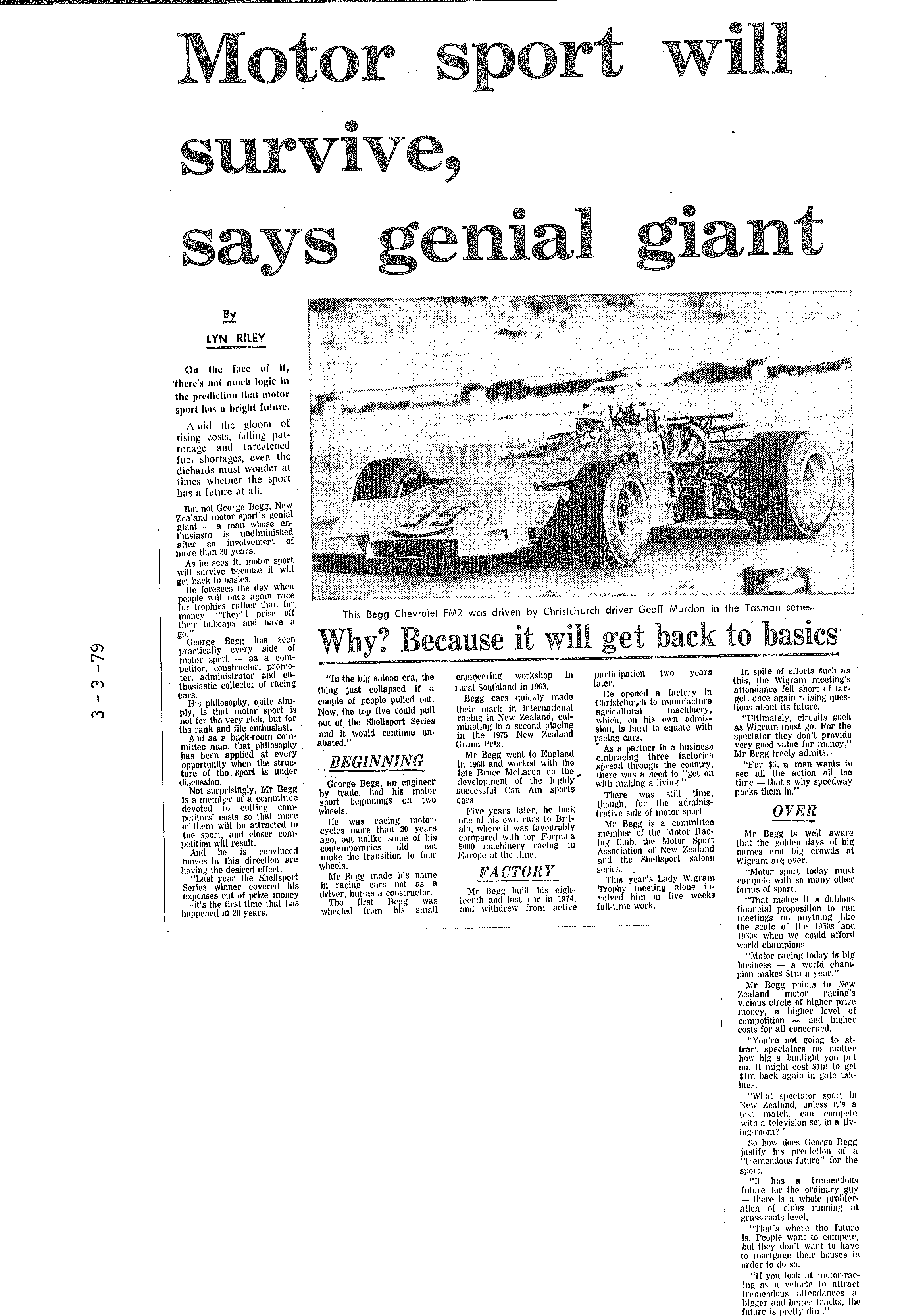
This Begg Chevrolet F
Why? Bec
"In the big saloon era, the
thing just collapsed if a
couple of people pulled out.
Now, the top five could pull
out of the Shellsport Series
Abated, "Would continue lib- and it
BEGINNING
George Begg. an engineer
by trade, hau his motor
sport beginnings on two
wheels.
Hc was racing motorcycles more than 30 years
ago, but unlike some of his
contemporaries did not
make the transition to four
wheels.
Mr Begg made his name
in racing cars not
driver, but as a constructor.
The first Begg Was
wheeled from his small
•M2 was driven by Christchurc
ause it will
engineering workshop in
rural Southland in 1963.
Begg cars quickly made
their mark in international
racing in New Zealand, cuiminating in a second placing
in the 1975 New Zealand
Grand Prix.
Mr Begg went lo England
In 1968 and worked with the
late Bruce MeLaren on the.
development of the highly
successful Can Am sports
cars.
Five years laler, he took
one of his own cars to Britain, where it was favourably
compared with top Formula
5000 machinery racing
Burope at the tune.
FACTORY
Mr Begs built his eighteenth and last car in 1974,
and withdrew from active
ch driver Geoff Mardon in
get back
participation two years
later.
He opened a faclory in
Christchu ah to manufacture
agricultural machinery,
which, on his own admission, is hard to equate with
racing cars.
As a partner in a business
embracing three factories
spread through the country,
there was a need to "get on
with making a living."
There was still time,
though, for the administrative side of motor sport.
Mr Begg is a committee
member of the Motor Racing Club, the Motor Sport
Association of New caland
and the Shellsport saloon
series.
This year's Lady Wigram
Trophy meeting alone
volved him in five weeks
full-time work.
•... eras.
the Tasman serity.
to basics
In spite of efforts such as
this, the Wigram meeting's
attendance fell short of target, once again raising ques.
tions aboul its future.
"Ultimately, circuits such
as Wigram must go. For the
spectator they don't provide
very good value for money,
Mr Begg freely admits.
"For $5, a man wants to
see all the action all the
time — that's why speedway
packs them in.
OVER
Mr Begg is weil aware
that the golden days of big
names and big crowds at
Wigram are over.
"Motor sport today must
compele with so many other
forns of sport.
'"That makes It a dubious
financial proposition to run
the scale of the 1050s like meetings on anything
and
1960s when we could afford
world champions.
"Motor racing today is big
business - a world champion makes $im a year.
Mr Begg points to New
Zealand motor racing's
vicious circle of higher prize
money, a higher level of - and higher
costs for all concerned.
"You're not going to attract spectators no matter
how big a bunfight you put
on. It might cost $im to get
$1m back again in gate takings.
"What spectator sport in
New Zealand, unless it's a
malch. can compete
with a television set in a living-room?"
So how does George Begg
Justify his prediction of a
"tremendous future" for the
sport.
"It has a tremendous
uture lor ihe orumary guy
_ there is a whole proller
ation of clubs running at
grass-roots level.
'That's where the future
Is. People want to compele,
but they don't want to have
to mortgage their houses in
order to do so.
"If you look at motor-racing as a vehicle to attract
tremendous allendances at
bigger and better tracks, the
future is pretty dim.
Summaries and tables are machine-read from the scan and may contain errors: the scan is the record.