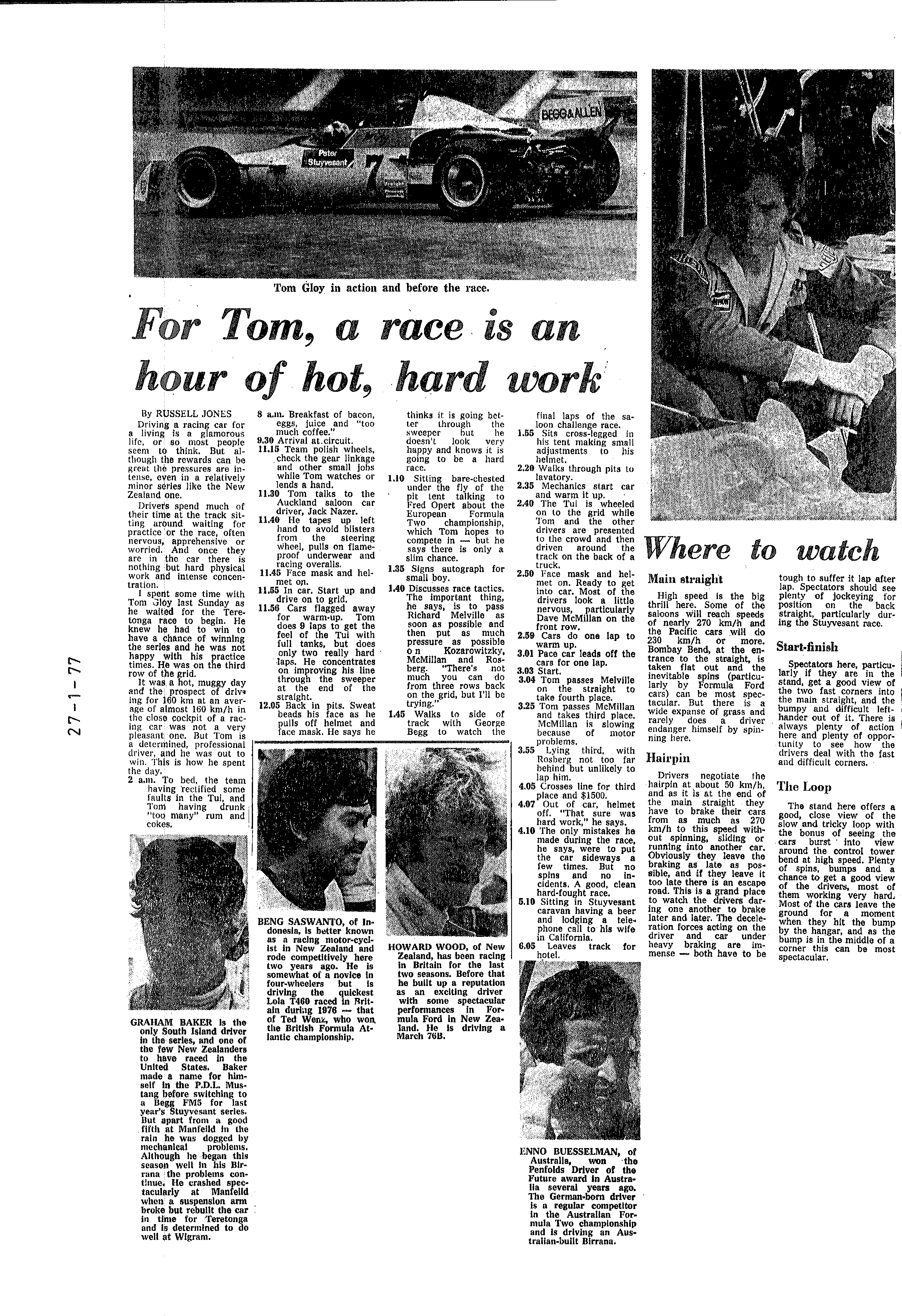
feature · Russell JonesFor Tom, a hot, hard hour of work
Russell Jones spends the Teretonga race day with American driver Tom Gloy (Tui), who needed a win to keep his series hopes alive, starting from the third row. Gloy passed Richard Melville and Dave McMillan (slowed by motor problems) to take third place. A minute-by-minute diary of his day ends with a beer in the Stuyvesant caravan.
Peter Stuyvesant series, Teretonga
Facts
- The 1977 Teretonga Stuyvesant race was over 160 km at an average of almost 160 km/h on a hot, muggy day.
- Tom Gloy finished third at Teretonga in 1977.
Photos
- Tom Gloy in action and before the race. Photo: Decca Allen
featureDrivers in the series: Baker, Saswanto, Wood and Buesselman
Further driver profiles for the 1977 Stuyvesant series: Graham Baker (Birrana), Beng Saswanto (Lola T460), Howard Wood (March 76B) and Enno Buesselman (Birrana).
featureWhere to watch at Wigram
Spectator guide to Wigram: main straight (saloons near 270 km/h, Pacific cars 230 km/h or more), Bombay Bend, the hairpin where cars brake from 270 km/h to about 50 km/h, the start-finish, and the loop.
Lap times
- (various): 270 km/h top speed
- (various): 230 km/h top speed
Facts
- At Wigram in 1977 saloon cars were expected to reach nearly 270 km/h on the main straight and Pacific cars 230 km/h or more.
- The Wigram hairpin was taken at about 50 km/h after braking from up to 270 km/h.
Read the OCR text
i Stuyvesant
DECCA ALLEN
Tom Gloy in action
and before the race.
For Tom, a
hour
By RUSSELL JONES
Driving a racing car for
living is a glamorous
life, or so most people
seem think. But although the rewards can be
great the pressures are inlense, even in a relatively
minor series like the New
Zealand one.
Drivers spend much of
their time at the track sitting around waiting for
practice or the race, often
nervous, apprehensive or
worried. And once thes are in the car there
nothing but hard physical
work and intense concentration.
I spent some time with
Tom Gloy last Sunday as
he walted for the Teretonga race to begin. He
knew he had to win to
have a , chance of winning
the series and he was not
happy with his practice
cimes. He was on the thirc
row of the grid.
It was a hot, muggy day
and the prospect of driva
ing for 160 km at an aver-
1 age of almost 160 km/h in
the close cockpit of a rac-
N ing car was not very
pleasant one. But Tom is
a determined, professional
driver, and he was out to
win. This is how he spent
the day.
2 a.lll. To bed, the team
having rectified some
auits in the tul, ano
Tom having drunk
"too many" rum and
cokes.
GRAHAM BAKER is the
only South Işland driver
in the series, and one of
the few New Zealanders
to have raced in the
United States. Baker
made & name for himself in the P.D.L. Mustang before switching to
a Begg FM5 for last
year's Stuyvesant series.
But apart from a good
fifth st Manfelld in the
rain he was dogged by
mechanical problems.
Although he began this
season well in his Bl
rana the problems continue. He crashed spectacularly at Manfelid
when a suspension arm
broke but rebullt the car
in time for Teretonga
and is determined to do
well at Wigram.
of hot,
8 aul. Breakfast of bacon,
much coffee and too eggs, juice
8.00 Arrival at.circuit.
11.15 Team polish wheels,
check the gear linkage
and other small jobs
while Tom watches or
lends a hand.
11.30 Tom talks to the
Auckland saloon car
driver, Jack Nazer.
11.40 He tapes up left
hand to avoid blisters
from the steering
wheel, pulls on flameproot underwear and
racing overalls.
11.45 Face mask and helmet on.
11.05 In car, Start up and
drive on to grid.
11.56 Cars flagged away
warm-up. Tom
does 9 laps to get the
feel of the Tui with
full tanks, but does
only two really hard
laps. He concentrates
on improving his line
through the sweeper
at the end of the
straight.
12.05 Back in pits. Sweat
beads his face as he
pulls of helmet and
lace mask. He says he
BENG SASWANTO, of Indonesla, is better known
as a racing motor-cyclist in New Zealand and
rode competitively here
two years ago. He is
somewhat of a novice In
four-wheelers but is
driving the quickest
Lola T460 raced in Rritain during 1976 - that
of Ted Wenz, who won,
the British Formula Atlantic championship.
race
is an
hard
thinks it is going better through the
sweeper but, he
doesn't look very
happy and knows it is
going to be a hard
race.
1.10 Sitling bare-chested
under the fly of the
pit lent talking to
Fred Opert about the
European Formula
Two championship,
which Tom hopes to
compete in -m but he
says there is only a
slim chance.
1.35 Signs autograph for
small boy.
1.40 Discusses race tactics.
The important thing,
he says, is to pass
Richard Melville
soon as possible and
then put as much
pressure as possible
o n Kozarowitzky,
McMillan and Rosberg: "There's not
much you can do
from three rows back
trying, "Brid, but r'll be on the
1.45 Walks to side of
track with George
Begg to watch the
HOWARD WOOD, of New
Zealand, has been racing
in Britain for • the last
two seasons. Before that
he built up a reputation
as an exciting driver
with some spectacular
performances in Formula Ford in New Zealand. He is driving a
March 76B.
work
final laps of the saloon challenge race.
1.65 Sits cross-legged in
his tent making small
adjustments his
helmet.
2.20 Walks through pits to
lavatory.
2.35 Mechanics start car
and warm it up.
2,40 The Tui is wheeled
on lo the grid while
Tom and the other
drivers are presented
1o the crowd and then
driven around the
track on the back of a
truck,
2.50 Face mask and helmet on. Ready to get
into car. Most of the
drivers look a little
nervous, particularly
Dave McMillan on the
front row.
2.59 Cars do one lap to
warm up.
3.01 Pace car leads off the
cars for one lap.
3.03 Start.
3.04 Tom passes Melville
on the straight to
take fourth place.
3.25 Tom passes McMillan
and takes third place.
McMillan is slowing
because of motor
problems.
3.55 Lying third, with
Rosberg not too far
behind but unlikely to
lap him.
4.05 Crosses line for third
4.07 lace and car,, Out of car, helmet
off. "That sure was
hard work," he says.
4.10 The only mistakes he
made during the race,
he says, were to put
the car sideways
few times. But
spins and no incidents. A good, clean
hard-fought race.
5.10 Sitting in Stuyvesant
caravan having a beer
and lodging telephone call to his wife
in California.
6.05 Leaves track for
hotel.
ENNO BUESSELMAN, of
WOn the
Penfolds Australle Driver of the
Future award in Australia several years ago.
The German-born driver
is a regular competitor
the Australian Formula Two championship
and is driving an Australian-built Birrana.
Stood. :
Where to
watch
Main straight
High speed is the big
thrill here. Some of the
saloons will reach speeds
of nearly 270 km/h and
the pacitic cars Wilt do
230 km/h OT more.
Bombay Bend, at the entrance to the straight, is
taken flat out and the
inevitable spins (particularly by Formula Ford
cars) can be most spectacular. But there is a
wide expanse of grass and
rarely does driver
endanger himself by spinning here.
Hairpin
Drivers negotiate the
hairpin at about 50 km/h,
and as it is at the end of
the main straight they
have to brake theit cars
from as much as 270
km/h to this speed without spinning, sliding
running into another car.
Obviously they leave the
braking as late as possible, ana if they leave it
too late there is an escape
road. This is a grand place
to watch the drivers daring one another to brake
later and later. The deceleration forces acting on the
driver and call under
heavy braking are immense - both have to be
tough to suffer it lap after
lap. Spectators should see
plenty of jockeying for
position on the back
straight, particularly during the Stuyvesant race.
Start-finish
Spectators here, particularly if they are in the
stand, get a good view of
the two fast corners into
the main straight, and the
bumpy and difficult lefthander out of it. There is
always plenty action
here and plenty of opportunity to see how the
drivers deal with the fast
and difficult corners.
The Loop
The stand here offers a
good, close view of the
slow and tricky loop with
the bonus of seeing the
cars burst into view
around the control tower
bend at high speed. Plenty
spins, bumps and
chance to get a good view
of the drivers, most of
them working very hard.
Most of the cars Jeave the
ground for moment
when they hit the bump
by the hangar, and as the
bump is in the middle of a
corner this can be most
spectacular.
Summaries and tables are machine-read from the scan and may contain errors: the scan is the record.