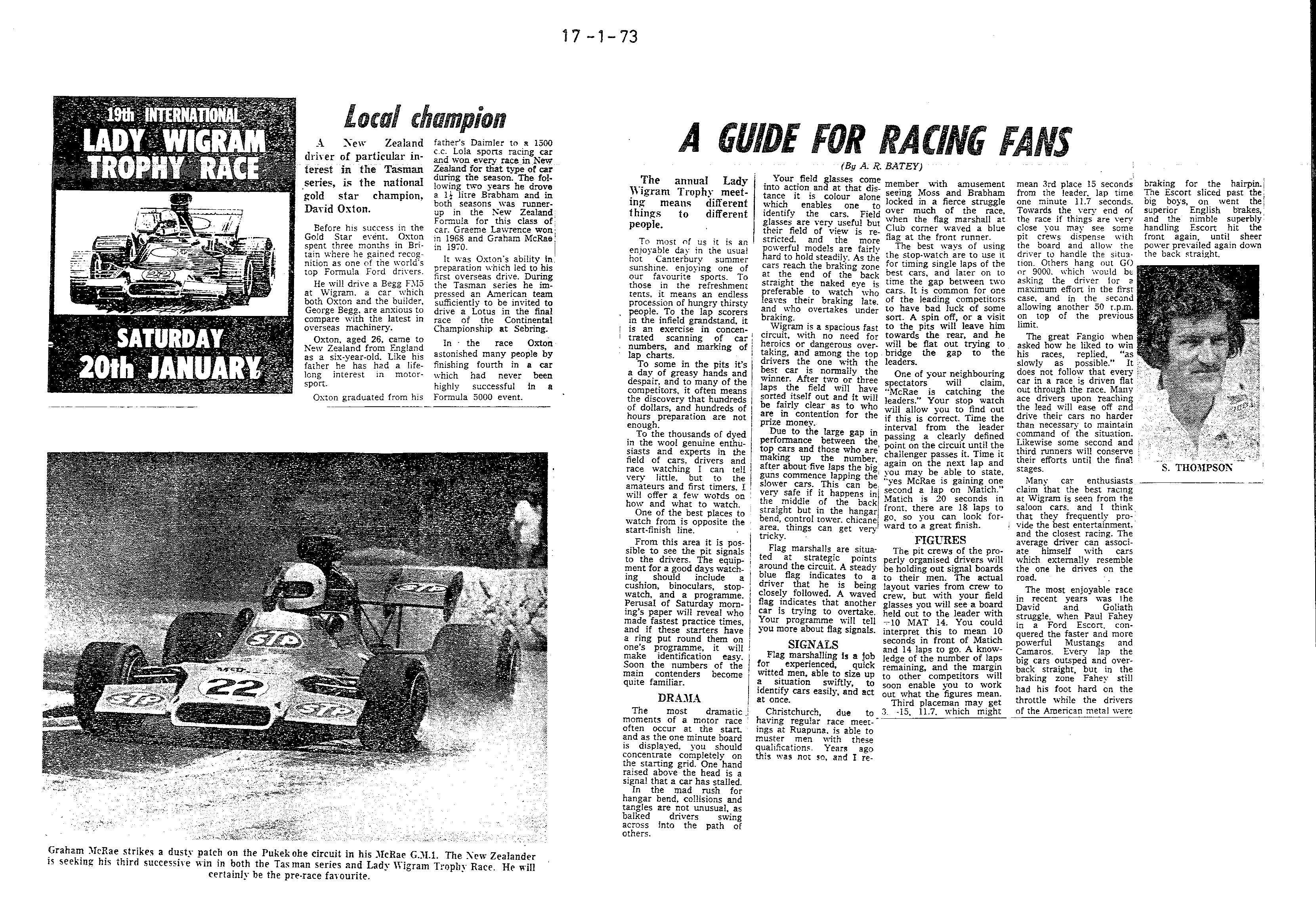
feature · The PressLocal champion
Profile of 26-year-old David Oxton, the national Gold Star champion, who will drive the Begg FM5 in the 19th Lady Wigram Trophy. Oxton spent three months in Britain as a top Formula Ford driver and finished fourth for an American team in a Lotus in the Continental Championship finale at Sebring.
Facts
- Oxton won every race for 1500cc Lola sports racing cars in New Zealand in one season and was twice runner-up in the 1.5-litre Brabham New Zealand Formula class.
- Graeme Lawrence won the NZ 1.5-litre formula in 1968 and Graham McRae in 1970.
Photos
- Graham McRae strikes a dusty patch on the Pukekohe circuit in his McRae GM1. The New Zealander is seeking his third successive win in both the Tasman series and the Lady Wigram Trophy race and will certainly be the pre-race favourite.
feature · The Press · A. R. BateyA guide for racing fans
A spectator's guide to watching the Lady Wigram Trophy: where to sit opposite the start-finish line, what to bring (binoculars, stopwatch, programme), how to read blue flags and pit signal boards, and how to time gaps. It recalls Paul Fahey's Ford Escort beating faster Mustangs and Camaros in a memorable saloon race, and an amusing blue flag shown to Moss and Brabham.
Facts
- At Wigram the most dramatic moments of a race often occur at the start; collisions are common in the rush for Hangar Bend.
- Big cars at Wigram commonly begin lapping slower cars after about five laps.
Read the OCR text
17-9-73
19th- INTERNATIONAL
LADY WIGRAM
TROPHY RACE
SATURDAY
20th JANUARY
Local champion
1 New Zealand
driver of particular interest in i the Tasman
series, is the national
gold star champion,
Darid Oxton.
Before his success in the
Gold Star event. Oxton
spent three months in Britain where he gained recognition as one of the world's
top Formula Ford drivers.
He will drive a Begg FM5
Wigram. a car which
both Oxton and the builder,
George Begg, are anxious to
compare with the latest in
overseas machinery.
Oxton, aged 26, came to
New Zealand from England
as a six-year-old. Like his
father he has had a lifelong interest in motorsport.
Oxton graduated from his
father's Daimler to a 1500
c.c. Lola sports racing car
and won every Iace in New
Zealand for that type of car
during the season. The following tiro years he drove
a 14 litre Brabham and in
both seasons was runnerup in the New Zealand
Formula for this class of
car. Graeme Lawrence won
in 1968 and Graham McRae
in 1970.
It was Oxton's ability in
preparation which lea to nis
first overseas drive. During
the Tasman series he impressed an American team
sufficiently to be invited to
drive a Lotus in the final
race of the Continental
Championship at Sebring.
In the race Oxton
astonished many people by
finishing fourth in a car
which had never been
highly successful in a
Formula 5000 event.
Graham McRae strikes a dusty patch on the Pukek ohe circuit in his MicRae G.M.1. The New Zealander
is seeking his third successive win in both the Tasman series and Lady Wigram Trophy Race. He will
certainly be the pre-race favourite.
A GUIDE FOR RACING FANS
The annual Lady
Wigram Trophy meeting means different
things to different
people.
To most nf us it is an
enjoyable day in the usual
Canterbury summer
sunshine. enjoying one of
our favourite sports. To
those in the refreshment
rents, it means an endless
procession of hungry thirsty
people. To the lap scorers
in the infield grandstand, it
is an exercise in concentrated scanning of car
numbers, and marking of
lap charts.
To some in the pits it's
a day of greasy hands and
despair, and to many of the
competitors, it often means
the discovery that hundreds
of dollars, and hundreds of
hours, preparation are not
enough.
To the thousands of dyed
in the wool genuine enthusiasts and experts in the
field of cars, drivers and
race watching I can tell
very little, but to ine
amateurs and first timers, I
will offer a few words on
how and what to watch.
One of the best places to
watch from is opposite the
start-finish line.
From this area it is possible to see the pit signals
to the drivers. The equipment for a good days watching should include
cushion, binoculars, stopwatch, and a programme.
Perusal of Saturday morning's paper will reveal who
made fastest practice times,
and if these starters have
a ring put round them on
one's programme, it will
make identification easy.
Soon the numbers of the
main contenders become
quite familiar.
DRAMA
The most dramatic
moments of a motor race
often occur at the start.
and as the one minute board
is displayed, you should
concentrate completely on
the starting grid. One hand
raised above the head is a
signal that a car has stalled.
In the mad rush for
hangar bend, collisions and
tangles are not unusual, as
balked drivers swing
across into the path of
others.
(By A. R.
Your feld glasses come
into action and at that distance it is colour alone
which enables one to
identify the cars. Field
glasses are very useful but
their field of view is restricted, and the more
powerful models are fairiv
hard to hold steady. As the
cars reach the braking zone
at the end of the back
straight the naked eye
preferable watch who
leaves their braking late.
and who overtakes under
braking.
Wigram is a spacious fast
circuit, with no need for
heroics or dangerous overtaking, and among the top
drivers the one with : the
best car is normally the
winner. After two or three
laps the field will have
sorted itself out and it will
be fairly clear as to who
are in contention for the
prize money.
Due to the large gap in
performance between
top cars and those who are
making up the number,
after about five laps the big
guns commence lapping the
slower cars. This can be
very safe if it happens in
middle of the back
straight but in the hangar]
pena, control tower. chicanei
area, things can get very
tricky.
Flag marshalls are situated at strategic points
around the circuit. A steady
blue flag indicates to
driver that he is being
closely followed. A waved
flag indicates that another
car is trying to overtake.
Your programme will tell
you more about flag signals.
SIGNALS
Flag marshalling is a job
for experienced,
witted mpe, ence to size ick
a situation swiftly, to
identify cars easily, and act
at once.
Christchurch, due to
having regular race meetings at Ruapuna. is able to
muster men with these
qualifications. Years ago
this was not so, and I re-
BATEY)
member with amusement
seeing Moss and Brabham
locked in a fierce struggle
over much of the race,
when the flag marshall at
Club corner waved a blue
flag at the front runner.
The best ways of using
the stop-watch are to use it
for timing single laps of the
best cars, and later on to
time the gap between two
cars. It is common for one
of the leading competitors
to have bad luck of some
sort. A spin ofi, or a vișit
to the pits will leave him
towards the rear, and he
will be flat out trying to
bridge the gap to the
leaders.
One of your neighbouring
spectators will claim,
"McRae is catching the
leaders." Your stop watch
will allow you to find out
if this is correct. Time the
interval from the leader
passing a clearly defined
point on the circuit until the
challenger passes it. Time it
again on the next lap and
you may be able to state,
"yes McRae is gaining one
second a lap on Matich."
Matich is 20 seconds in
front. there are 18 laps to
go, so you can look forward to a great finish.
FIGURES
The pit crews of the properly organısed drivers will
be holding out signal boards
their men. The actual
layout varies from crew to
crew, but with your field
glasses you will see a board
held out to the leader with
-10 MAT 14. You could
interpret this to mean 10
seconds in front of Matich
and 14 laps to go. A knowledge of the number of laps
remaining, and the margin
competitors will
enable you to work
out what the figures mean.
Third placeman may
3. - 15. 11.7. Which might
mean 3rd place 15 seconds
from the leader, lap time
опе minute 11.7 seconds.
Towards the very end of
the race if things are very
close you may see some
pit crews dispense with
the board and allow the
driver to handle the situation. Others hang out GO
or 9000. which would be
asking the driver 10г
maximum effort in the first
case. and in the second
allowing another 50 i.p.m.
On top of the previous
limit.
The great Fangio when
asked how he liked to win
his races, replied, "as
slowiy as possible." It
does not follow that every
car in a race is driven flat
out through the race. Many
ace drivers upon reaching
the lead will ease off and
drive their cars no harder
than necessary to maintain
command of the situation.
Likewise some second and
third runners will conserve
their efforts until the final
stages.
Many car enthusiasts
claim that the best racing
at Wigram is seen from the
saloon cars. and I think
that they frequently provide the best entertainment,
and the closest racing. The
average driver can associate himself with cars
which externally resemble
the one he drives on the
road.
The most enjoyable race
in recent years was 1he
David and Goliath
struggle, when Paul Fahey
in a Ford Escort. conquered the faster and more
powertul Mustangs
Camaros. Every lap the
big cars outsped and overback straight, but in the
braking zone Fahey still
had his foot hard on the
throttle while the drivers
of the American metal were
braking for the hairpin.
The Escort sliced past the
big on went the
superior and boys, English the nimble superbly brakes,
handling Escort hit the
front again until sheer
power prevailed again down
the back straight.
into
S. THOMPSON
Summaries and tables are machine-read from the scan and may contain errors: the scan is the record.