feature · The PressEnglish driver
Profile of Englishman Alan Rollinson, second in the New Zealand Grand Prix, who is out to win the 1973 Tasman series. His blue and yellow McRae GM1 (chassis 007) shares its paint scheme with Gary Pedersen's Begg. Rollinson was fourth behind McRae in the last European Formula 5000 series and has ten years of racing behind him, including a 1967 Grovewood Award.
Facts
- Rollinson won several big races in Colombia in a Brabham BT30 after the 1970 European season.
- Rollinson's McRae chassis 007 was painted blue and yellow for the 1973 Tasman series.
feature · The PressMcCormack profile
Profile of John McCormack, whose surprise win in the New Zealand Grand Prix at Pukekohe made him a Wigram Trophy favourite. He drives the Elfin-Repco MR5, built in Adelaide by Garrie Cooper, and had a long record in Gold Star racing, finishing third in the 1972 Gold Star series and fourth in the Repco series in Victoria. The text is heavily garbled.
Facts
- McCormack bought an ex-Scuderia Veloce Brabham-Climax and was third at Longford in the 1966 Gold Star round and second the following year.
- McCormack's team did an extensive 1972 Australian season of 21 events, including the seven-race Gold Star series and the five-race Repco series.
Photos
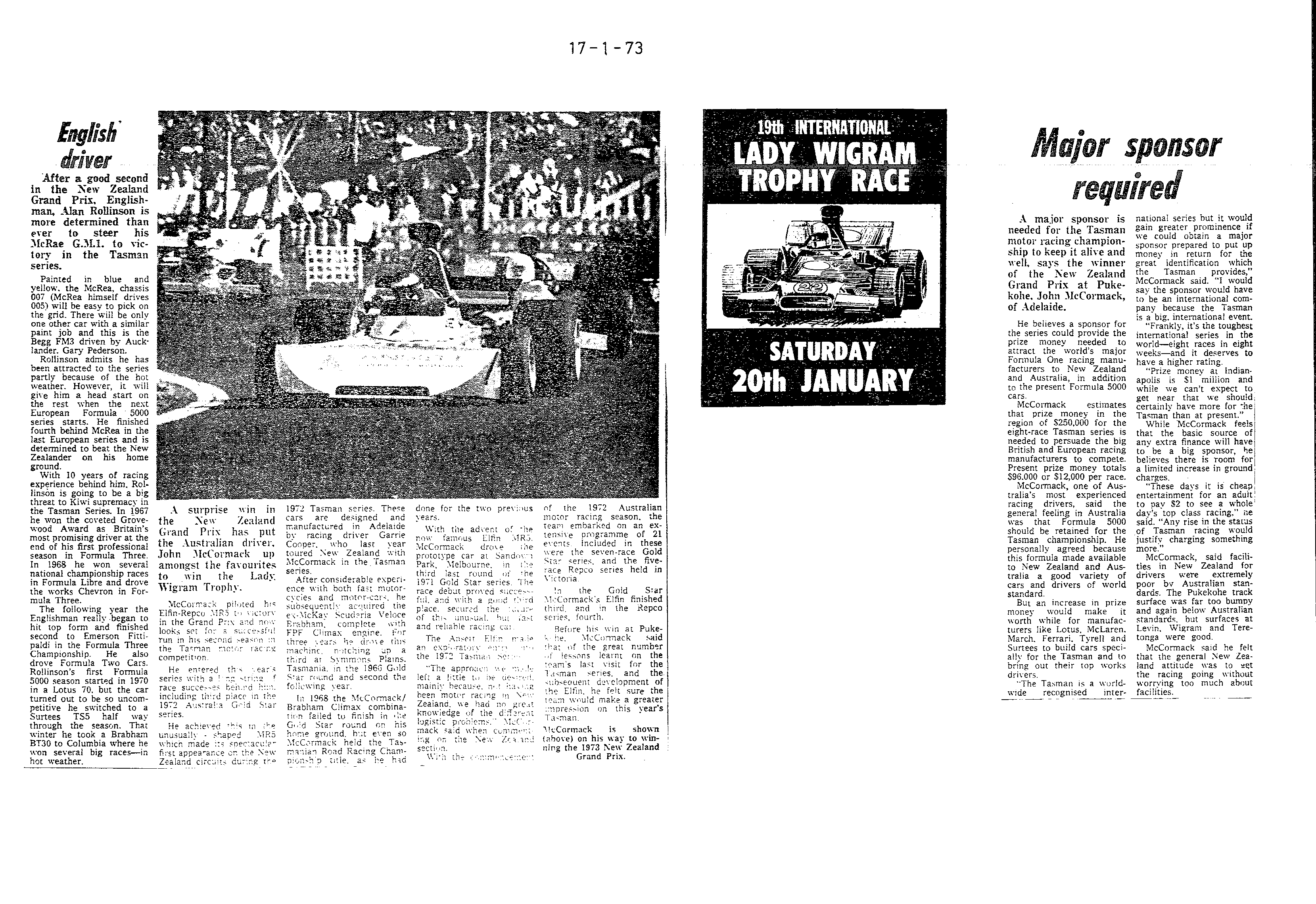
- McCormack is shown on his way to winning the 1973 New Zealand Grand Prix.
news · The PressMajor sponsor required
NZ Grand Prix winner John McCormack says the Tasman series needs a major sponsor to survive, estimating about $250,000 in prize money for the eight-race series (then $96,000, or $12,000 a race) is needed to draw Formula One manufacturers. He criticised the bumpy Pukekohe surface and poor driver facilities in New Zealand but praised Levin, Wigram and Teretonga surfaces.
Facts
- In January 1973 total prize money for the eight-race Tasman series was $96,000, about $12,000 per race.
- McCormack said an adult could see a full day of top-class racing for about $2.
- McCormack called the Tasman the toughest international series in the world, eight races in eight weeks.