Wigram TrophyMotor racing at Wigram airfield · Christchurch · 1949–2000
Home › Archive › 1972 › Matich and McRae
← 19 Jan 1972All 1972 pages19 Jan 1972 →
Scan of the clipping page, 19 January 1972
↗
Drag to move · scroll or pinch to zoom
feature

Matich and McRae

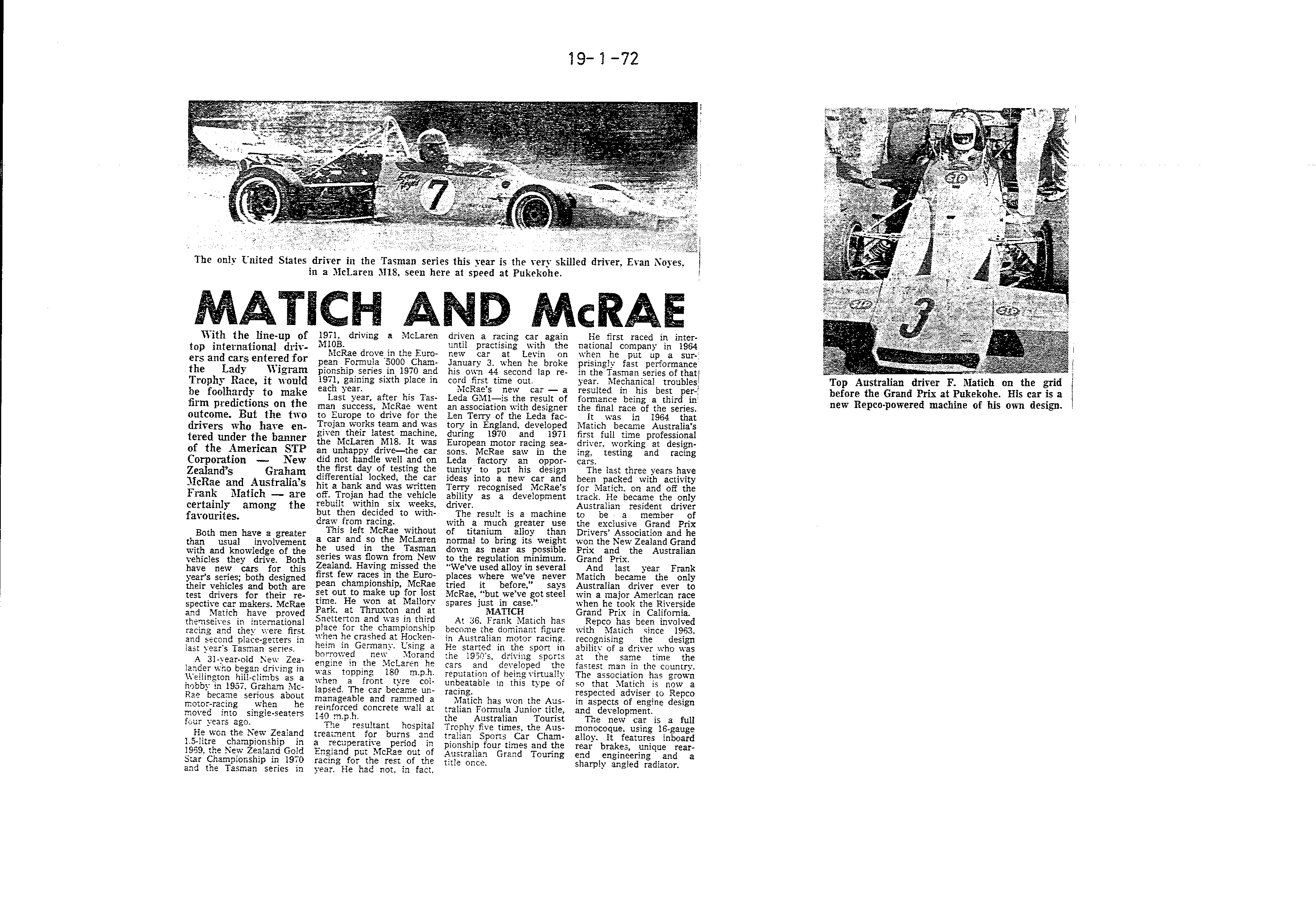
Profiles of the two STP-backed favourites for the 1972 Lady Wigram Trophy: 31-year-old New Zealander Graham McRae (1971 Tasman champion, 1970 Gold Star winner, new Leda GM1 built with Len Terry) and 36-year-old Australian Frank Matich (dominant in Australian racing, new Repco-powered monocoque Matich A50). McRae's European season ended with a Hockenheim crash and burns.

Facts

  • Graham McRae set a 44-second lap record the first time out in the new Leda GM1 at Levin on 3 January 1972.
  • In 1971 McRae drove for the Trojan works team in Europe in a McLaren M18; the car was written off in testing and Trojan withdrew from racing.
  • McRae won three European Formula 5000 races in 1971 and was third in the championship before crashing at Hockenheim, where a front tyre collapsed at over 180 mph and the car hit a concrete wall at 140 mph; he missed the rest of the season.
  • The Leda GM1 made extensive use of titanium alloy to get down near the minimum regulation weight.
  • Frank Matich became Australia's first full-time professional driver in 1964 and was the only Australian resident member of the Grand Prix Drivers' Association.
  • Frank Matich's 1971 win at the Riverside Grand Prix made him the only Australian driver to win a major American race; Repco had been involved with him since 1963.
  • The new Matich A50 is a full monocoque in 16-gauge alloy with inboard rear brakes.

Photos

  • The only United States driver in the Tasman series this year is the very skilled driver Evan Noyes, in a McLaren M18, seen here at speed at Pukekohe.
  • Top Australian driver F. Matich on the grid before the Grand Prix at Pukekohe. His car is a new Repco-powered machine of his own design.
Read the OCR text
19-1-72 7 The only United States driver in the Tasman series this year is the very skilled driver, Evan Noves, in a MeLaren M18, seen here at speed at Pukekohe. MATICH A With the line-up of top international drivers and cars entered for the Lady Wigram Trophy Race, it would be foolhardy to make firm predictions on the outcome. But the two drivers who have entered under the banner of the American STP Corporation - New Zealand's Graham McRae and Australia's Frank Matich — are certainly among the favourites. Both men have a greater than usual involvement with and knowledge of the vehicles they drive. Both have new cars for this year's series; both designed their venicles and both are test drivers for their respective car makers. McRae and Matich have proved themseives in interational racing and they were first and second place-getters in last year's Tasman series. A 3l-year-old New Zealander who began driving in Wellington hill-climbs as a hobby in 1957, Graham Mc- Rae became serious about motor-racing when he moved into single-seaters four vears ago. He won the New Zealand 1.5-litre championship in 1959, the New Zealand Gold Star Championship in 1970 and the Tasman series in 1971, driving a McLaren MI0B. McRae drove in the European Formula 5000 Championship series in 1970 and 1971, gaining sixth place in each year. Last year, after his Tasman success, McRae went to Europe to drive for the Trojan works team and was given their latest machine, the McLaren M18. It was an unhappy drive-the car did not handle well and on the first day of testing the differential locked, the car hit a bank and was written ofi. Trojan had the vehicle rebuilt within six weeks, but then decided to withdraw from racing. This left McRae without a car and so the McLaren he used in the Tasman series was flown from New Zealand. Having missed the first few races in the European championship, McRae set out to make up for lost time. He won at Mallory Park, at Thruxton and at Snetterton and was in third place for the championship when he crashed at Hockenheim in Germany. Using a borrowed new Morand engine in the McLaren he was topping 180 m.p.h. when a front tyre collapsed. The car became unmanageable and rammed a reinforced concrete wall at 140 m.p.h. The resultant hospital treatment for burns and a recuperative period in England put McRae out of racing for the rest of the year. He had not, in fact, ND MCRAE driven a racing car again until practising with the new car at Levin on January 3. when he broke his own 44 second lap record first time out. McRae's new car — a Leda GMI-is the result of an association with designer Len Terry of the Leda factory in England, developed during 1970 and 1971 European motor racing seasons. McRae saw in the Leda factory an opportunity to put his design ideas into a new car and Terry recognised McRae's ability • as a development driver. The result is a machine with a much greater use of titanium alloy than normal to bring its weight down as near as possible to the regulation minimum. "We've used alloy in several places where we've never tried before, says VeRae, "but we've gorsteel spares just in case. MATICH At 36. Frank Matich has become the dominant figure in Australian motor racing. He started in the sport in the 1950's, driving SportS cars and dereloped the reputation of being virtually unbeatable in this type of racing. Matich has won the Australian Formula Junior title, the Australian Tourist Trophy five times, the Australian Sports Car Championship four times and the Australian Grand Touring title once. He first raced in international company in 1964 when put up a surprisingly fast performance in the Tasman series of that year. Mechanical troubles resulted in his best performance being a third in the final race of the series. was in 1964 that Matich • became Australia's firsi fuil time professional driver, working at designing. testing and racing cars. The last three years have been packed with activity 10г Matich. on and off the track. He became the only Australian resident driver to be a member of the exclusive Grand Prix Drivers' Association and he won the New Zealand Grand Prix and the Australian Grand Prix. And last year Frank Matich became the only Australian driver ever to win a major American race when he took the Riverside Grand Prix in California. Repco has been involved with Matich since 1963. recognising the design ability of a driver who was the same tine the fastest man in the country. The association has grown so that Matich is now a respected adviser to Repco in aspects of engine design and development. The new car is a full monocoque, using 16-gauge alloy. It features inboard rear brakes, unique rearend engineering and a sharply angled radiator. GP. Top Australian driver F. Matich on the grid before the Grand Prix at Pukekohe. His car is a new Repco-powered machine of his own desig.

Summaries and tables are machine-read from the scan and may contain errors: the scan is the record.