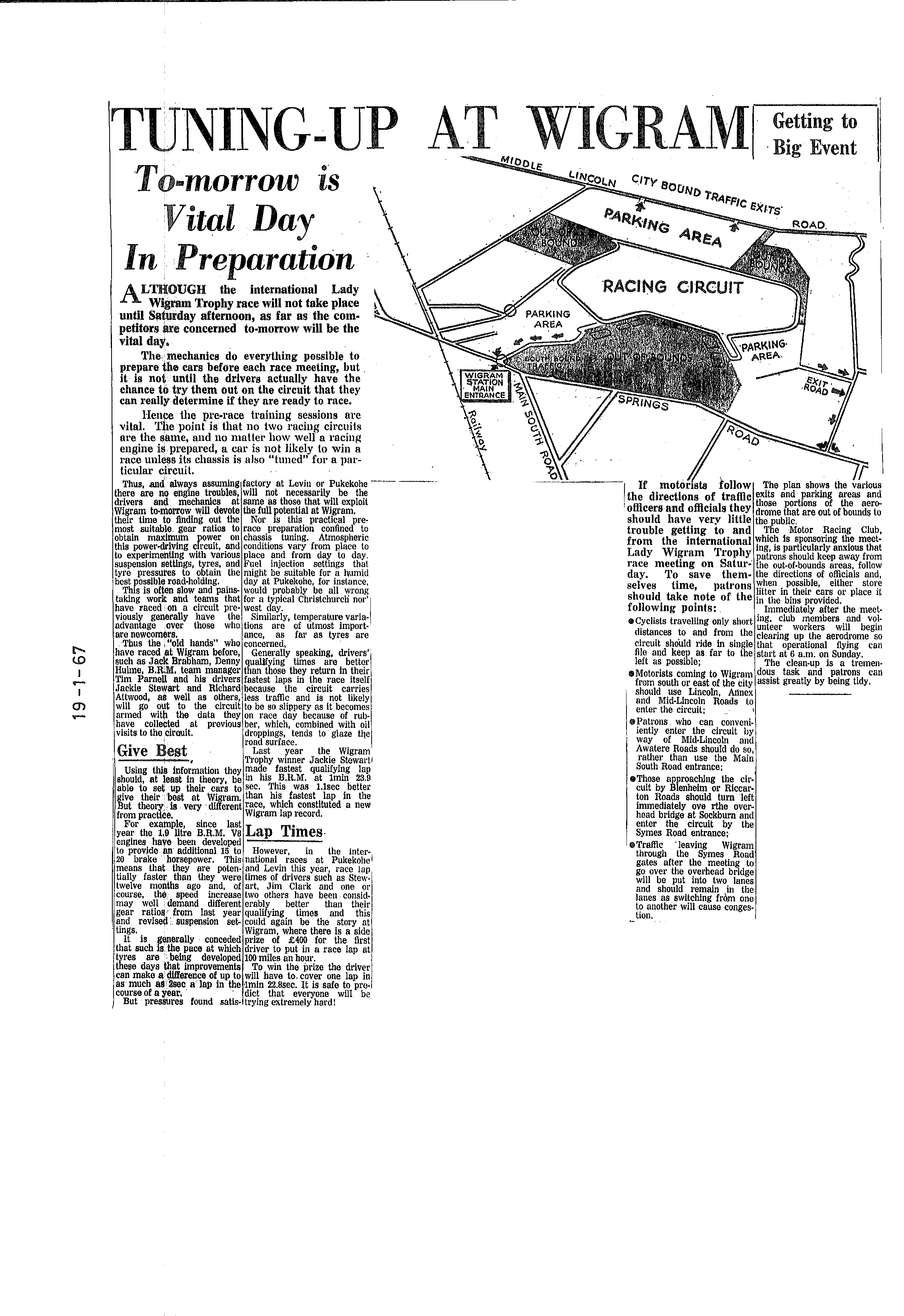
featureTuning-up tomorrow is vital day in preparation
Explains why Friday's practice before the 1967 Lady Wigram Trophy matters: teams must work out gear ratios, suspension, tyres and fuel-injection settings for Wigram, and experienced teams (Brabham, Hulme, BRM's Parnell, Stewart and Attwood) hold data from earlier visits. Qualifying laps are usually quicker than race laps, but at Pukekohe and Levin race laps had been faster, and a 100 mph lap needed 1min 22.8sec.
Lap times
- Jackie Stewart (BRM): 1:23.9 qualifying
- Jackie Stewart (BRM): 1:25.0 lap record
- : 1:22.8 other
Facts
- Jackie Stewart's fastest qualifying lap in 1966 was 1min 23.9sec, 1.1 seconds quicker than his race fastest lap which was a new Wigram lap record.
- To win the 400 pound side prize in 1967 a driver had to lap Wigram in 1min 22.8sec for 100 mph.
- Since 1966 the BRM 2-litre V8 engines had been developed to give an extra 15 horsepower or so.
newsGetting to the big event at Wigram
Traffic and parking guide for the 1967 Lady Wigram Trophy meeting: entry via Lincoln, Annex and Middle Lincoln Roads from the south and east, Symes Road for Blenheim and Riccarton Road arrivals, with out-of-bounds aerodrome areas and a request to be tidy so flying can resume at 6 am Sunday.
Facts
- Wigram was an operational RNZAF aerodrome and club members and volunteers cleared the site after the meeting so flying could restart at 6 am on Sunday.
Read the OCR text
TUNING-U
1o-morrow IS
Vital Day
In Preparation
ALTHOUGH the international Lady Wigram Trophy race will not take place
until Saturday afternoon, as far as the competitors are concerned to-morrow will be the
vital day.
The mechanice do everything possible to
prepare the cars before each race meeting, but
it is not until the drivers actually have the
chance to try them out on the circuit that they
can really determine if they are ready to race.
Hence the pre-race training sessions are
vital. The point is that no two racing circuits
are the same, and no matter how well a racing
engine is prepared, a car is not likely to win a
race unless its chassis is also "tuned" for a particular circuit.
Thus, and always assuming
there are no engine troubles,
drivers and mechanics at
Wigram to-morrow will devote
their time to finding out the
most suitable gear ratios to
obtain maximum power on
this power-driving circuit, and
to experimenting with various
suspension settings, tyres, and
tyre pressures to obtain
best possible road-holding.
This is often slow and painstaking work and teams that
have raced on a circuit previously generally have the
advantage over those who
are newcomers.
Thus the "old hands" who
have raced at wigram betore,
such as Jack Brabham, Denny
Hulme, B.RiM, team manager
Tim Parnell and his drivers
Jackie Stewart and Richard
Attwood, as well as others,
will go out to the circuit
armed with the data they
have collected at previous
visits to the cirouit.
Give Best
Using this information they
should, at least in theory, be
able to set up their cars to
give their best at Wigram.
But theory is very different
from practice.
For example, since last
year the 1,0 litre B.R.M. V8
engines have been developed
to provide an additional 15 to
brake horsepower. This
means that they are potentially faster than they were
twelve months ago and, of
course, the speed increase
may well: demand different
gear ratios from last year
and revised: suspension settings.
It is generally conceded
that such is the pace at which
tyres are being developed
these days that improvements
can make a cutterence of up to
as much as sec a lap in the
course of a year.
But pressures found satis
factory at Levin or Pukekohe
will not necessarily be the
same as those that will exploit
the full potential at Wigram.
Nor is this practical prerace preparation confined to
chassis tuning. Atmospheric
conditions vary from place to
place and from day to day.
Fuel injection settings that
might be suitable for a humid
day at Pukekohe, for inslance,
would probably be all wrong
for a typical Christchurch nor'
west day.
Similarly, temperature variations are of utmost importance, as far as tyres are
concerned,
Generally speaking, drivers'
qualiying times are better
than those they return in their
fastest laps in the race itself
because the circuit carries
¡less traffic and is not likely
to be so slippery as it becomes
on race day beçause of rubber, which, combined with oil
droppings, tends to glaze the
road surface.
Last year the Wigram
Trophy winner Jackie Stewarti
made fastest qualifying lap
in his B.R.M. at 1min 23.9
sec. This was 1.1sec better
than his fastest lap in the
race, which constituted a new
Wigram lap record.
Lap Times
However, in the international races at Pukekohe
and Levin this year, race lap
imes of drivers such as Stewart, Jim Clark and one ol
two others have been considerably better than their
qualifying times and this
could again be the story at
wigram, where there is a side
prize of £400 for the first
driver to put in a race lap at
100 miles an hour.
To win the prize the driver
will have to. cover one lap in
min 22.8sec. It is safe to predict that everyone will be
trying extremely hard!
P AT WIGRAM Getting to
Big Event
MIDDLE
LINCOLN
CITY BOUND TRAFFIC EXITS
PARKING AREA ROAD
RACING CIRCUIT
PARKING
AREA
•PARKING.
AREA:
WIGRAM
STATION EXIT
ENTRANCE MAIN •ROAD S
SPRINGS
Railway SOUTH ROAD
ROAD
If motorists follow! The plan shows the various
the directions of traffic exits and parking areas and
those portions the
officers and officials they drome that are out of bounds lo should have very little the public.
trouble getting to and Motor Racing Club,
from the international which is sponsoring the meet-
Lady Wigram Trophy ing, is particularly anxious that
patrons should keep away from
race meeting on satur- the out-of-bounds areas, follow
day. To save them- the directions of officials and,
selves when possible, either store
time, patrons hitter in their cars or place it
should take note of the in the bins provided.
following points: Immediately after the meet-
@Cyclists travelling only short ing, club members and volunteer workers will begin
distances to and from the clearing up the aerodrome so
ircuit should ride in single thai operational flying
ile and keep as far to the start at 6 am. on Sunda
• Motorists coming to Wigram dous task and patrons. can
from south or east of the city assist greatly by being tidy.
should use Lincoln, Annex
and Mid-Lincoin Roads lo
enter the circuit;
@Patrons. who can conveniiently enter the circuit by
way of Mid-Lincoln and
Awatere Roads should do so,
rather than use the Main
South Road entrance;
@Those approaching the cir
cult by Blenheim or Riccar
ton Roads should turn left
immediately ove ithe overhead bridge at Sockburn and
enter the circuit by the
Symes Road entrance;
@Traffic leaving Wigram
through the Symes Road
gates
and should remain in the
lanes as switching from one
to another will cause conges.
Summaries and tables are machine-read from the scan and may contain errors: the scan is the record.