otherFlag signals
Explanation of the flag signals used by marshals at Wigram: red means complete stop, yellow no overtaking, yellow with vertical red stripes oil on the course, blue waved a car trying to overtake, blue motionless a car following closely, white a service vehicle on the course, black with white number the car must stop at pits, green danger cleared, and the NZ flag starts all races.
Facts
- At Wigram in 1965 a white flag meant a service vehicle was on the course and the New Zealand flag was used to start all races.
featurePhil Hill
Profile of Phil Hill, quiet Californian aged 36, world champion for Ferrari in 1961, winner of Le Mans three times, Sebring 12-hour three times and Belgian and Italian Grands Prix. After parting from Ferrari in 1962 and a failed ATS season he joined Bruce McLaren in the Cooper team.
Facts
- Phil Hill won the 1961 world championship for Ferrari; at Monza that year von Trips crashed fatally and Hill took the title.
previewSaloon events
Preview of the 1965 Wigram saloon races: the allcomers race has a big varied entry in which a Ford (Anglia) looks likely to win, with Lotus Cortinas, the lone Jaguar 3.8 of F. I. Dow (Geraldine), Mini Coopers and a production saloon race including Dow's Jaguar, Cortinas and a Skoda.
featureJim Palmer
Profile of Jim Palmer, last year's champion from Hamilton: easy winner of the 1964 NZ Gold Star and NZ Racing Drivers Club championship in a Cooper-Climax, started racing at 16 in a Buckler, third in the 1963 NZ Grand Prix, won the first Gold Star round of 1965 at Renwick and drives a Brabham at Wigram.
Facts
- Jim Palmer won the 1964 New Zealand Gold Star and NZ Racing Drivers Club championship in a Cooper-Climax and won the first Gold Star event of 1965 at Renwick.
featureRex Flowers
Profile of Rex Flowers, a Wellington driver who started about five years earlier in a Jaguar XK120, raced a Lotus Mark VI, a Gemini and a 1500cc Lotus, and will drive a Lola 2.5 litre at Wigram. He was seventh at Wigram in 1964, third, fourth and seventh in Australia, and lost a near-certain victory at Waimate to gearbox failure.
featureKerry Grant
Profile of Kerry Grant, Wellington's spirited 1964 saloon car champion, in his first season in a single-seater at Wigram. In 1964 he won the title with a Lotus Cortina, set a new lap record at Levin, won the open scratch race at Pukekohe and finished second at Waimate behind P. Fahey to take the championship 37 points to Sprague's.
Facts
- Kerry Grant clinched the 1964 saloon car championship at Waimate by finishing second behind P. Fahey after Sprague crashed.
- Grant set a new lap record and won at Levin, his home course, in 1964.
Photos
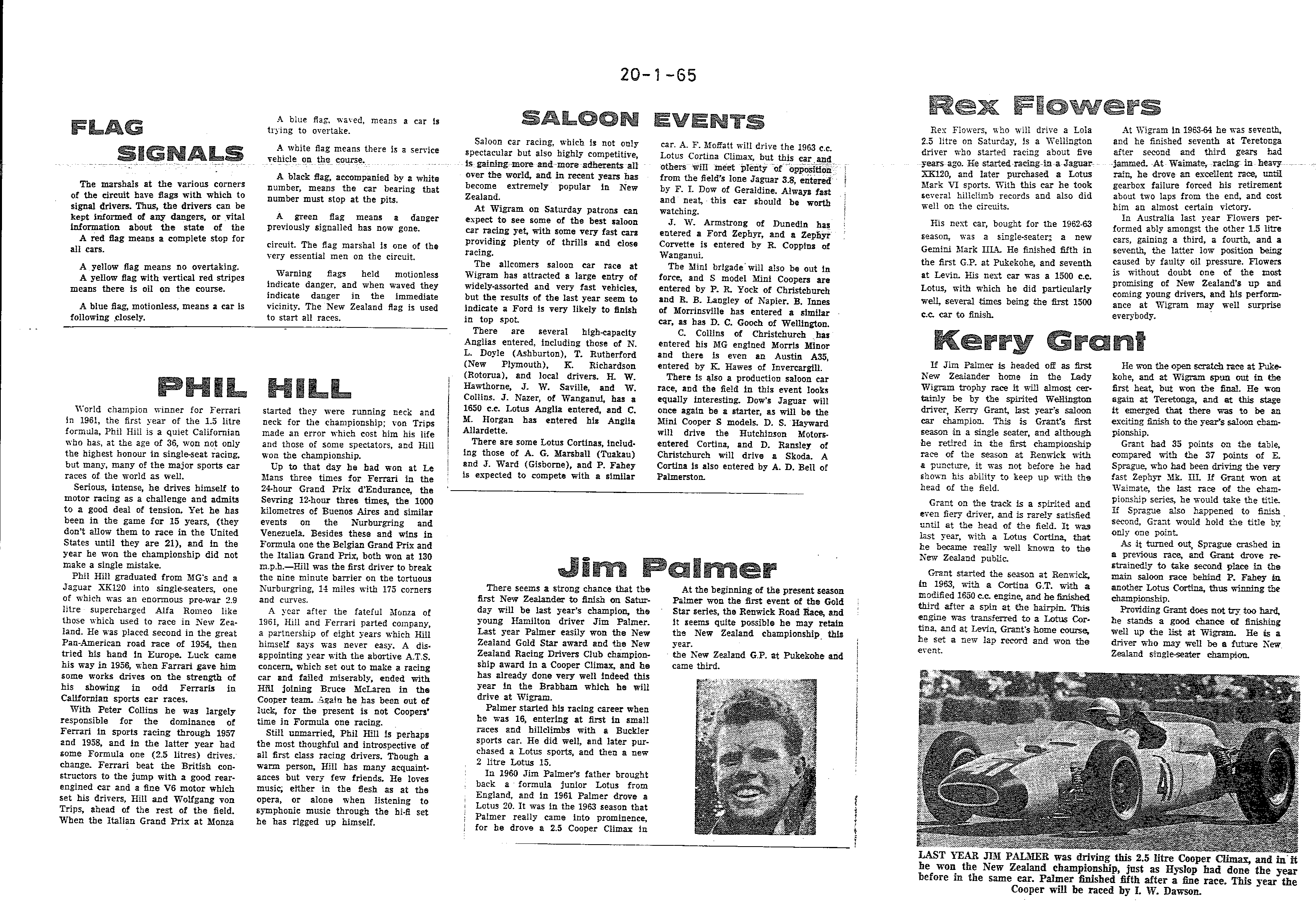
- Last year Jim Palmer was driving this 2.5 litre Cooper-Climax, and in it won the New Zealand championship, just as Hyslop had done the year before in the same car. This year the Cooper will be raced by I. W. Dawson.
Read the OCR text
20-1-65
A blue flag, waved, means a car is
FLAG trying to overtake.
SIGNALS
The marshals at the various corners
of the circuit have flags with which to
signal drivers. Thus, tae drivers can be
kept informed of any dangers, or vital
information about the state of the
A red flag means a complete stop for
all cars.
A yellow flag means no overtaking.
A yellow flag with vertical red stripes
means there is oil on the course.
A blue fiag, motionless, taeans a car is
following closely.
PHIL
World champion winner for Ferrari
in 1961, the first year of the 1.5 litre
formula, Phil Hill is a quiet Californian
who has, at the age of 36, won not only
the highest honour in single-seat racing,
but many, many of the major sports car
races of the world as well.
Serious, intense, he drives himself to
motor racing as a challenge and admits
to a good deal of tension. Yet he has
been in the game for 15 years, (they
don't allow them to race in the United
States until they are 21), and in the
year he won the championship did not
make a single mistake.
Phil fill graduated from MG's and a
Jaguar XK120 into single-seaters, one
of which was an enormous pre-war 2.9
litre supercharged Alfa Romeo like
those which used to race in New Zealand. He was placed second in the great
Pan-American road race of 1954, then
tried his hand in Europe. Luck came
his way in 1956, when Farrari gave him
some works drives on the strength of
his showing in odd Ferraris in
Californian sports car races.
With Peter Collias he was largely
responsible for the dominance of
Ferrari in sports racing through 1957
and 1958, and in the latter year had
some Formula one (2.5 litres) drives.
change. Ferrari beat the British constructors to the jump with a good rearengined car and a fine V6 motor which
set his drivers, Hill and Wolfgang von
Trips, ahead of the rest of the field.
When the Italian Grand Prix at Monza
A white flag means there is a service
Fehicle on the course.
A black fag, accompanied by a white
number, means the car bearing that
number must stop at the pits.
green flag means 2 danger
previously signalled has now gone.
circuit. The flag marshal is one of the
very essential men on the circuit.
Warning flags
indicate danger, and
indicate danger in
vicinity. The New Ze:
to start all races.
held motionless
when waved they
the immediate
aland flag is used
started they were running neck and
neck for the championship; von Trips
made an error which cost him his life
and those of some spectators, and Hill
won the championship.
Up to that day he had won at Le
Mans three times for Ferrari in the
24-hour Grand Prix d'Endurance, the
Sevring 12-hour thres times, the 1000
kilometres of Buenos Aires and similar
events on the Nurburgring and
Venezuela. Besides these and wins in
Formula one the Belgian Grand Prix and
the Italian Grand Prix, both won at 130
mn.p.h.-Hill was the first driver to break
the nine minute barrier on the tortuous
Nurburgring, 11 miles with 175 corners
and curves.
A ycar after the fateful Monza of
1961, Hill and Ferrari parted company,
a partnership of eight years which Hill
himself says was never easy. A disappointing year with the abortive A.T.S.
солсе, Which set out to make a racing
car and failed miserably, ended with
Hil Joining Bruce McLaren in the
Cooper team. Again he has been out of
luck, for the present is not Coopers'
time in Formula one racing.
Still unmarried, Phil Hill is perhaps
the most thoughful and introspective of
all first class racing drivers. Though a
warm person, Hill has many acquaintances but very few friends. He loves
music; either in the flesh as at the
opera, or alone when listening to
symphonie music through the hi-f set
he has rigged up himself.
SALOON EVENTS
Saloon car racing,
spectacular but also
is gaining more and
over the world, and
become extremely
Zealand.
which is not only
highly competitive,
more adherents all
in recent years has
popular In New
At Wigram on Saturday patrons can
expect to see some of the best saloon
car racing yet, with some very fast cars
providing plenty of thrills and close
racing.
The allcomers saloon car race at
Wigram has attracted a large entry of
widely-assorted and very fast vehicles,
but the results of the last year seem to
indicate a Ford is very likely to finish
in top spot.
There are several high-capacity
Anglias entered, including those of N.
I. Doyle (Ashburton), I. Rutherford
(New Plymouth),: K. Richardson
(Rotorua), and local drivers. H. W.
Hawthorne, J. W. Saville, and W.
Collins. J. Nazer, of Wanganul, bas a
1650 c.c. Lotus Anglia entered, and C.
M. Horgan bas entered his Anglia
Allardette.
There are some Lotus Cortinas, Inciuding those of A. G. Marshall (Tuakau)
and J. Ward (Gisborne), and P. Fahey
is expected to compete with a similar
car. A. F. Moffatt will drive the 1963 c.c.
Lotus Cortina Climax, but this car and
otbers will meet plenty of opposition
from the field's lone Jaguar 3.8, entered
by F. I. Dow of Geraidine. Always fast
and neat, this car should be worth
watching.
J. W. Armstrong of Dunedin has
entered & Ford Zephy, and a Zephyr
Corvette is entered by R. Coppins of
Wanganui.
The Mini brigade will also be out in
force, and S model Mini Coopers are
entered by P. R. Yock of Christchurch
and B. B. Langley of Napier. B. Innes
of Morrinsville has entered a similar
car, as has D. C. Gooch of Wellington.
C. Collins of Christchurch has
entered his MG engined Morris Minor
and there is even an Austin A35,
entered by K. Hawes of Invercargill.
There is also a production saloon car
race, and the field in this event looks
equally interesting. Dow's Jaguar will
once again be a starter, as will be the
Mini Cooper S models. D. S. Hayward
will drive the Hutchinson Motorsentered Cortina, and D. Ransley of
Christchurch will drive s Skoda. A
Cortina is also entered by A. D. Bell of
Palmerston
Jim P
There seems a strong chance that the
first New Zealander to finish on Saturday will be last year's champion, the
young Hamilton driver Jim Palmer.
Last year Palmer easily won the New
Zealand Gold Star award and the New
Zealand Racing Drivers Club championship award in a Cooper Climas, and he
has already done very well indeed this
year in the Brabham which he will
drive at Wigram.
Palmer started his racing career when
he was 16, entering at first in small
races and hillelimbs with & Buckler
sports car. He did well, and later purchased a Lotus sports, and then a new
2 litre Lotus 15.
In 1960 Jim Palmer's father brought
back a formula Junior Lotus from
England, and in 1961 Palmer drove a
Lotus 20. It was in the 1963 season that
Palmer really came into prominence,
for be drove # 2.5 Cooper Climax in
almer
At the beginning of the present season
Palmer won the first event of the Gold
Star series, the Renwick Road Race, and
it seems quite possible he may retain
the New Zealand championship this
year.
the New Zealand G.P. at Pukekohe and
came third.
Rex Flowers
Rex Flowers, who will drive a Lola
2.5 litre on Saturday, is a Wellington
driver who started racing about five
Fears ago. He started racing-in a Jaguar
XK120, and later purchased a Lotus
Mark VI sports. With this car he took
several hiliclimb records and also did
well on the circuits.
His next car, bought for the 1962-63
season, was a single-seaters a new
Gemini Mark IIA He finished fifth in
the first G.P. at Pusekobe, and seventh
at Levin. His next car was a 1500 c.c.
Lotus, with which he did particularly
well, several times being the first 1500
c.c. car to finish.
At Wigram in 1963-64 he mas seventh,
and he finished seventh at Teretonga
after second and third gears had
jammed. At Waimate, racing in heavy
raili, he drove an escellent race, until
gearbox failure forced his retirement
about two laps from the end, and cost
him an almost certain victory.
In Australia last year Flowers performed ably amongst the other 1.5 litre
cars, gaining a third, a fourth, and a
seventh, the latter low position being
caused by faulty oil pressure. Flowers
is without doubt one of the most
promising of New Zealand's up and
coming young drivers, and his performance at Wigram may fell surprise
everybody.
Kerry Grant
If Jim Palmer is headed off as first
New Zealander home in the Lady
Wigram trophy race it will almost certainly be by the spirited Wellington
driver, Kerry Grant, last rear's saloon
car champion. This is Grant's first
season in a single seater, and although
he retired in the first championsiap
race of the season at Renwick with
a puncture, it was not before he had
shown his ability to keep up with the
head of the field.
Grant on the track is a spirited and
even fiery driver, and is rarely satisfied
until at the head of the field. It was
last year, with a Lotus Cortina, that
he became really well known to the
New Zealand public.
Grant started the season at Renwick,
In 1963, with a Cortina G.T. with a
modified 1650 c.c. engine, and he finished
third after a spin at the hairpin. This
engine was transferred to a Lotus Cortina, and at Levin, Grant's home course,
be set a new lap record and won the
event.
He won the open scratch race at Pukekone, and at Wigram spun out in the
frst beat, but fon the final. He won
again at Teretonga, and at this stage
it emerged that there was to be at
exciting finish to the year's saloon championship.
Grant had 35 points on the table,
compared with the 37 points of E.
Sprague, who had been driving the very
fast Zephyr MIk. II. If Grant won at
Waimate, the last race of the championship series, he would take the title.
If Sprague also happened to finish
second, Grant would hold the title br
only one point
As it turned out, Sprague crashed in
a previous race, and Grant drove re
strainedly to take second place in the
main saloon race behind P. Fahey in
another Lotus Cortina, thus winning the
championship.
Providing Grant does not try too hard,
he stands a good chance of finishing
well up the list at Wigram. He is a
driver who may well be a future New
Zealand single seater champion.
LAST YEAR JIM PALMER was driving this 2.5 litre Cooper Climas, and in it
before in the same car. Palmer finished he won the New Zealand championship, just as Hysiop had done the year
ith after a fine race. This year the
Cooper will be raced by I. W. Dawson.
Summaries and tables are machine-read from the scan and may contain errors: the scan is the record.