previewSports, specials: Motor Racing Club championship
Preview of the 1965 Motor Racing Club championship for sports cars and specials at Wigram. The main duel is between Maurice Stanton's 4940cc Stanton Corvette and B. N. Walker's 1658cc Mirage, with Barry Porter's Lotus 15, Miss I. Stephenson (Buckler), R. Rutherford (260M Zephyr), G. Lawrence and R. Sager among the contenders.
Facts
- The 1965 Motor Racing Club championship at Wigram was for sports cars and specials; sports car racing was undergoing a revival in New Zealand.
- The Stanton Corvette (4940cc) and the Mirage (1658cc) were both locally-built sports cars (1965).
featureTimes and speeds
Reference box of Wigram race figures ahead of the 1965 race: McLaren won in 1964 at 93.1 mph average for 100 miles with a lap record of 1:26.9 (about 96 mph); in 1963 on the earlier 2.073-mile circuit he averaged 93.82 mph for 150.236 miles with Brabham's 97.5 mph record lap; Moss won in 1962 at 93.27 mph. A 1:22.8 lap would win the 300-pound 100 mph prize, and a McLaren win would make him the second three-time consecutive winner after Peter Whitehead (1954, 1956, 1957).
Lady Wigram Trophy 1964 (100 miles)
| 1 | Bruce McLaren (New Zealand) | Cooper-Climax | |
Lady Wigram Trophy 1963 (150.236 miles)
| 1 | Bruce McLaren (New Zealand) | Cooper-Climax | |
Lady Wigram Trophy 1962 (150.236 miles)
| 1 | Stirling Moss (England) | Lotus-Climax | |
Lap times
- Bruce McLaren (Cooper-Climax): 1:26.9 lap record
- Jack Brabham (Repco-Brabham-Climax): 1:18.3 lap record
- Stirling Moss (Lotus-Climax): 1:20.1 fastest race lap
Facts
- The 1964 Lady Wigram Trophy was the first run in two 25-mile heats and a final of about 100 miles; the 1965 format was the same on a 2.3 mile circuit.
- Lap record 1:26.9 (96 mph) and race average record 93.1 mph, both set by Bruce McLaren in 1964, stood going into the 1965 meeting.
- Peter Whitehead (Ferrari) won the Lady Wigram Trophy in 1954, 1956 and 1957; no race was held in 1955 as the aerodrome was being sealed.
- A 1:22.8 lap during the race would win the 300-pound prize for a 100 mph lap in 1965.
featureBruce McLaren
Profile of Bruce McLaren, rated among the world's best half-dozen drivers for five seasons, seventh in the Formula One championship; at Wigram he drives a specially modified 2.5-litre Cooper-Climax with Phil Hill in a similar car. He started racing at 15 in an Ulster Austin bought by his father Les, and won three of four NZ internationals in 1964 for the Tasman Cup.
Facts
- Bruce McLaren won three of the four international races in New Zealand in 1964 to establish an unassailable lead in the Tasman Cup series.
featureJim Clark
Profile of Jim Clark: world champion in 1964 (per the article) and within half a lap of the title again for 1965, 27 years old, Lotus 25 designer Colin Chapman's driver, who visited New Zealand for the 1961 NZ Grand Prix and ran sixth. A Scottish sheep farmer who began competition driving at 20, he was praised by Stirling Moss. In the Tasman Championship he will probably drive a Lotus 33 with a 2.5 litre Coventry-Climax.
Facts
- Jim Clark visited New Zealand for the 1961 New Zealand Grand Prix and ran sixth in a Lotus.
- Jim Clark was the only man quicker than Stirling Moss in a Le Mans start, according to the 1965 profile.
Photos
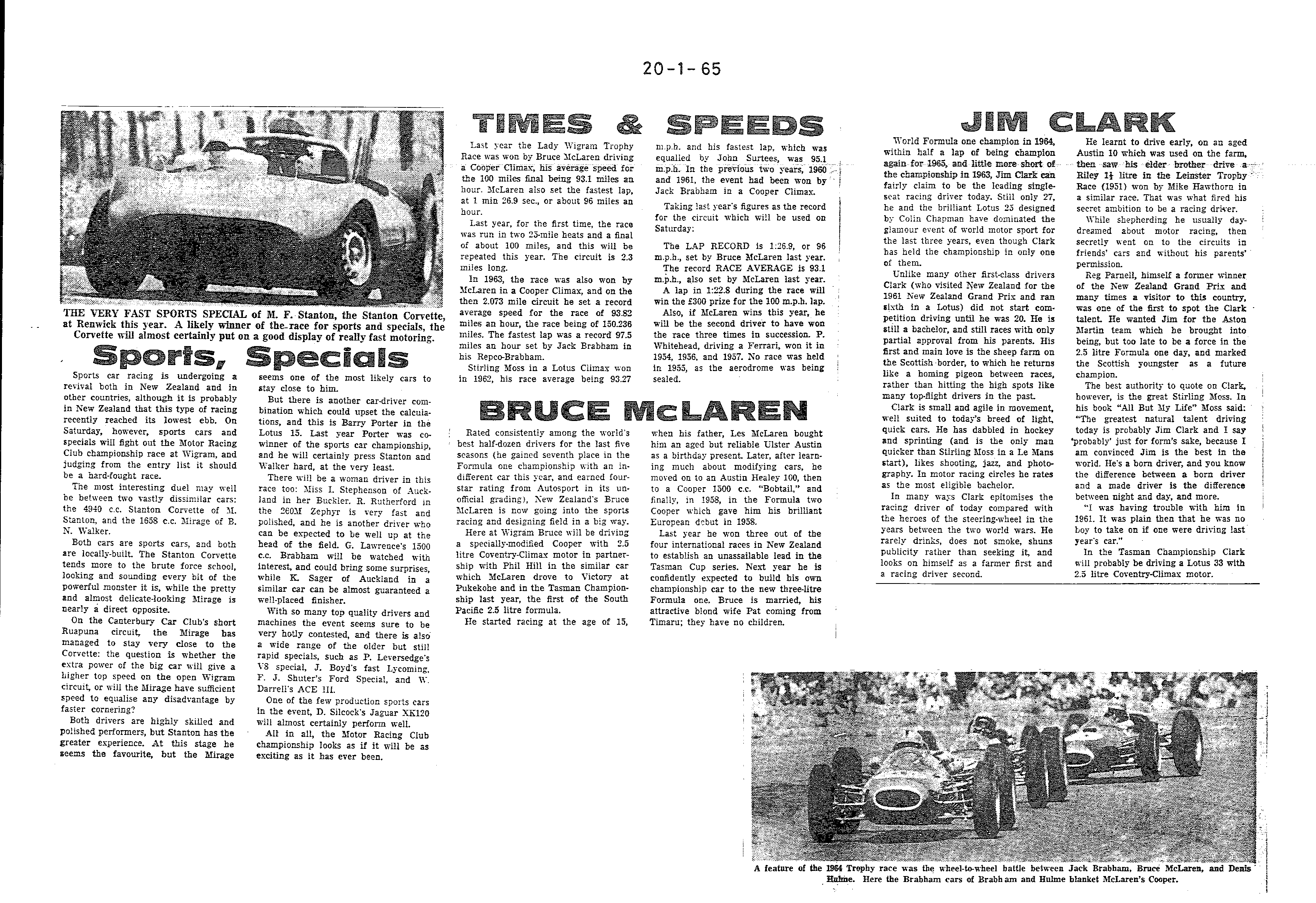
- A feature of the 1964 Trophy race was the wheel-to-wheel battle between Jack Brabham, Bruce McLaren and Denis Hulme; the Brabham cars of Brabham and Hulme blanket McLaren's Cooper.
- The very fast sports special of M. F. Stanton, the Stanton Corvette, at Renwick this year, likely winner of the race for sports and specials.
Read the OCR text
20-9-65
THE VERY FAST SPORTS SPECIAL of M. F. Stanton, the Stanton Corvette,
at Kenwick this year. A hely winner of the race for sports and specials, the Corvette wil almost certainly put on a good display of really fast motoring.
Sporis, Specials
Sports car racing is undergoing a seems one of the most likely cars to
revival both in New Zealand and in stay close to him.
other countries, although it is probably But there is another car-driver comin New Zealand that this type of racing bination which could upset the calcularecentiy reached its lowest ebb. On tions, and this is Barry Porter in the
Saturday, however, sports cars and Lotus 15. Last year Porter was cospecials will fight out the Motor Racing winner of the sports car championship,
Club championship race at Wigram, and and he will certainly press Stanton and
judging from the entry list it should Walker hard, at the very least.
be a hard-fought race. There will be a woman driver in this
The most interesting duel may well race too: Miss I. Stephenson of Auckbe between two vastly dissimilar cars: land in her Buckler. R. Rutherford in
the 4940 c.c. Stanton Corvette of JI. the 2601I Zephyr is very fast and
Stanton, and the 1658 c.c. Mirage of B. polished, and he is another driver who
N. Walker. can be expected to be well up at the
Both cars are sports cars, and both bead of the field. G. Lawrence's 1500
are locally-built. The Stanton Corvette c.c. Brabham will be watched with
tends more to the brute force school, interest, and could bring some surprises,
looking and sounding every bit of the while R. Sager of Auckland in a
powerful monster it is, while the pretty similar car can be almost guaranteed a
and almost delicate-looking Mirage is well-placed finisher.
nearly a direct opposite. With so many top quality drivers and
On the Canterbury Car Club's short machines the event seems sure to be
Ruapuna circuit, the Mirage bas
very hotly contested, and there is also
managed to stay very close to the a wide range of the older but still
Corvette: the question is whether the rapid specials, such as P. Leversedge's
extra power of the big car will give a V8 special, J. Boyd's fast Lycoming,
higher top speed on the open Wigram F. J. Shuter's Ford Special, and W.
circuit, or will the Mirage have sufficient Darrell's ACE III.
speed to equalise any disadvantage by One of the few production sports cars
faster cornering? In the event, D. Sileock's Jaguar XK120
Both drivers are highly skilled and will almost certainly perform well.
polished performers, but Stanton has the All in all, the Blotor Racing Club
greater experience. At this stage he championship looks as if it will be as
seems the favourite, but the Mirage exciting as it has ever been.
TIMES
Last year the Lady Wigram Trophy
Race was won by Bruce McLaren driving
a Cooper Climax, his average speed for
the 100 miles final being 93.1 miles an
hour. MicLaren also set the fastest lap,
at 1 min 26.9 sec., or about 96 miles an
Last year, for the
was run in two 25-m
of about 100 miles
repeated this year.
miles long.
: first time, the race
He heats and a final
, and this will be
The circuit is 2.3
In 1963, the race was also won by
McLaren in a Cooper Climax, and on the
then 2.073 mile circuit be set a record
average speed for
miles an hour, the
miles. The fastest 1
miles an hour set
his Repco-Brabham
Stirling Moss in
in 1962, his race
the race of 93.82
race being of 150.236
lap was a record 97.5
by Jack Brabham in
a Lotus Climas won
average being 93.27
SPEEDS
m1.p.n. and his fastest
equalled by Jonn Sur
mp.a. In the previous
and 1961, the event ha
Jack Brabham in a Co
lap, which was
rees, was 95.1
....
two years, 1960
d been won by
poper Climax.
Taking last year's figures as the record
for the circuit which will be used on
Saturday:
The LAP RECOR
m.p.h., set by Bruce
The record RACE
m.p.h., also set by
A lap in 1:22.8 du
D is 1:26.9, or 96
McLaren last year.
• AVERAGE is 93.1
McLaren last year.
uring the race will
win the £300 prize for the 100 m.p.h. lap.
Also, if McLaren wins this year, he
will be the second driver to have won
the race three times in succession. P.
Whitehead, driving a Ferrari, won it in
1954, 1956, and 1957. No race was held
in 1955, as the aerodrome was being
sealed.
BRUCE MCLAREN
Rated consistently
best half-dozen drive:
seasons (he gained se
Formula one champi
diferent car this yea
among the world's
rs for the last five
eventh place in the
onship with an in-
, and earned four
star rating from Autosport in its unoficial grading), New Zealand's Bruce
McLaren is now going into the sporis
racing and designing field in a big way.
Here at Wigram Bruce will be driving
a specially-modified Cooper with 2.5
litre Coventry-Climax motor in partnership with Phil Hill in the similar car
which McLaren drove to Victory at
Pukekohe and in the Tasman Championship last year, the first of the South
Pacific 2.5 litre formula.
He started racing at the age of 15,
when his father, Les McLaren bought
him an aged but reliable Ulster Austin
as a birthday present. Later, after learning much about modifying cars, be
moved on to an Austin Healey 100, then
to a Cooper 1500 c.c. "Bobtail," and
finally, in 1958, in the Formula two
Cooper which gave him his brilliant
European debut in 1958.
Last year he won three out of the
four international races in New Zealand
to establish an unassailable lead in the
Tasman Cup series. Next year he is
confidently expected to build his own
championship car to the new three-litre
Formula one, Bruce is married, his
attractive blond wife Pat coming from
Timaru; they have no children.
JIM
World Formula one champion in 1964,
within half a • lap of being champion
again for 1965, and little more short of
the championship in 1963, Jim Clark can
fairly claim to be the leading singleseat racing driver today. Still only 27,
he and the brilliant Lotus 25 designed
by Colin Chapman have dominated the
glamour event of world motor sport for
the last three years, even though Clark
has held the championship in only one
of them.
Unlike many other first-class drivers
Clark (who visited New Zealand for the
1961 New Zealand Grand Prix and ran
sixth in a Lotus) did not start competition driving until he was 20. He is
still a bachelor, and still races with only
partial approval from his parents. His
frst and main love is the sheep farm on
the Scottish border, to which he returns
like a homing pigeon between races,
rather than hitting the high spots like
many top-flight drivers in the past.
Clark is small and agile in movement,
well suited to today's breed of light,
quick cars. He has dabbled in hockey
and sprinting (and is the only man
quicker than Stirling Moss in a Le Mans
start), likes shooting, jazz, and photography. In motor racing circles he rates
as the most eligible bachelor.
In many wars Clark epitomises the
racing driver of to
the heroes of the s
years between the
Iarely drinks, does
publicity rather th
looks on himself as
a racing driver sec
oday compared with
steering-wheel in the
two world wars. He
s not smoke, shuns
han seeking it, and
s a farmer first and
LARK
He learnt to drive early, on an aged
Austin 10 which was used on the farm,
then saw his elder brother drive a
Riley If litre in the Leinster Tropby
Race (1951) won by Mike Hawthorn in
a similar race. That was what fired his
secret ambition to be a racing driver.
While shepherding he usually daydreamed about motor racing, then
secretly went on to the circuits in
friends' cars and without his parents'
permission.
Reg Parneil, himseli a former winner.
of the New Zealand Grand Prix and
many times a visitor to this country,
was one of the first to spot the Clark
talent. He wanted Jim for the Aston
Martin team which be brought into
being, but too late to be a force in the
2.5 litre Formula one day, and marked
the Scottish youngster as a future
champion.
The best authority to quote on Clark,
however, is the great Stirling Moss. In
his book "All But My Life" Moss said:
"The greatest natural taient driving
today is probably Jim Clars and 1 say
"probably' just for form's sake, because I
am convinced Jim is the best in the
world. He's a born driver, and you know
the difference between a born driver
and a made driver is the difference
between night and day, and more.
"I was having trouble with hira in
1961. It was plain ten that he was no
boy to take on if or
year's car."
In the Tasman (
will probably be driv
2.5 litre Coventry-Cl
were driving last
Championship Clark
ving a Lotus 33 with
limax motor.
A feature of the 1964 Trophy race was the wheel-to-wheel battle between Jack Brabhara, Bruce McLaren, and Denis
Halme. Here the Brabham cars of Brabh am and Hulme blanket McLaren's Cooper.
Summaries and tables are machine-read from the scan and may contain errors: the scan is the record.