Read the OCR text
31-1-59
TROPHY
RACE
HOLD
OWN IN
ANY
COMPANY
ALTHOUGH the tremendous duel betveen Ron Flock- hart and Jack Brabham overshadowed everything
else in the Lady Wigram Trophy race last Saturday, New
Lealanders were by no means disgraced. They proved
once again, as they had already done in the New Zealand
Grand Prix at Ardmore a fortnight earlier, that among
them are men who can hold their own in any company.
It is true that the brilliant
voung Auckiander. Bruce Me-
Laren, sid Jensen, of palmerston
North, and Johnnie Mansell,
another Aucklander, were quite
a distance benind Flockhart and
Brabham when they were
flagged off, but that margin was
almost entirely due to the fact
that their cars were outclassed
by "works" models.
There is only. one private.
owner in the world to-day who
can really throw a scare into the
factory teams. He is the Englishman, Rob Walker, whose
2014 c.c. Cooper-Climaxes took
the Argentine Grand Prix and
the Monaco Grand Prix last
season in the hands of Stirling
Moss and Maurice Trintignant
respectively.
It was perhaps asking too
much to expect Mclaren,
Jensen, and Mansell to hold
their own with factory cars,
especially on Wigram, which
exceptionally fast
circuit.
It is certain that the New Zealanders will show to much better
advantage at leretonga Park,
Invercargill, next Saturday, on
the snorter, tighter course,
where driving ability counts
rather more than sheer performance.
Out on Own
Once the practice times were
announced it was obvious that
Flockhart's B.R.M. and Brab
ham's 2200 C.C. Cooper-Climax
were in a class of their own as
far as Wigram was concerned.
As it happened McLaren, Jensen,
and Mansell, with their smaller
cars, dia not put a foot wrong
and there is absolutely nothing
to suggest that if they had been
mounted on faster machines
they would not have held on to the overseas men.
As it happened they all lapped
at speeds that a couple of years
ago would have won the trophy
race and, with the exception of
Mansell. did it with far smaller
cars.
On the basis of Wigram it
is a pity that Mclarer is
the only New Zealander who
can look forward to wholehearted support during the
fast- approaching European
season. McLaren has proved
himself in the best overseas
• company already. Jensen
during a brief tour gave
European drivers something
to think about last season
and Merr Neil, another
Aucklander, aiso acquitted
himself well.
Mansell, given the chance,
could turn into a real force in
this country and with overseas
experience might also turn into a
top nignt driver.
it Is a pity that last year's
New Zealand champion, Ross
Jensen, has not had • the chance
this season to show just what
he is capable of doing. The 250F
El Salvador Maserati, specially
commissioned for Jensen for the
New Zealand season, has proved
rather disappointing.
Misgivings
Even before the car reached
this country, Jensen, after the
Teretonga Park meeting : late
last year, had some reservations
about it. On the whole he might
have fared better with his old
ex-Moss car, which is being
driven this season by Mansell
At Auckland it was only the
fact that the _clutch packed up
that stopped Jensen from bring
ing it home in fourth place. As
it was, Schell, by dint of inspired
driving. was able to take him
in the last few laps and so bring
home a Temple Buell Piccol
Maserati in fourth place.
In the practice session at Wig
ram Jensen managed 1min 26.2
sec with the 3I Salvador car.
but he did not appear to be
nearly as happy as he was the
previous year with the older
Maseratl. In fact there were
quite a number of experienced
drivers and observers who be.
lieved that New Zealand's No
1 racing driver of last seasor
was right on the limit.
SHOWED
Drising right on the limit
is something that can be
necessary to sin a race in
the last few laps when spit
seconds count. But it is not
a healthy occupation when
all that is at stake is a place
in the front row of a starting grid.
The Flockhart-Brabham duel
must have made up for a lot of
discomfort the thousands
spectators suttered througn poor
organisation at Wigram. It is
being suggested in some quarters that Flockhart could have
gone even harder with the
B.R.M. if the need had arisen.
But it is hard to believe that
any driver would be prepared
to hold back just for the sake
of winning by a mere 3.7sec.
Even the slightest error-and
that could be one that would
not even have been detected by
the spectators-would have been
enough to put the Brabham
Cooper-Climax in front in the
last lap or two. So seems
logical to assume that Flockhart
would have opened up a wider
gap once he assumed the lead
for the last time if it was within :
his power to do so.
Slow Cars
There is no doubt that the
greatest difficulty these overseas drivers met was the number of slow cars in the field.
The time has come for a really
realistic approach to this matter
by race organisers not only in
Christchurch, but right throughout the country. Unless the slow
cars and siow drivers-and there
can be slow drivers in fast cars
are weeded out . the very
near future there is going to
be a nasty accident as sure as
night follows day.
It is absolutely nonsensical to
permit slow cars and drivers to
compete an international
event just for the sake of building up the field. In point of fact
the slow machines only serve to
contuse the issue for spectators
who find a 150 mile race difficult
enough to follow in any case.
There are now enough
fast cars in this country to
provide good racing. But
most organising clubs seem
to labour under the impres
sion that unless there is a
big field there cannot be a
good race.
N.Z. DRIV
That might have been the case
five or six years ago, when
speeds were slower and when
cars were not so reliable. In
the early days, in fact, there • was
almost alwars an unspoken fear
that by the time the chequered
flag fell there might only be two
or three cars still running. It
would certainly be surprising if
such a thing happened these
days. In any case if that fear
still remains motor sport is
doomed in this country.
Finaliy Wigram must have
proved that motor racing on the
grand scale is not purely for the
enjoyment of those taking part
and those running the event.
Financial Aspect
The Lady Wigram Trophy
race is an international event. It
draws drivers from Europe with
first-class cars. They are men
who can command good starting
money. It also draws first-class
New Zealand drivers, and it is
no secret that some of them
were paid to appear on the starting grid last Saturday. This
money and all the other money
tnat is required to put on the
race has to come from some
where. And the only place it
can come from is out of John
Citizen's pocket.
Money is hard enouh to come
by at any time and there is a
strong suspicion at the moment
that now it is harder to come by
than ever.
That is one good reason
why a meeting such as Wigram must rub like • clockmork. It certainis did not
last Saturday.
The Motor Racing Club, sponsor of the event, has a dificult
task owing to the very short
space of time available to put in
all the equipment needed for the
running of the race. It would be
well advised to make the strongest representations to the Government to get more time to
made preparations on the aerodrome.
If this is not possible the only
alternative is to find another
equally suitable venue. Where
that would be is anybody's
guess.
ERS
8.47
But there is more involved
nan just this question. Wigram
big business. It involves some
housands of pounds, and this
being the case there are grounds
for believing that the expenditure of this money and the
eventual recouping of it through
the gates should not be left in
the hands of enthusiastic but
part-time workers.
At the same time as the Motor
Racing Club makes the bold
stroke and eliminates the slow
cars it should also look around
for a capable organiser to work
on the co-ordination of every.
thing for at least four months
before each race.
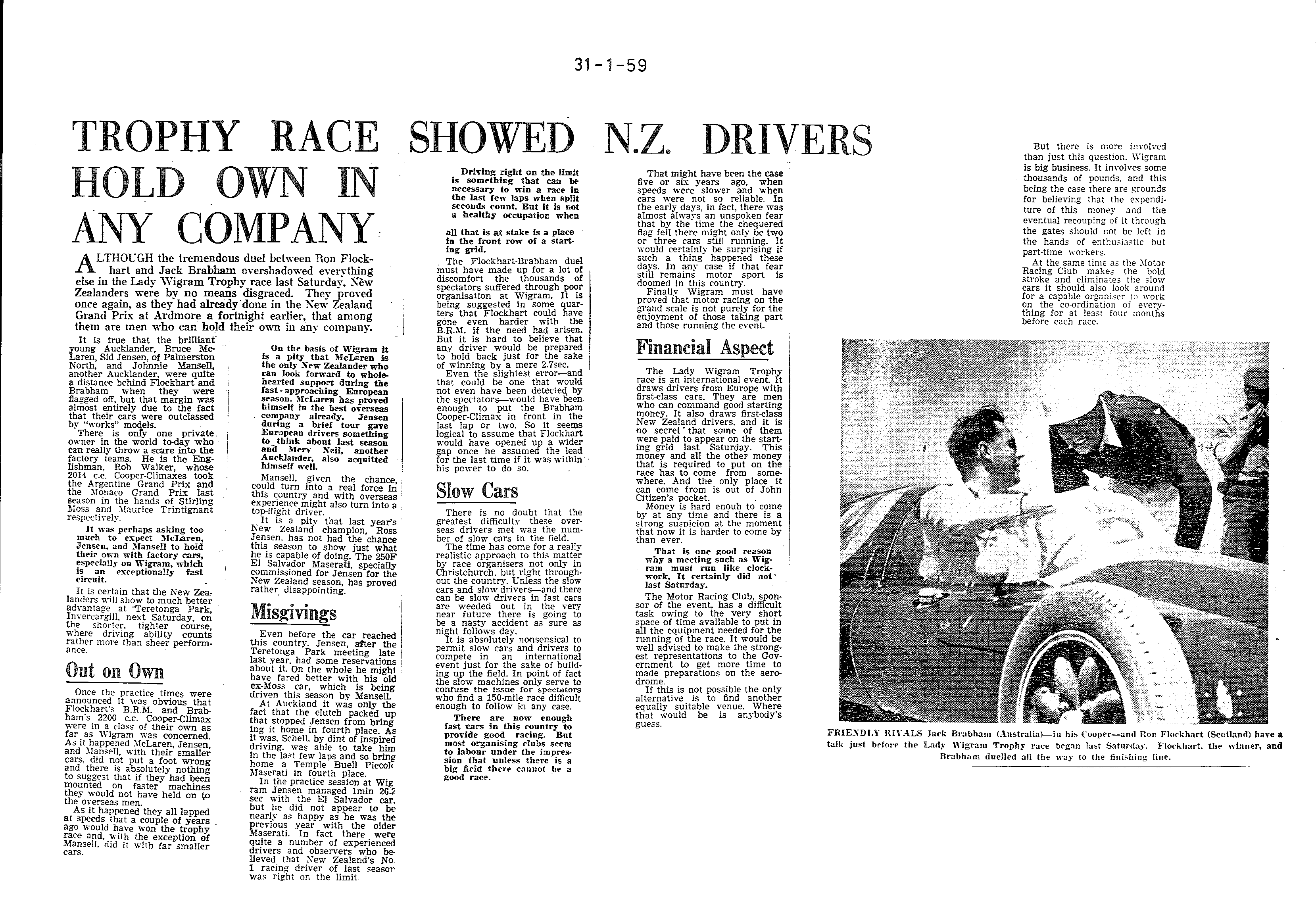
FRIENDLI RIVALS lack Brabham (Australia)—in his Cooper-and Ron Flockhart (Scotland) have a
talk just before the Lady Wigram Trophs race began last Saturday. Flockhart, the winner, and
Brabham duelled all the way to the finishing line.
Summaries and tables are machine-read from the scan and may contain errors: the scan is the record.