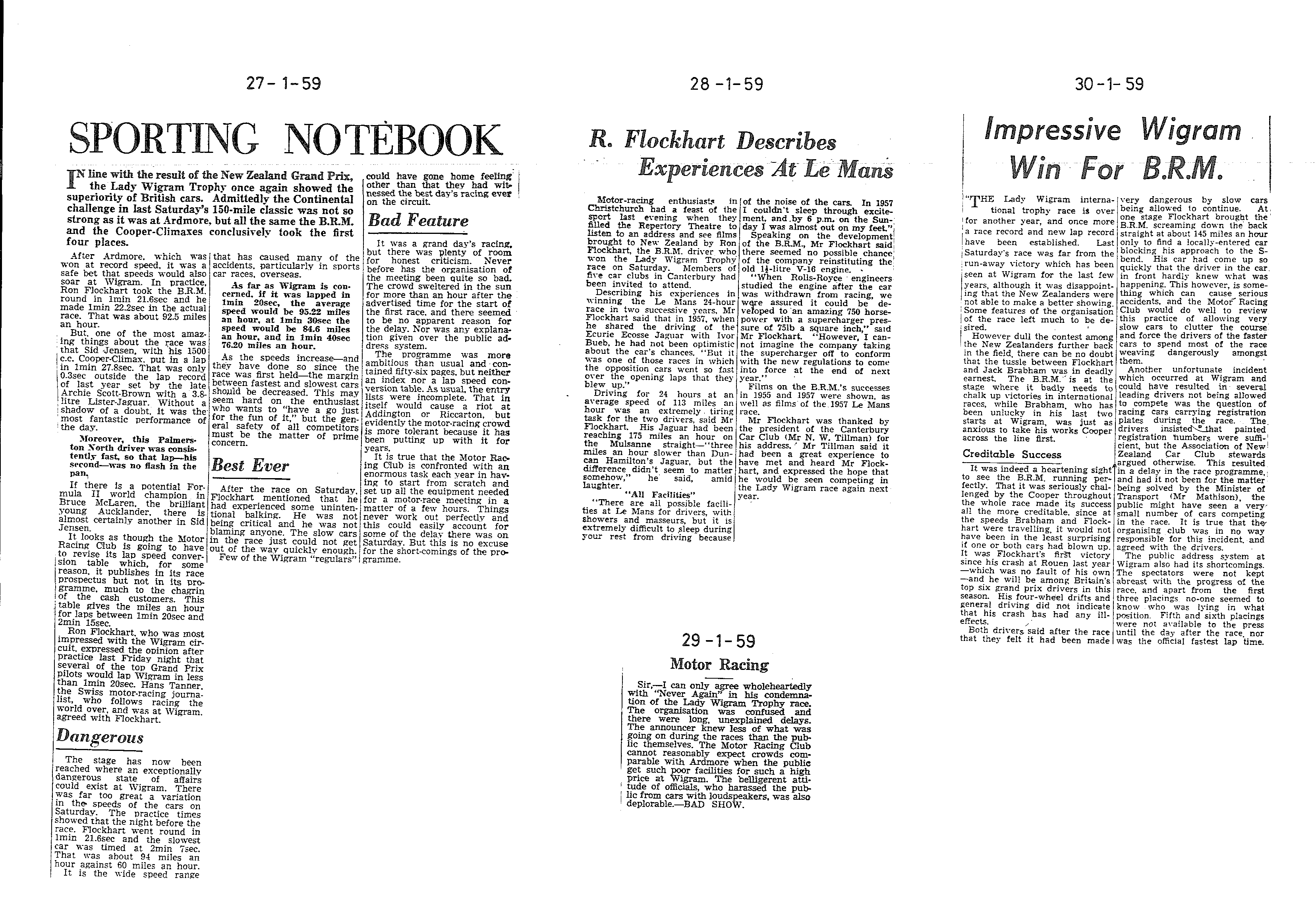
featureSporting notebook: British cars supreme, but Wigram speeds too varied
The columnist notes that the BRM and Cooper-Climaxes took the first four places in the Lady Wigram Trophy, with Flockhart lapping in 1:22.2 (about 92.5 mph) and Syd Jensen's 1500cc Cooper-Climax recording 1:27.8, only 0.3sec outside Scott-Brown's lap record, the most fantastic performance of the day. He warns the speed gap between fastest and slowest cars (about 94 mph versus 60 mph) is dangerous, criticises the poor organisation (the first race starting over an hour late), and the programme's 56 pages lacking an index or lap speed table. Flockhart and journalist Hans Tanner thought some Grand Prix drivers could lap Wigram under 1:20.
Lap times
- Syd Jensen (Cooper-Climax 1500cc): 1:27.8 other
- Ron Flockhart (BRM): 1:22.2 fastest race lap
- Ron Flockhart (BRM): 1:21.6 qualifying
Facts
- At Wigram a lap in 1min 20sec averages 95.22 mph, 1min 30sec 84.6 mph and 1min 40sec 76.20 mph.
- Syd Jensen's 1500cc Cooper-Climax lapped in 1min 27.8sec in the 1959 Lady Wigram Trophy, 0.3sec off the 1958 record.
- In 1959 the Wigram programme ran to fifty-six pages but had no index or lap speed conversion table.
newsR. Flockhart describes experiences at Le Mans
Ron Flockhart addressed motor-racing enthusiasts at the Repertory Theatre, Christchurch, showing films. He described winning Le Mans in 1957 with Ivor Bueb in an Ecurie Ecosse Jaguar (average 113 mph, 175 mph on the Mulsanne straight) and discussed BRM development, saying the old 1.5-litre V16 would not be revived. Canterbury Car Club president N. W. Tillman thanked him.
Facts
- Ron Flockhart won Le Mans in 1957 with Ivor Bueb in an Ecurie Ecosse Jaguar at an average of 113 mph.
letterMotor racing: letter from Bad Show
A reader agrees with an earlier critic of the Lady Wigram Trophy, calling the organisation confused, with long unexplained delays, an ill-informed announcer and belligerent officials using loudspeakers against the public.
otherImpressive win for Wigram BRM
Editorial comment on the Lady Wigram Trophy: the BRM and Brabham's Cooper fought in deadly earnest, with Flockhart's first victory since his Rouen crash; but the writer criticises slow local cars cluttering the track, a delay over whether cars needed registration plates (resolved by Minister of Transport Mathison), and a poor public address system that left fifth and sixth placings and the official fastest lap unavailable until the next day.
Facts
- Stewards of the Association of NZ Car Clubs insisted racing cars carry registration plates at the 1959 Wigram meeting; drivers argued painted numbers sufficed, and the Minister of Transport resolved it.
- Flockhart's BRM approached about 145 mph on the back straight at Wigram in 1959.
Read the OCR text
27 - 1-59 28-1-59 30-1-59
SPORTING
NOTEBOOK
N line with the result of the New Zealand Grand Pris,
the Lady Wigram Trophy once again showed the
superiority of British cars. Admittedly the Continental
challenge in last Saturday's 150-mile classic was not so
strong as it was at Ardmore, but all the same the B.R.M.
and the Cooper-Climares conclusively took the first
four places.
After Ardmore. which was
won at record speed, it was a
safe bet that speeds would also
soar at Wigram. In practice,
Ron Flockhart took the B.R.M.
round in 1min 21.6sec and he
made 1min 22.2sec in the actual
race. That was about 92.5 miles
an hour.
But, one of the most amazing things about the race was that Sid Jensen, with his 1500
c.c. Cooper-Climax, put in a lap
in 1min 27.8sec. That was only
0.3sec outside the lap record
of last year set by the late
Archie Scott-Brown with a 3.8litre Lister-Jaguar. Without a
shadow of a doubt, it was the
most fantastic performance of
the day.
Moreover, this Palmerston North driver was consistently fast, so that lap -his
second-was no flash in the
pan.
that has caused many of the
accidents, particularly in sports
car races, overseas.
As far as Wigram is concerned, if it was lapped in
1min 20sec, the average
speed would be 95.22 miles
an hour, at 1min 30sec the
speed would be 84.6 miles
an hour, and in 1min 40sec
76.20 miles an hour.
As the speeds increase-and
they have done so since the
race was first held-the margin
between fastest and slowest cars
should be decreased. This may
seem hard on the enthusiast
who wants to , "have a go just
for the fun of it," but the general safety of all competitors
must be the matter of prime
concern.
Best Ever
If there is a potential Formula II world champion in
Bruce Mebaren. the brilliant
young Aucklander. there is
almost certainly another in Sid
Jensen.
It looks as though the Motor
Racing Club is going to have
to revise its lap speed conversion table which, for some
¡ reason, it publishes in its race
prospectus but not in its programme, much to the chagrin
lof the cash customers. This
¡table gives the miles an hour
for laps between Imin 20sec and
2min 15sec.
Ron Flockhart. who was most
impressed with the Wigram circuit, expressed the opinion after
practice last Friday night that
several of the top Grand Prix
pilots would lap Wigram in less
than 1min 20sec. Hans Tanner.
, list, the Swiss motor-racing, journa- who follows racing the
world over, and was at Wigram.
agreed with Flockhart.
Dangerous
The stage has now been
reached where an exceptionally
dangerous state of affairs
could exist at Wigram. There
was far too great a variation
in the speeds of the cars on
Saturday. The practice times
showed that the night before the
race. Flockhart went round in
1min 21.6sec and the
car mas timed at min me. Tsec.
That was about 94 miles an
hour against 60 miles an hour.
It is the wide speed range
After the race on Saturday.
Flockhart mentioned that he
had experienced some unintentional balking. He was not
being critical and he was not
blaming anyone. The slow cars
in the race just could not get
out of the way quickly enough.
Few of the Wigram "regulars"
could have gone home feeling
other than that they had witnessed the best day's racing ever
on the circuit.
Bad Feature
It was a grand day's racing.
but there was plenty of room
for honest criticism. Never
before has the organisation of
the meeting been quite so bad.
The crowd sweltered in the sun
for more than an hour after the
advertised time for the start of
the first race, and there seemed
to be no apparent reason for
the delay. Nor was any explanation given over the public address system.
The programme was more
ambitious than usual and contained fifty-six pages. but neither
an index nor a lap speed conversion table. As usual, the entry
lists were incomplete. That in
itself would cause a riot at
Addington Riccarton, but
evidently the motor-racing crowd
is more tolerant because it has
been putting up with it for
years.
It is true that the Motor Racing Club is confronted with an
enormous task each year in having to start from scratch and
set up all the equipment needed
for a motor-race meeting in a
matter of a few hours. Things
never work out perfectly and
this could easily account for
some of the delay there was on
Saturday. But this is no excuse
for the short-comings of the programme.
R. Flockhart Describes
Experiences At Le Mans
Motor-racing enthusiasts in of the noise of the cars. In 1957
Christchurch had a feast of the I couldn't sleep through excitesport last erening when they ,ment, and by 6 p.m. on the Sunflled the Repertory Theatre to day I was almost out on my feet."
listen to an address and see flms Speaking on the development
brought to New Zealand by Ron of the B.R.M., Mr Flockhart said
Flockhart, the B.R.M. driver who there seemed no possible chance
won the Lady • Wigram Trophy of the company reinstituting the
race on Saturday. Members old 14-litre V-16 engine.
fire car clubs in Canterbury had •When Rolls-Royce engineers
been invited to attend. studied the engine after the car
Describing his experiences in was withdrawn from racing, we
winning the Le Mans 24-hour were assured it could be
race in two successive years, Mr vełoped to an amazing 750 horse-
Flockhart said that in 1957, when power with a supercharger
he shared the driving the!
Ecurie Ecosse Jaguar with Ivor! sure of 75lb a square inch. Pres- Mr Flockhart. "However, I can-
Bueb, he had not been optimistic not imagine the company taking
about the car's chances. "But it the supercharger off to conform
was one of those races in which with the new regulations to come
the opposition cars went so fast into force at the end of next
over the opening laps that they year."
blew up." Films on the B.R.M.'s successes
Driving for 24 hours at an in 1955 and 1957 were shown, as
average speed of 113 miles an well as films of the. 1957 Le Mans
hour was an extremely tiring race.
task for the two drivers, said Mr Mr Flockhart was thanked by
Flockhart. His Jaguar had been the president of the Canterbury
reaching 175 miles an hour on Car Club (Mr N. W. Tillman) for
the Mulsanne straight-'three his address. ' Mr Tillman said it
miles an hour slower than Dun- had been a great experience to
can Hamilton's Jaguar, but the have met and heard Mr Flockdifference „didn't seem • to matter hart, and expressed the hope that
somehow, he said, amid he would be seen competing
laughter. the Lady Wigram race again next
"All Facilities" year.
«There are all possible facilities at Le Mans for drivers, with
showers and masseurs, but it is
extremely difficult to sleep during
your rest from driving because
29 - 1-59
Motor Racing
Sir,—I can only agree wholeheartedly
with "Never Again" in his condemnation of the Lady Wigram Trophy race.
The organisation was confused and
there were long, unexplained delays.
The announcer knew less of what was
going on during the races than the public themselves. The Motor Racing Club
cannot reasonably expect crowds comparable with Ardmore when the public
I'he belligerent atti-
' tude of officials, who harassed the public from cars with loudspeakers, was also
deplorable.-BAD SHOW.
Impressive
Win For
Wigram
B.R.M.
"THE Lady Wigram interna-(very dangerous by slow cars
tional trophy race is over being allowed to continue. At
one stage Flockhart brought the
! for another year, and once more B.R.M. screaming down the back
, a race record and new lap record straight at about 145 miles an hour
have been established. Last only to find a locally-entered car
¡Saturday's race was far from the blocking : his approach to the Srun-away victory which has been bend. His car had come up so
quickly that the driver in the car
seen at Wigram for the last few in front hardly knew what was
years, although it was disappoint- happening. This however, is someing that the New Zealanders were thing which can cause serious
not able to make a better showing. accidents, and the Motor Racing
Some features of the organisation Club would do well to review
of the race left much to be de- this practice of allowing very
sired. slow cars to clutter the course
However dull the contest among and force the drivers of the faster
the New Zealanders further back cars to spend most of the race
in the field . there can be no doubt weaving dangerously amongst
that the tussle between Flockhart them.
and Jack Brabham was in deadly Another unfortunate incident
earnest. The B.R.M. is at the which occurred at Wigram and BR MI5
stage where it badly needs to could have resulted in several
chalk up victories in international leading drivers not being allowed
races, while Brabham. wno nas! to compete was the question of
been unlucky in his last two racing cars carrying registration
starts at Wigram, was just as plates during the race. The
anxious to take his works Cooper drivers insisted "that painted
across the line first. registration humbers were sufficient, but the Association of New
Creditable Success Zealand Car Club stewards
It was indeed a heartening sight argued otherwise. This resulted. 'in a delay in the race programme,:
to see the B.R.M. running per- and had it not been for the matter
fectly. That it was seriously chal- being solved by the Minister of
lenged by the Cooper throughout Transport (Mr Mathison, the
the whole race made its success public might have seen a very
all the more creditable, since at! small number of cars competing
the speeds Brabham and Flock- in the race. It is true that the
hart were travelling, it would not organising club was in no way
have been in the least surprising responsible for this incident. and
it one or both cars had blown up. agreed with the drivers.
It was Flockhart's first victory The public address system at
since his crash at Rouen last year Wigram also had its shortcomings.
—which was no fault of his own The spectators were not kept
-and he will be among Britain's abreast with the progress of the
top six grand prix drivers in this race, and apart from the first
season. His four-wheel drifts and three placings no-one seemed to
general driving did not indicate know who was lying in what
that his crash has had any ill- position. Fifth and sixth placings
effects. were not available to the press
Both drivers said after the race until the day after the race. nor
that they felt it had been madelwas the official fastest lap time.
Summaries and tables are machine-read from the scan and may contain errors: the scan is the record.