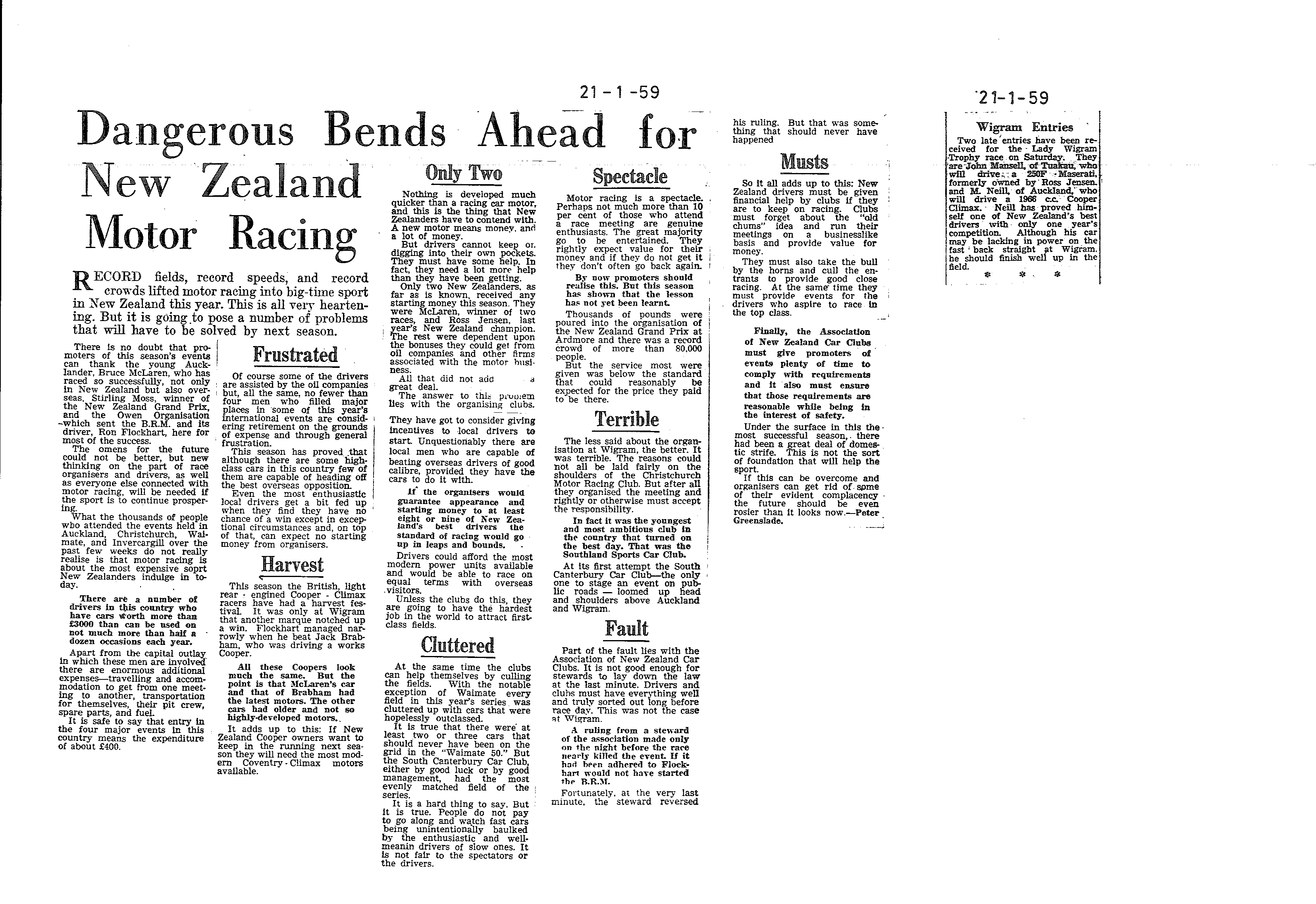
feature · Peter GreensladeDangerous bends ahead for New Zealand motor racing
Peter Greenslade reviews the 1959 international series (Auckland, Christchurch, Waimate, Invercargill), with record fields, speeds and crowds credited to Bruce McLaren, Stirling Moss and the BRM visit. He warns that racing is very expensive, that four leading drivers were considering retirement, and that only McLaren and Ross Jensen received starting money. Cooper-Climaxes dominated except at Wigram, where Flockhart's BRM narrowly beat Brabham's works Cooper. He urges clubs to pay local drivers, cull outclassed entries, and run better-organised meetings, criticising the Wigram organisation, praising Waimate and the Southland Sports Car Club, and noting a last-minute stewards' ruling that nearly stopped Flockhart starting.
Facts
- Entry in the four major 1959 international events cost a New Zealand driver about 400 pounds.
- Only two New Zealanders, McLaren and Ross Jensen, received starting money in the 1959 international series.
- A crowd of more than 80,000 attended the 1959 NZ Grand Prix at Ardmore, according to Peter Greenslade.
- The Waimate 50 had the most evenly matched field of the 1959 series.
- A steward's ruling made the night before the 1959 Lady Wigram Trophy nearly prevented Flockhart starting the BRM, but was reversed at the last minute.
newsWigram entries
Two late entries were received for the Lady Wigram Trophy: John Mansell of Tuakau in a 250F Maserati formerly owned by Ross Jensen, and M. Neill of Auckland in a 1966cc Cooper Climax; Neill had proved one of New Zealand's best drivers after only a year of competition.
Read the OCR text
21-1-59
Dang
New
erous Be
Zealand
Motor
Racing
RECORD felds, record speeds, and record
crowds lifted motor racing into big-time sport
in New Zealand this year. This is all very heartening. But it is going to pose a number of problems
that will have to be solved by next season.
There is no doubt that promoters of this season's events
can thank the young Aucklander, Bruce McLaren, who has
raced so successfully, not only
in New Zealand but also overseas, Stirling Moss, winner of
the New Zealand Grand Prix,
and the Owen Organisation
-Pyhich sent the B.R.M. and its
driver, _ Ron Flockhart, here for
most of the success.
The omens for the future
could not be better, but new
thinking on the part of race
organisers and drivers, as well
as everyone else connected with
motor racing, will be needed if
the sport is to continue prospering.
What the thousands of people
who attended the events held in
Aucklana, _ Christchurch, Waimate, and Invercargill over the
past few weeks do not really
realise is that motor racing is
about the most expensive
New Zealanders indulge soprt • to
day.
Haere are a number of
drivers in this country who
have cars worth more than
23000 than can be used on
not much more than half &
dozen occasions each year.
Apart from the capital outlay
in which these men are involved
there are enormous additional
expensestravelling and accommodation to get from one meeting to another, transportation
for themselves, their pit crew,
spare parts, and fuel.
It is safe to say that entry in
the four major events in this
country means the expenditure
of about £400.
Frustrated
Of course some of the drivers
are assisted by the oil companies
but, all the same, no fewer than
four men who filled major
places in some of this year's
international events are consic- l
ering retirement on the grounds
of expense and through general
frustration.
although there are some higa- This season has proved
class cars in this country few of
them are capable of heading off
the best overseas opposition.
Even the most enthusiastic
local drivers get a bit fed up
when they find they have no
chance of a win except in exceptional circumstances and, on top
of that, can expect no starting
money from organisers.
arvest
This season the British, light
rear : engined Cooper - Climax
racers have had a harvest festival. It was only at Wigram
that another marque notched up
a win. Flockhart managed narrowly when he beat Jack Brabham, who was driving a works
Cooper.
All these Coopers 100k
much the same. But the
point is that McLaren's car
and that of Brabham had
the latest motors. The other
cars had older and not so
highly-dereloped motors..
It adds up to this: If New
Zealand Cooper owners want to
keep in the running next season they will need the most modern • Coventry - Climax motors
availabie.
nds Ahead for
Only Two
Nothing is developed much
quicker than a racing car motor,
and this is the thing that New
zealanders nave to contend with.
A new motor means money. and
a lot of money.
But drivers cannot keep or.
digging into their own pockets.
They must have some help. In
fact, they need a lot more help
than they have been getting.
Only two New Zealanders, as
tar as is known, received any
starting money this season. They
were McLaren, winner of two
races, and Ross Jensen, last
year's New Sealano champion.
The rest were dependent upon
the bonuses they could get from
oil companies and other firms
associated with the motor husiness.
All that did not add
great deal.
The answer to this pruviem
lies with the organising clubs.
They have got to consider giving
incentives to local drivers to
start. Unquestionably there are
local men who are capable of
beating overseas drivers of good
calibre, provided they have the
cars to do it with.
lí the organisers pould
guarantee appearance and
starting money to at least
eight or nine of New Zealand's best drivers the
standard of racing would go
up in leaps and bounds.
Drivers could afford the most
modern power units available
and would be able to race on
equal terms with overseas
. visitors.
Unless the clubs do this, they
are going to have the hardest
job in the world to attract firstclass felds.
Cluttered
At the same time the clubs
can help themselves by culling
the fields. With the notable
exception of Waimate every
field in this year's series. was
cluttered up with cars that were
hopelessly outclassed
It is true that there weré at
least two or three cars that
should never have been on the
grid in the "Waimate 50." But
the South Canterbury Car Club,
either by good luck or by good
management, had the most
evenly matched feld of the
series.
It is a hard thing to say. But
it is true. People do not pay
to go along and watch fast cars
being unintentionally baulked
by the enthusiastic and wellmeanin drivers of siow ones. It
is not fair to the spectators or
the drivers.
Spectacle
Motor racing is a spectacle.
Perhaps not much more than 10
per cent of those who attend
race meeting are genuine
enthusiasts. The great majority
go to be entertained. They
rightiy expect value for their
money and if they do not get it
they don't often go back again.
By now promoters should
realise this. But this season
has shown that the lesson
has not set been learnt.
Thousands of pounds were
poured into the organisation of
the New Zealand Grand Prix at
Ardmore and there was a record
crowd of more than 80,000
people.
But the service most were
given was below the standard
that could reasonably be
expected for the price they paid
to be there.
Terrible
The less said about the organisation at Wigram, the better. It
was terrible. The reasons could
not all be laid fairly on the
shoulders of the Christchurch
Motor Racing Club. But after all
they organised the meeting and
rightly or otherwise must accept
the responsibility.
In fact it was the youngest
and most ambitious club in
the country that turned on
the best day. That was the
Southland Sports Car Club.
At its first attempt the South
Canterbury Car Club-the only
one to stage an event on pubne roads - loomed up, head
and • Shoulders above Auckland
and Wigram.
Fault
Part of the fault lies with the
Association of New Zealand Car
Clubs. It is not good enough for
stewards . to lay down the law
at the last minute. Drivers and
cluns must have everything well
and truly sorted out long before
race day. This was not the case
at Wigram.
A ruling from a steward
of the association made only
on the night before the race
nearly Killed the event. If it
had • been adhered to Flockhart mould not have started
the B.R.J.
Fortunately, at the very last
minute, the steward reversed
nis ruling. But that was something that should never have
happened
Musts
So it all adds up to this: New
Zealand drivers must be given
financial help by clubs if they
are to keep on racing. Clubs
must. forget about the "old
chums" idea and run their
meetings on a businesslike
basis and provide value for
money.
They must also take the bull
by the horns and cull the entrants to provide good close
racing. At the same time they
must provide events for the
drivers who aspire to race in
the top class.
Finally, the Association
of New Zealand Car Clubs
must give promoters of
events plenty of time to
comply with requirements
and • It also must ensure
that those requirements are
reasonable while being in
the interest of safety.
Under the surface in this the most successful season, there
had been a great deal of domestic strife. This is not the sort
of foundation that will help the
sport.
If this can be overcome and
organisers can get rid of seme
their evident complacency
the future should be even
rosier than it looks now.-Peter
Greenslade.
29-9-59
Wigram Entries
Two late entries have been received for the Lady Wigram
Trophy race on Saturday. They
are John Mansell, of Tuakau, who
wil drive; a 250F Maserati,
formerly owned by Ross Jensen.
and M Neill, of Auckland, who
will drive a 1966 cc Cooper
Climax. Neill has proved himself one of New Zealand's best
drivers with only one year's
competition. Although his саг
may be lacking in power on the
fast: back straight he should finish well up in the Wigram.
field.
Summaries and tables are machine-read from the scan and may contain errors: the scan is the record.