Read the OCR text
19-6-04
Sta
nion
orot
The 1950s were a quest for speed
for Charlie and Maurice Stanton.
These were the years when a postwar challenge to use Kiwi ingenuity
and courage led two mechanics
from Christchurch to design a
vehicle that surpassed all expecțations. ROCHELLE EVANS recalls a
memorable motoring era.
t is a crisp Canterbury moming in
November 1958. Charlie checks the
tyre pressure and chain drive one
last time before helping his younger
Stanton brother, Maurice, strap into his
four-way aircraft harness. The wind is
beginning to pick up, and the barbed
wire fence along either side of the
4m-wide shingle Tram Road is
beginning to look sharper than usual.
Their rear-mounted Gipsy Major
engine roars into life and the smell of
high octane fuel fills the air. Charlie
promises to himself this is the last run
of the day. As it is, their homemade car
rocks in the wind whenever it passes an
exposed part of road. At 280kmh it
wouldn't take much for the car to
imitate its engine source, and leave the
ground.
"But there is a fan club waiting, and
neither brother wants to have to go
through the rigmarole of recordbreaking again next year. They have
other cars to build, more ideas to try,
and a business to run. They are driven
on by the excitement of seeing if their
"Stanton Special" will reach its
predicted maximum speed. Maurice
puts his foot down and the rev counter
peaks at 3200rpm.
On that day in November the Cropduster (as it became known because of
the noise from its aero engine) broke
the Australasian land speed record of
173.8mph (280 kmh) for the flying
kulometre.
Built for hill climbs, their Stanton
Special soon made its name in sprints
holding New Zealand records for the
flying kilometre, standing kilometre,
standing quarter mile and hill climbs.
Three stil stand today.
in recognition of their contribution
to motor racing, two cul de sacs in a
new subdivision off Clearbrook Street.
have been named Maurice Stanton
Place, and Charlie Stanton Place. The
streets are found in Mairehau, the seei
of street racing in the 1950s when the
area was still mosty rural.
The streets were officially named at
a private function last week, and a
plaque showing the records held by the
brothers was unveiled.
Maurice Stanton passed away in
1997. Charlie retired to Nelson 24 years
Charlie Stanton Maurice Stanton
ago, and was pleased to hear they would
be given the rare recognition that was so
hard to come by in a racing world which
favoured factory-built cars. "We were too
grassroots. Maurice and I were just a
couple of mechanics in our suburban
garage. We didn't have the money for new
parts, so would make our own," says
Charlie.
Their Stanton Special was in every way
a hybrid machine, built around its main
feature, the aircraft engine, which was
fitted backwards and upside down. In its
entire career, no engine stoppage
occurred.
Maurice and Charlie conceived the idea
for aircraft engine propulsion when the
Government advertised war surplus Gipsy
Major engines for tender in 1947. Charlie's
experience as a driver mechanic in the
World War 2, and Maurice's service as an
air force rigger in the Solomon Islands in
1945, told them that the Gipsy Major
engine would supply great power for its
weight.
Getting the Gipsy engines back from
Dunedin was an accomplishment in itself.
Heading off at 55kmh to save rationed fuel,
they blew two spare tyres and were forced
to abandon their Bentley at Oamaru in
order to find and return with another tyre.
They hitchhiked back to Christchurch
and then arrived at Oamaru by night train
at 2am. Bowling the replacement wheel
down the dark streets, Charlie was
accosted by a policeman on a bicycle, who
took some convincing that the wheel had
not been stolen.
Hunt for tyres
"Back in those days tyres were just
absolutely unobtainable. You just couldn't
get them after the war and every Saturday
afternoon the Christchurch Star would
have a column 'car parts for sale', Charlie
recalls.
"We would go up and wait for the paper
to come up out of the
would grao to see if tr
sale. We would rush o
somebody else nad go
now short tyres were.
office, which we
ere was a 525/21 for
ut to find that
t there first, that's
Three engines were bought, with the
ntention of installing the first during
esting, then the second for racing and
peed records. The third engine was a
pare on standby. The breaking point o
ners a
spe
cla
breed
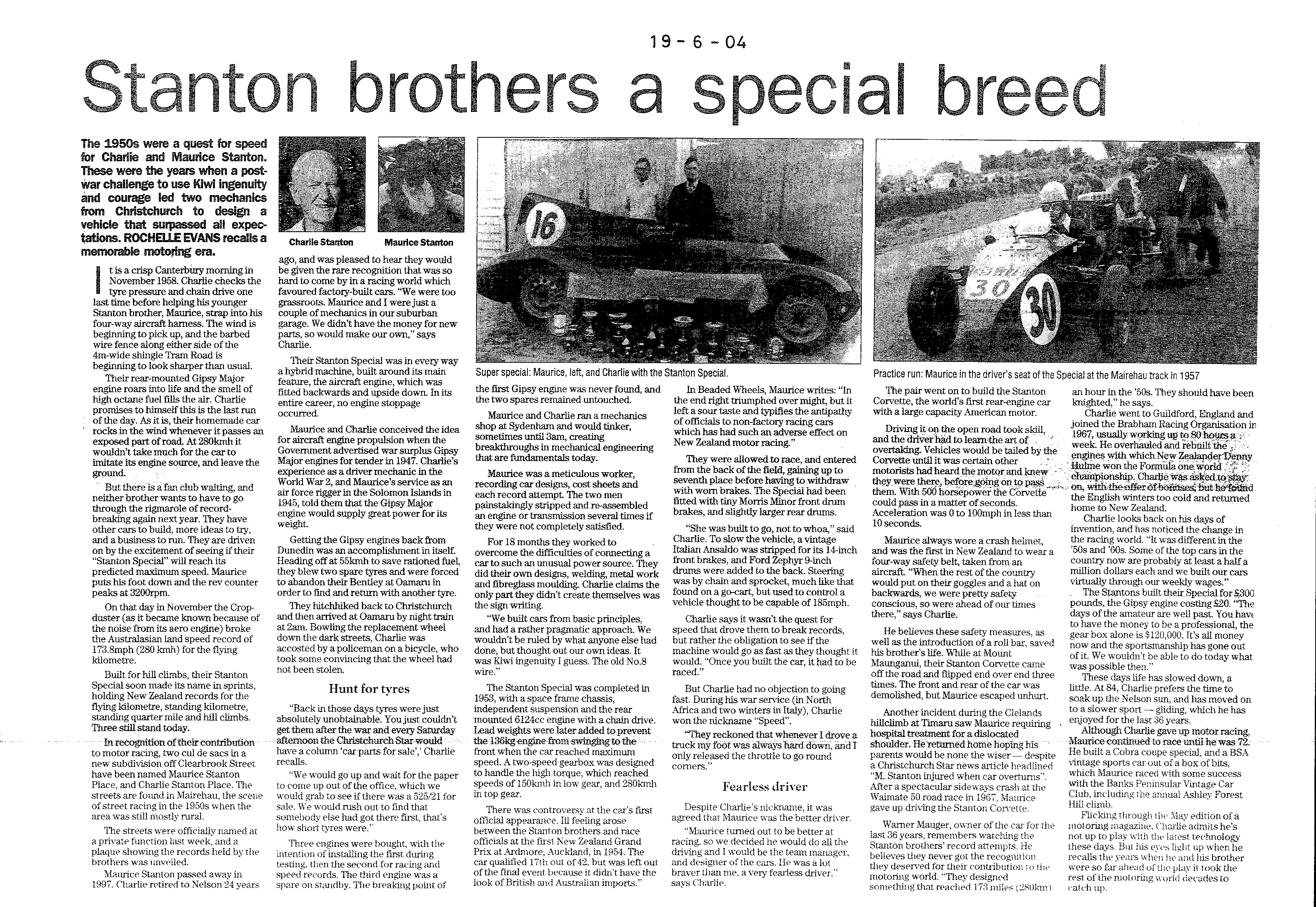
Super special: Maurice, left, and Charlie with the Sta
anton Special
the first Gipsy engine was never found, and
the two spares remained untouched.
Maurice and Charlie ran a mechanics
shop at Sydenham and would tinker,
sometimes until 3am, creating
breakthroughs in mechanical engineering
that are fundamentals today.
Maurice was a meticulous worker,
recording car designs, cost sheets and
each record attempt. The two men
painstakingly stripped and re-assembled
an engine or transmission several times if
they were not completely satisfied.
For 18 months they worked to
overcome the difficulties of connecting a
car to such an unusual power source. They
did their own designs, welding, metal work
and fibreglass moulding. Charlie claims the
only part they didn't create themselves was
the sign writing.
"We built cars from basic principles,
and had a rather pragmatic approach. We
wouldn't be ruled by what anyone else had
done, but thought out our own ideas. It
was Kiwi ingenuity I guess. The old No.8
wire
The Stanton Special was completed in
1953, with a space frame chassis,
independent suspension and the rear
mounted 6124cc en
Lead weights were
the 136kg engine fr
front when the car:
speed. A two-speed
to handle the high t
speeds of 150kmh i
in top gear.
ngine with a chain drive.
later added to prevent
com swinging to the.:
reached maximum
i gearbox was designed
torque, which reached
in low gear, and 280kmh
There was contro
official appearance. I
between the Stanton
officials at the first N
Prix at Ardmore, Auc
car qualified 17th out
of the final event bec
look of British and A
versy at the car's first
Il feeling arose
brothers and race
ew Zealand Grand
kland, in 1954. The
: of 42, but was left out
ause it didn't have the
ustralian imports."
In Beaded Wheels, Maurice writes: "In
the end right triumphed over might, but it
left a sour taste and typifies the antipathy
of officials to non-factory racing cars
which has had such an adverse effect on
New Zealand motor racing."
They were allowed to race, and entered
from the back of the field, gaining up to
seventh place before having to withdraw
with worn brakes. The Speciai had been
fitted with tiny Morris Minor front drum
brakes, and slightly larger rear drums.
"She was built to
Charlie. To slow the
Italian Ansaido was s
front brakes, and FO
drums were added to
go, not to whoa," said
vehicle, a vintage
stripped for its 14 inch
›rd Zephyr 9 inch
o the back. Steering
was by chain and sprocket, much like that
found on a go cart, but used to control a
vehicle thought to be capable of 185mph.
Charlie says it wasn't the quest for
speed that drove them to break records,
but rather the obligation to see if the
machine would go as fast as they thought it
would. "Once you built the car, it had to be
raced."
But Charlie had no objection to going
fast. During his war service (in North
Africa and two winters in Italy), Charlie
won the nickname "Speed"
"They reckoned that whenever I drove a
truck my foot was always hard down, and I
only released the throttle to go round
corners.
Fearless driver
Despite Charlie's nickname, it was
agreed that Maunce was the better dr
"Maurice tured out to be better at
racing, so we decided he would do all
driving and I would be the team mana
and designer of the cars. He was a lot
braver than me, a very feariess driver.
says Charlie.
Practice run: Maurice in the driver's seat of the Special at the Mairehau track in 1957
The pair went on to build the Stanton
Corvette, the world's first rear-engine car
with a large capacity American motor.
Driving it on the open road took skili,
and the driver had to learn the art of
overtaking. Vehicles would be tailed by the
Corvette until it was certain other
motorists had heard the motor and knew
they were there, before going on to pass
them. With 500 horsepower the Corvette
could pass in a matter of seconds.
Acceleration was 0 to 100mph in less than
10 seconds.
Maurice always wore a crash helmet,
and was the first in New Zealand to wear a
four-way safety belt, taken from an
aircraft. "When the rest of the country
would put on their goggles and a hat on
backwards, we were pretty safety
conscious, so were ahead of our times
there," says Charlie.
He believes these s
well as the introductic
his brother's life. Whil
Maunganui, their Stan
off the road and flippe
times. The front and r
demolished, but Maur
safety measures, as
on of a roll bar, saved
le at Mount
ton Corvette came
ed end over end three
ear of the car was
rice escaped unhurt.
Another incident di
hillclimb at Timaru saT
hospital treatment for
shoulder. He retumed
parents would be none
uring the Cielands
w Maurice requiring
a dislocated
home hoping his
e the wiser - despite
a Christchurch Star
"M. Stanton injured
Alter a spectacular
Waimate 00 road rac
gave up driving the s
news article headline
when car overturns".
sideways crash at the
ce in 1967, Maurice
Stanton Corvette.
Warner Mauger,
last 36 years, remen
Stanton brothers' re
believes they never
they deserved for ti
motoring world. "TI
something that reac
owner of the car for
mbers watching the
ecord attempts. He
got the recognition
heir contribution to t
hey designed
ched 173 miles (280k
an hour in the 50s. They should have been
knighted," he says.
Charlie went to Guildford, England and
joined the Brabham Racing Organisation in
1967, usually working up to 80 hours a
week. He overhauled and rebnilt the
engines with which vew zealander Denny
Hutme won the Formula one world. *
championship, Charlie was asked to stay
on, with the offer of boarses, but he fotad
the English winters too cold and returned
home to New Zealand.
Charlie looks back on his days of
invention, and has noticed the change in
the racing world. "It was different in the
'50s and '60s. Some of the top cars in the
country now are probably at least a half a
million dollars each and we built our cars
virtually through our weekly wages."
The Stantons built their Special for $300
pounds, the Gipsy engine costing $20. "The
days of the amateur are well past. You have
to have the money to be a professional, the
gear box alone is $120,000. It's all money
now and the sportsma
of it. We wouldn't be
was possible then."
These days life has
little. At 84, Charlie pr
soak up the Nelson su
unship has gone out
ble to do today what
slowed down, a
reters the time to
in, and has moved on
to a slower sport enjoyed for the last:
Although Charlie
Maurice continued t
He built a Cobra cou
vintage sports car ou
which Maurice racer
with the Banks Penit
Club, including the a
Hill climb.
Flicking through t
motoring magazine.
not up to play with ti
these days. But his e
recalls the vears whe
were so far ahead of
rest of the motoring
catch up.
gliding, which he has
36 years.
gave up motor racing.
o race until he was 12.
ipe special, and a BSA
ut of a box of bits,
a with some success
nsular Vintage Car
annual Ashley Forest
he May edition of a
Charlie admits he's
it larest technology
ves light up when he
en he and his brother
the play it took the
world decades to
Summaries and tables are machine-read from the scan and may contain errors: the scan is the record.