Wigram TrophyMotor racing at Wigram airfield · Christchurch · 1949–2000
Home › Archive › 1998 › Long history of flying at Wigram
← May 1998All 1998 pages18 Aug 1998 →
Scan of the clipping page, 31 July 1998
↗
Drag to move · scroll or pinch to zoom
feature

Long history of flying at Wigram

Local history of how the Wigram airbase at Sockburn began: in August 1916 Henry Wigram called for a flying school in Canterbury, 40 hectares were bought next to Plumpton Park, and by December 1916 40 pupils had enrolled with the Canterbury Aviation Company. In 1921 he offered the Government a 10,000 pound gift to take over the field, accepted in April 1923, and on 14 May 1923 it was christened Wigram Aerodrome.

Facts

  • Wigram Aerodrome was christened on 14 May 1923 after Henry Wigram's offer to the Government was accepted.
  • The first pupils moved on to the base in June 1917 and 32 graduated in February 1918.

Photos

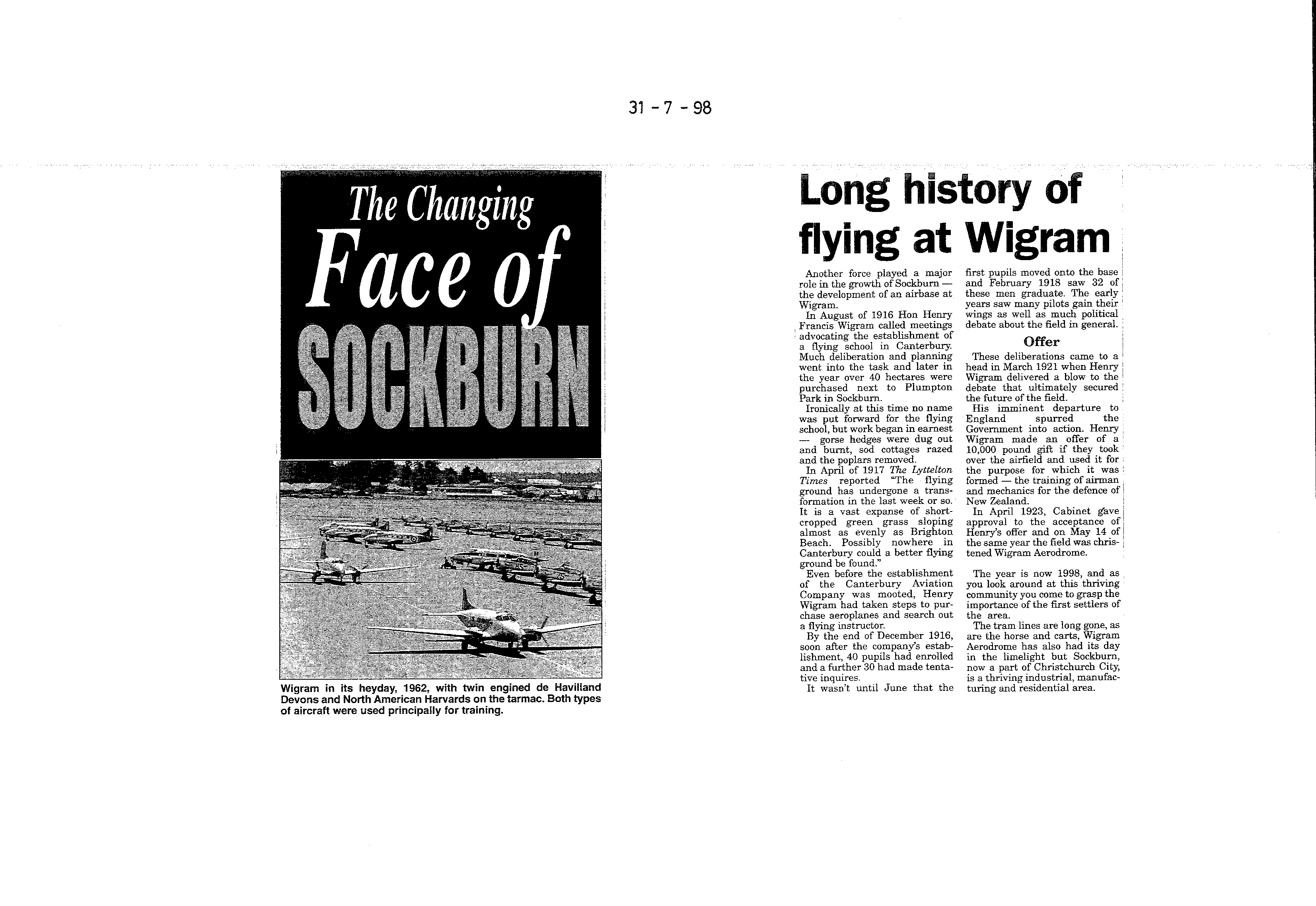
  • Wigram in its heyday, 1962, with twin engined de Havilland Devons and North American Harvards on the tarmac.
Read the OCR text
31-7-98 The Fa SOC Changing ce of Wigram in its heyday, 1962, with twin engined de Havilland Devons and North American Harvards on the tarmac. Both types of aircraft were used principally for training. Long history of flying at Wigram Another force played a major role in the growth of Sockburn the development of an airbase at Wigram. In August of 1916 Hon Henry Francis Wigram called meetings advocating the establishment of a flying school in Canterbury. Much deliberation and planning went into the task and later in the year over 40 hectares were purchased next to Plumpton Park in Sockburn. Ironically at this time no name was put forward for the flying school, but work began in earnest - gorse hedges were dug out and burnt, sod cottages razed and the poplars removed. In April of 1917 The Lyttelton Times reported "The flying ground has undergone a transformation in the last week or so. It is a vast expanse of shortcropped green grass sloping almost as evenly as Brighton Beach. Possibly nowhere Canterbury could a better flying ground be found." Even before the establishment of the Canterbury Aviation Company was mooted, Henry Wigram had taken steps to purchase aeroplanes and search out a flying instructor. By the end of December 1916, soon after the company's establishment, 40 pupils had enrolled and a further 30 had made tentative inquires. It wasn't until June that the first pupils moved onto the base and February 1918 saw 32 of these men graduate. The early years saw many pilots gain their wings as well as much political debate about the field in general. Offer These deliberations came to a head in March 1921 when Henry Wigram delivered a blow to the debate that ultimately secured the future of the field. His imminent departure to England spurred the Government into action. Henry Wigram made an offer of a 10,000 pound gift if they • took over the airfield and used it for the purpose for which it was formed — the training of airman and mechanics for the defence of New Zealand. In April 1923, Cabinet gave approval to the acceptance of Henry's offer and on May 14 of the same year the field was christened Wigram Aerodrome. The year is now 1998, and as you look around at this thriving community you come to grasp the importance of the first settlers of the area. The tram lines are long gone, as are the horse and carts, Wigram Aerodrome has also had its day in the limelight but Sockburn, now a part of Christchurch City, is a thriving industrial, manufacturing and residential area.

Summaries and tables are machine-read from the scan and may contain errors: the scan is the record.