Wigram TrophyMotor racing at Wigram airfield · Christchurch · 1949–2000
Home › Archive › 1995 › Base to close in style
← 27 Jul 1995All 1995 pages25 Jul 1997 →
Scan of the clipping page, 9 August 1995
↗
Drag to move · scroll or pinch to zoom
news · Nick Tolerton

Base to close in style

Wigram's closure after nearly 60 years as an air force base will be marked by a service at Christchurch Cathedral on 10 September, and on 14 September a parade reviewed by the Chief of Air Staff and a ball for 2500 people. The article recalls Sir Henry Wigram forming the Canterbury Aviation Co in 1916 at Sockburn, the 182 pilots trained during the war, and the airfield's role as the RNZAF's flying and technical training base.

Facts

  • Sir Henry Wigram donated 81 acres for an airfield extension in 1931.
  • 182 pilots passed through the Canterbury Aviation Co school during the First World War.

Photos

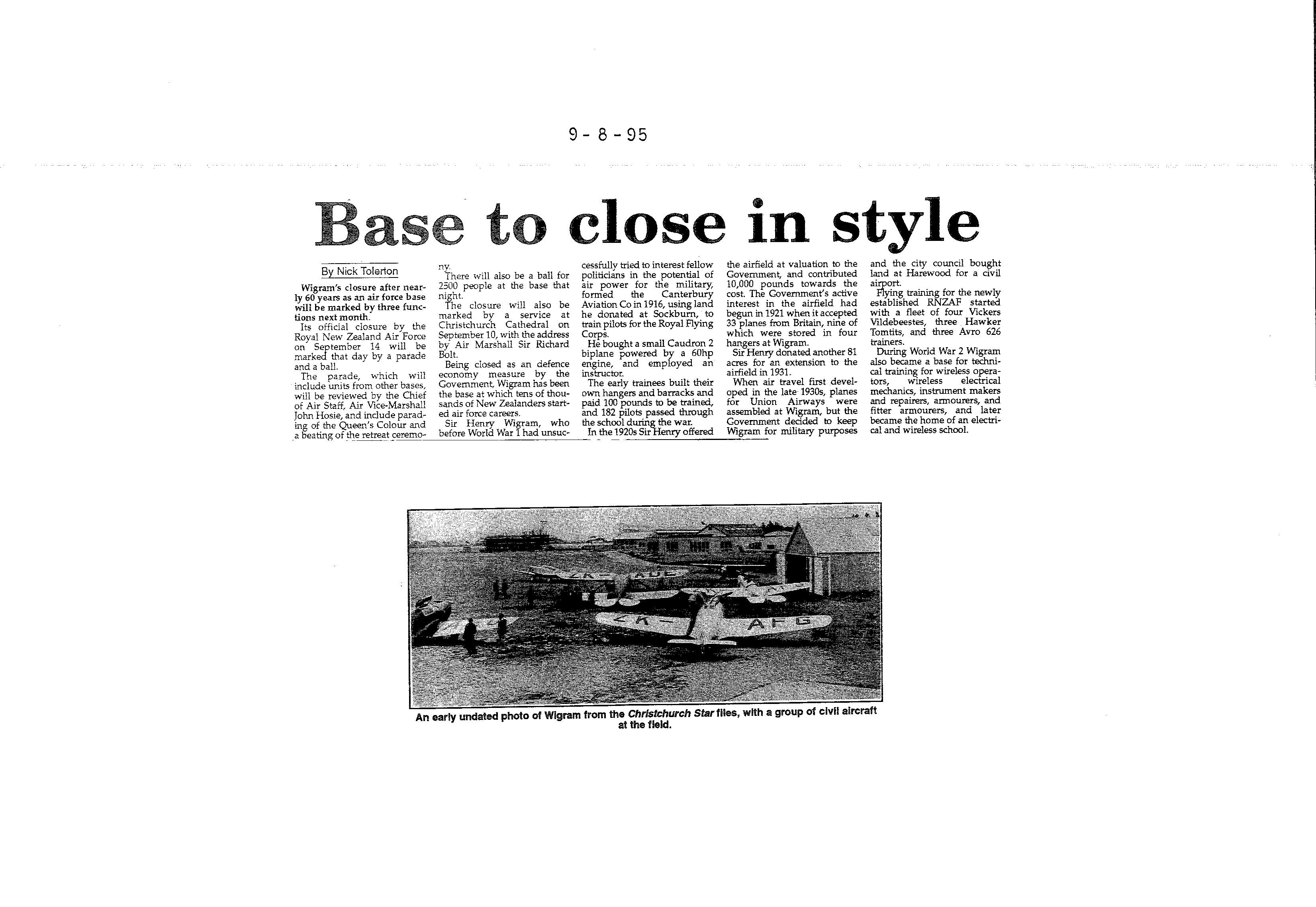
  • An early undated photo of Wigram from the Christchurch Star files, with a group of civil aircraft at the field.
Read the OCR text
9-8-95 Bas By Nick Tolerion Wigram's closure after nearly 60 years as an air force base will be marked by three functions next month. Its official closure by the Royal New Zealand Air Force September 14 will . be marked that day by a parade and a ball. The parade, which will include units from other bases, will be reviewed by the Chief of Air Staff, Air Vice-Marshall John Hosie, and include parading of the Queen's Colour and a beating of the retreat ceremo e to close in s ny. There will also be a ball for 2500 people at the base that night. The closure will also be marked by a service at Christchurch Cathedral on September 10, with the address by Air Marshall Sir Richard Bolt. Being closed as an defence economy measure by the Government, Wigram has been the base at which tens of thousands of New Zealanders started air force careers. Sit tienry Wigram, who before World War 1 had unsuc- cessfully tried to interest fellow politicians in the potential of air power for the military, formed the Canterbury Aviation Co in 1916, using land he donated at Sockburn, to train pilots for the Royal Flying Corps. He bought a small Caudron 2 biplane powered by a bunp engine, and employed an instructor. The early trainees built their own hangers and barracks and paid 100 pounds to be trained, and 182 pilots passed through the school during the war. In the 1920s Sir Henry offered the airfield at valuation to the Government, and contributed 10,000 pounds towards the cost. The Government's active interest in the airfield had begun in 1921 when it accepted 33 planes from Britain, nine of which were stored in four hangers at Wigram. Sir Henry donated another 81 acres for an extension to the airfield in 1931. When air travel first developed in the late 1930s, planes for Union Airways were assembled at Wigram, but the Government decided to keep Wigram for military purposes tyle and the_city council bought land at Harewood for a civil airport. Flying training for the newly established RNZAF started with a fleet of four Vickers Vildebeestes, three Hawker Tomtits, and three Avro 626 trainers. During World War 2 Wigram also became a base for technical training for wireless operatOTS, wireless electrical mechanics, instrument makers and repairers, armourers later fitter armourers, and became the home of an electrical and wireless school. ARL An early undated photo of Wigram from the Christchurch Star files, with a group of civil aircraft at the field.

Summaries and tables are machine-read from the scan and may contain errors: the scan is the record.