feature · Lindsay KerrWigram back but for how long?
After 43 years, the annual Wigram meeting is threatened by the Government's plan to close the air base to flying. The 1992 meeting, back after two years at Ruapuna, drew about 3000 on Sunday against a Lancaster Park cricket test but the Lady Wigram Trophy still attracted 10,000. Harry Nuttall, here to learn, said Wigram was the fastest he had driven; Julian Westwood finished just 0.36sec behind winner Craig Baird.
Facts
- The 1992 Lady Wigram Trophy was won by Craig Baird, with Julian Westwood only 0.36sec behind.
- The 1992 Wigram meeting returned after a two-year stint at Ruapuna while the runways were resealed.
- Sunday crowd at the 1992 Wigram meeting was around 3000, competing with a cricket test at Lancaster Park, but the Lady Wigram Trophy race attracted 10,000.
- Winners of the Lady Wigram Trophy have included Jack Brabham, Jackie Stewart, Jimmy Clark, Bruce McLaren and Graham Hill, with Stirling Moss and Denny Hulme runners-up.
Photos
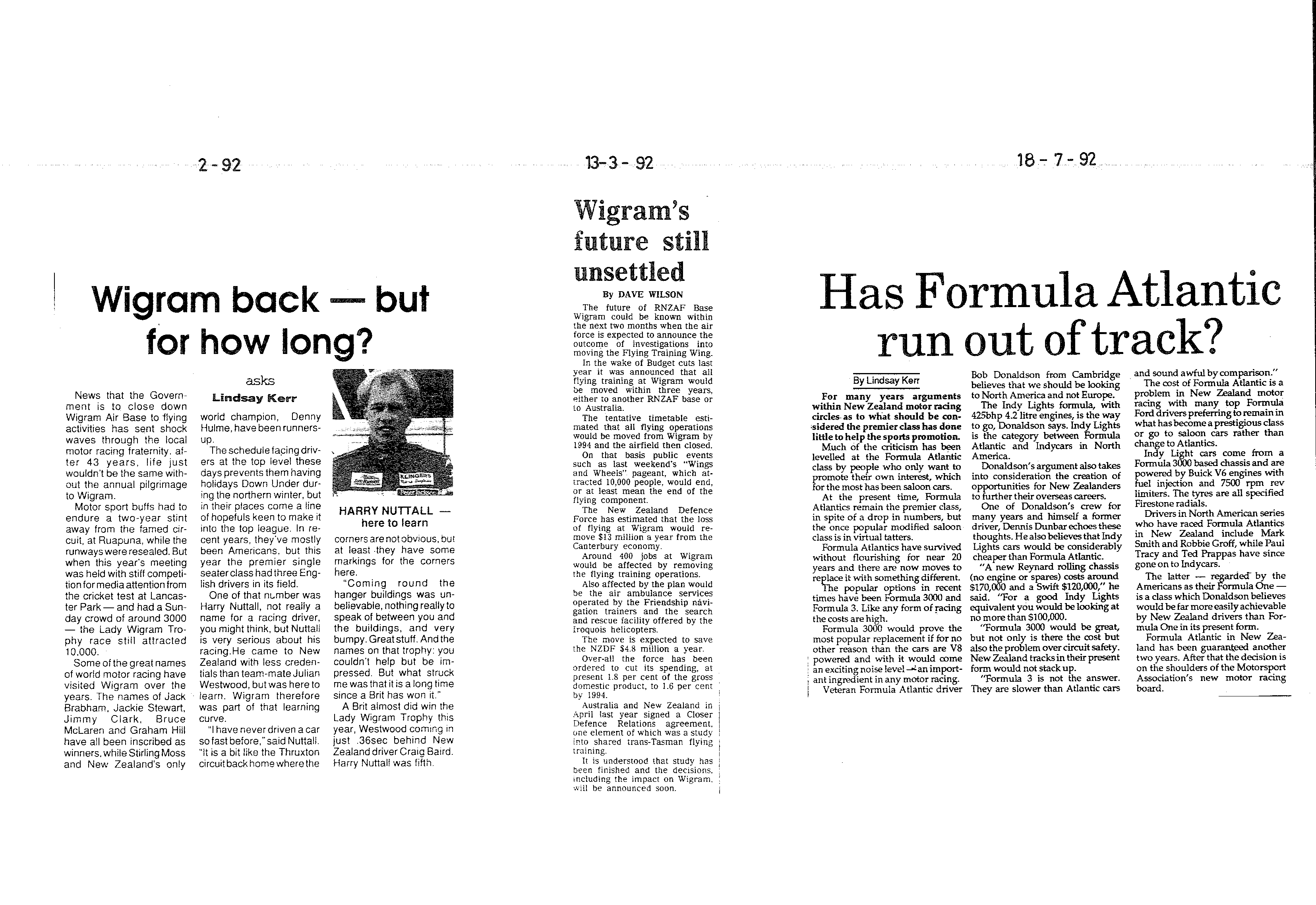
- Harry Nuttall, here to learn
news · Dave WilsonWigram's future still unsettled
The future of RNZAF Base Wigram could be known within two months. After Budget cuts all flying training at Wigram was to be moved within three years, with flying operations expected to leave by 1994 and the airfield closed, ending events like the Wings and Wheels pageant that drew 10,000. The move is estimated to remove $13 million a year from the Canterbury economy and save the NZDF $4.8 million a year.
Facts
- The RNZAF planned to move all flying from Wigram by 1994, after which the airfield would close; about 400 jobs were affected.
- The 'Wings and Wheels' pageant at Wigram in January 1992 attracted 10,000 people.
feature · Lindsay KerrHas Formula Atlantic run out of track?
Lindsay Kerr discusses calls to replace Formula Atlantic as New Zealand's premier racing class, with Formula 3000, Formula 3 and Indy Lights as options. Bob Donaldson and Dennis Dunbar favour Indy Lights, which they say would cost under $100,000 against $170,000 for a new Reynard or $120,000 for a Swift. Formula Atlantic was guaranteed two more years before the Motorsport Association's new racing board decides.
Facts
- In 1992 a new Reynard Formula Atlantic rolling chassis cost about $170,000 and a Swift about $120,000.
- Formula Atlantic in New Zealand was guaranteed another two years as of 1992.
- Indy Lights cars of the era used Buick V6 engines, about 425bhp, with 7500rpm rev limiters and Firestone radials.
Read the OCR text
2-92 13-3-92 18-7-92
Wigram's
future still
Wigram back but
for how long?
News that the Government is to close down
Wigram Air Base to flying
activities has sent shock
waves through the local
motor racing fraternity. after 43 years, life just
wouldn't be the same without the annual pilgrimage
to Wigram.
Motor sport buffs had to
endure a two-year stint
away from the famed circuit, at Ruapuna, while the
runways were resealed. But
when this year's meeting
was neid with stiff competition for media attention from
the cricket test at Lancaster Park - and had a Sunday crowd of around 3000
- the Lady Wigram Trophy race still attracted
10.000.
Some of the great names
of world motor racing have
visited Wigram over the
years. The names of Jack
Brabham, Jackie Stewart,
Jimmy Clark, Bruce
McLaren and Graham Hill
have all been inscribed as
winners. while Stirling Moss
and New Zealand's only
asks
Lindsay Kerr
world champion, Denny
Hulme, have been runners-
up.
The schedule facing drivers at the top level these
days prevents them having
holidays Down Under during the northern winter, but
in their places come a line
of hopefuls keen to make it
into the top league. In recent years, they've mostly
been Americans, but this
year the premier single
seater class had three English drivers in its field.
One of that number was
Harry Nuttall, not really a
name for a racing driver
you might think, but Nuttal!
is very serious about his
racing.He came to New
Zealand with less credentials than team-mate Julian
Westwood, but was here to
learn. Wigram therefore
was part of that learning
curve.
"I have never driven a car
so fast before," said Nuttall.
"It is a bit like the Thruxton
circuit back home where the
HARRY NUTTALL
here to learn
corners are not obvious, but
at least they have some
markings for the corners
here.
"Coming round the
hanger buildings was unbelievable, nothing really to
speak of between you and
the buildings, and very
bumpy. Great stuff. Andthe
names on that trophy: you
couldn't help but be impressed. But what struck
me was that it is a long time
since a Brit has won it."
A Brit almost did win the
Lady Wigram Trophy this
year, Westwood coming in
just .36sec behind New
Zealand driver Craig Baird.
Harry Nuttall was fifth.
unsettled
By DAVE WILSON
The future of RNZAF Base
Wigram could be known within
the next two months when the air
force is expected to announce the
outcome of investigations into
moving the Flying Training Wing.
In the wake of Budget cuts last
year it was announced that all
flying training at Wigram would
be moved within three years,
either to another RNZAF base or
10 Australia.
The tentative timetable estimated that all flying operations
would be moved from Wigram by
1994 and the airfield then closed.
On that basis public events
such as last weekend's "Wings
and Wheels" pageant, which attracted 10,000 people, would end,
or at least mean the end of the
flying component.
The New Zealand Defence
Force has estimated that the loss
of flying at Wigram would remove $13 million a year from the
Canterbury economy.
Around 400 jobs at Wigram
would be affected by removing
the flying training operations.
Also affected by the plan would
be the air ambulance services
operated by the Friendship navigation trainers and the search
and rescue facility offered by the
Iroquois helicopters.
The move is expected to save
the NZDF $4.8 million a year.
Over-all the force has been
ordered to cut its spending, at
present 1.8 per cent of the gross
domestic product, to 1.6 per cent
by 1994.
Australia and New Zealand in
April last year signed a Closer
Defence Relations agreement,
one element of which was a study
into shared trans-Tasman flying
training.
It is understood that study has
been finished and the decisions.
including the impact on Wigram.
will be announced soon.
Has Formula Atlantic
run out of track?
By Lindsay Kerr
For many years arguments
within New Zealand motor racing
circles as to what should be considered the premier class has done
little to help the sports promotion.
Much of the criticism has been
levelled at the Formula Atlantic
class by people who only want to
promote their own interest, which
for the most has been saloon cars.
At the present time, formula
Atlantics remain the premier class,
in spite of a drop in numbers, but
the once popular modified saloon
class is in virtual tatters.
Formula Atlantics have survived
without flourishing for near 20
years and there are now moves to
replace it with something ditterent.
The popular options in recent
times have been Formula 3000 and
Formula 3. Like any form of racing
the costs are high.
Formula 3000 would prove the
most popular replacement if for no
other reason than the cars are V8
powered and with it would come
an exciting noise level * an important ingredient in any motor racing.
Veteran Formula Atlantic driver
Bob Donaldson from Cambridge
believes that we should be looking
to North America and not Europe.
The Indy Lights formula, with
425bhp 4.2 litre engines, is the way
to go, Donaldson says. Indy Lights
is the category between Formula
Atlantic and Indycars in North
America.
Donaldson's argument also takes
into consideration the creation of
opportunities for New Zealanders
to further their overseas careers.
One of Donaldson's crew for
many years and himself a former
driver, Dennis Dunbar echoes these
thoughts. He also believes that Indy
Lights cars would be considerably
cheaper than Formula Atlantic.
"A' new Reynard rolling chassis
(no engine or spares) costs around
$170,000 and a Swift $120,000," he
said. "For a good Indy Lights
equivalent you would be looking at
no more than $100,000.
"Formula 3000 woula be great,
but not only is there the cost but
also the problem over circuit safety.
New Zealand tracks in their present
form would not stack up.
"Formula 3 is not the answer.
They are slower than Atlantic cars
and sound awful by comparison."
The cost of Formula Atlantic is a
problem in New Zealand motor
racing with many top formula
Ford drivers preferring to remain in
what has become a prestigious class
or go to saloon cars rather than
change to Atlantics.
Indy Light cars come from a
Formula 3000 based chassis and are
powered by Buick V6 engines with
fuel injection and 7500 pm rev
limiters. The tyres are all specified
Firestone radials.
Drivers in North American series
who have raced Formula Atlantics
in New Zealand include Mark
Smith and Robbie Groff, while Paul
Tracy and Ted Prappas have since
gone on to Indycars.
The latter - regarded by the
Americans as their Formula One —
is a class which Donaldson believes
would be far more easily achievable
by New Zealand drivers than formula One in its present form.
Formula Atlantic in New Zealand has been guaranteed another
two years. After that the decision is
on the shoulders of the Motorsport
Association's new motor racing
board.
Summaries and tables are machine-read from the scan and may contain errors: the scan is the record.