Wigram TrophyMotor racing at Wigram airfield · Christchurch · 1949–2000
Home › Archive › 1989 › Wigram celebrates 40th anniversary
← 27 Jan 1989All 1989 pages28 Jan 1989 →
Scan of the clipping page, 27 January 1989
↗
Drag to move · scroll or pinch to zoom
feature · The Press · Lindsay Kerr

Wigram celebrates 40th anniversary

History of the Lady Wigram Trophy marking the 40th anniversary of the first meeting in 1949, won by Morrie Proctor in a Riley Nine. Covers the 1950s and 1960s visits by Whitehead, Flockhart, Brabham, Clark, Stewart, Rindt and others, the Formula 5000 era dominated by Graham McRae, and the Formula Pacific era whose drivers included Rosberg, Sullivan, Rahal and Moreno.

Facts

  • The first Lady Wigram Trophy race was held in 1949 and won by Morrie Proctor in a Riley Nine; the Motor Racing Club has organised the meeting annually since 1951.
  • In 1989 the Wigram meeting was described as the only international motor racing meeting still held on an operational airfield, on the RNZAF base.
  • Graham McRae won the Lady Wigram Trophy four times, the most victories to that date.
  • The final Formula 5000 Lady Wigram race in 1976 was won by Ken Smith; Formula Pacific with 1600cc Ford BDA engines then replaced it.
  • Keke Rosberg was second at Wigram in 1977 and 1978 but never won.
  • Jeff McPherson won the Lady Wigram Trophy in 1986.

Photos

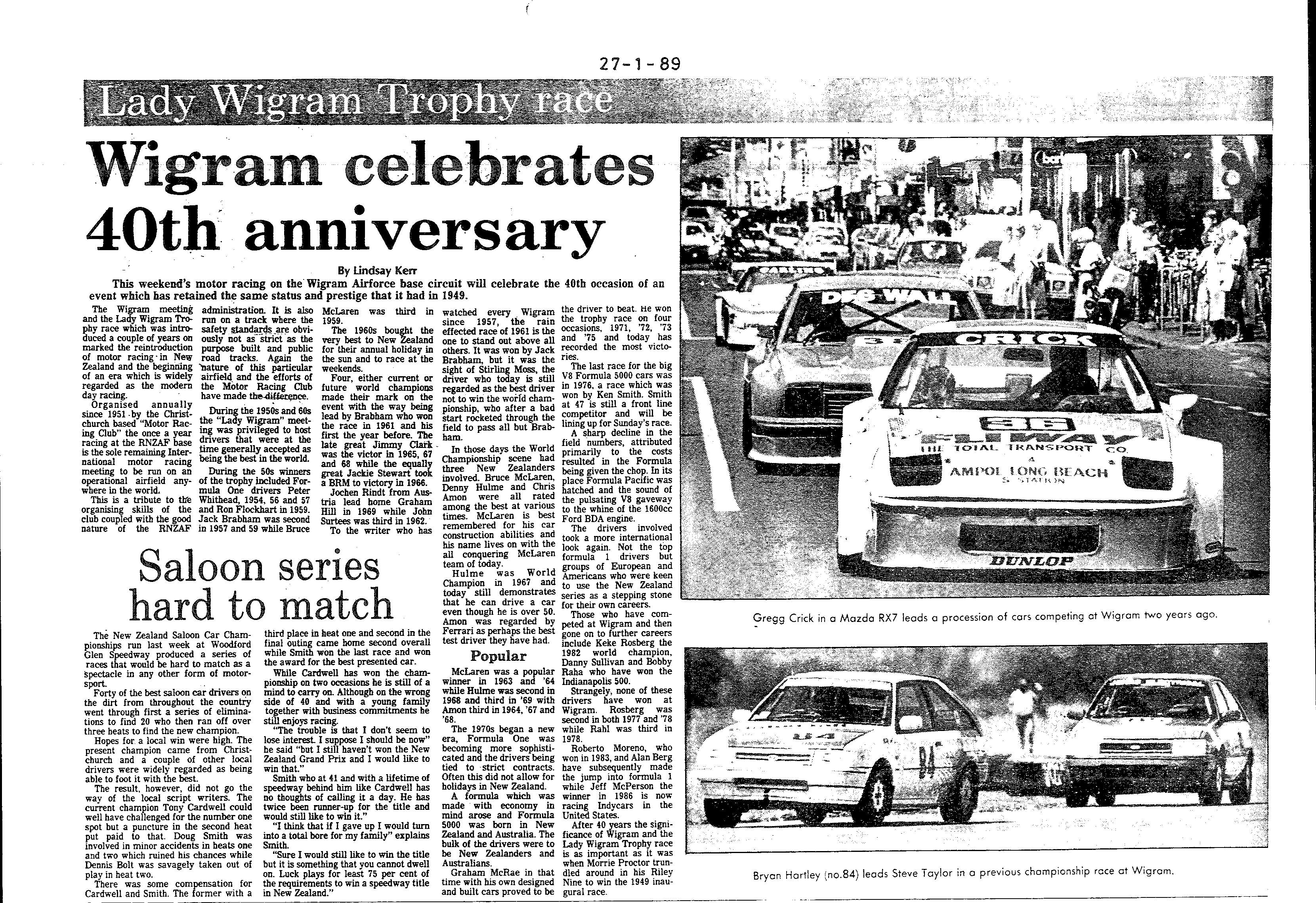
  • Gregg Crick in a Mazda RX7 leads a procession of cars competing at Wigram two years ago.
  • Bryan Hartley (no. 84) leads Steve Taylor in a previous championship race at Wigram.
race report · The Press

Saloon series hard to match

Report on the New Zealand Saloon Car (speedway) Championships at Woodford Glen Speedway: 40 drivers were whittled to 20 who raced three heats. Defending champion Tony Cardwell of Christchurch was second overall after a puncture in heat two, while Doug Smith won the final heat and best-presented car award.

Facts

  • Forty drivers contested eliminations at the NZ Saloon Car Championships at Woodford Glen, with 20 going through to three heats.
Read the OCR text
27-9-89 Lady Wigram Trophy race Wigr am celebrates 40th annive This weekend's event which has reta The Wigram meeting and the Lady Wigram Tropay race which was intro duced a couple of years on marked the reintroduction of motor racing in New Zealand and the beginning of an era which is widely regarded as the modern day racing. Organised annually since 1951 by the Christchurch based "Motor Rac ing Club" the once a vear racing at the RNZAF base is the sole remaining International motor racing meeting to be run on an operational airfield anywhere in the world. This is a tribute to the organising skills of the club coupled with the good nature of the RNZAF By Lindsay Kerr motor racing on the Wigram Airforce base cir ined the same status and prestige that it had in administration. It is also run on a track where the satety standards are obviously not as strict as the purpose bullt and public road tracks. Again the nature of this particular airfield and the efforts of the Motor Racing Club have made the difference. During the 1950s and 60s the "Lady Wigram" meeting was privileged to host drivers that were at the time generally accepted as being the best in the world. During the 50s winners of the trophy included Formula One drivers Peter Whithead, 1954, 56 and 57 and Ron Flockhart in 1959. Jack Brabham was second in 1957 and 59 while Bruce McLaren was third in 1959. The 1960s bought the very best to New Zealand for their annual holiday in the sun and to race at the weekends. Four, either current or future world champions made their mark on the event with the way being lead by Brabham who won the race in 1961 and his first the year before. The late great Jimmy •Clark was the victor in 1965, 67 and bo whue the equally great Jackie Stewart t00k a BRM to victory in 1966. Jochen Rindt from Austria lead home : Graham Hill in 1969 while John Surtees was third in 1962. To the writer who has Saloon hard to series match The New Zealand Saloon Car Championships run last week at Woodford Glen Speedway produced a series of races that would be hard to match as a spectacle in any other form of motorsport. Forty of the best saloon car drivers on the dirt from throughout the country went through first a series of eliminations to find 20 who then ran off over three heats to find the new champion. Hopes for a local win were high. The present champion came from Christchurch and a couple of other local drivers were widely regarded as being able to foot it with the best. The result, however, did not go the way of the local script writers. The current champion Tony Cardwell could well have challenged for the number one spot but a puncture in the second heat put paid to that. Doug Smith was involved in minor accidents in beats one and two which ruined his chances while Dennis Bolt was savagely taken out of play in heat two. There was some compensation for Cardwell and Smith. The former with a third place in heat one and second in the final outing came home second overall while Smith won the last race and won the award for the best presented car. While Cardwell has won the championship on two occasions he is still of a mind to carry on. Although on the wrong side of 40 and with a young family together with business commitments ne still enjoys racing 'The trouble is that I don't seem to lose interest I suppose i should be now" he said "but I still haven't won the New Zealand Grand Prix and I would like to win that." Smith who at 41 and with a lifetime of speedway behind him like Cardwell has no thoughts of calling it a day. He has twice been runner-up for the title and would still like to win it." "I think that if I gave up I would turn into a total bore for my family" explains Smith. "Sure I would still like to win the title but it is something that you cannot dwell on. Luck plays for least 75 per cent of the requirements to win a speedway title in New Zealand." rsary reuit will celebrate the 40th occasion of an 1949. watched every Wigram since 1957, the rain effected race of 1961 is the one to stand out above all others. It was won by Jack Brabham, but it was the sight of Stirling Moss, the driver woo today is still regarded as the best driver not to win the world championship, who after a bad start rocketed through the field to pass all but Brabhara. In those days the World Championship scene had three Zealanders involved. Bruce McLaren, Denny Hulme and Chris Amon were all rated among the best at various times. McLaren is best remembered for his car construction abilities and his name lives on with the all conquering McLaren team of today. Huime was World Champion in 1967 and today still demonstrates that be can drive a car even though he is over 50. Amon was regarded by Ferrari as perhaps the best test driver they have had. Popular Mclaren was a popular winner in 1963 and '64 while Hulme was second in 1968 and third in '69 with Amon third in 1964, '67 and '68. The 1970s began a new era, Formula One becoming more sophisticated and the drivers being tied to strict contracts. Often this did not allow for holidays in New Zealand. A formula which was made with economy in mind arose and Formula 5000 was born in New Zealand and Australia. The bulk of the drivers were to be New Zealanders and Australians. Graham McRae in that time with his own designed and built cars proved to be the driver to beat. He won the trophy race on four occasions, 19/1, '72, and "75 and today has recorded the most victories. The last race for the big V8 Formula 5000 cars was in 1976, a race which was won by Ken Smith. Smith at 47 is still a front line competitor and will be lining up for Sunday's race. A sharp decline in the field numbers, attributed primarily the costs resulted in the Formula being given the chop. in its place Formula Pacific was hatched and the sound of the pulsating V8 gaveway to the whine of the 1600cc Ford BDA engine. The drivers involved took a more international look again. Not the top formula 1 drivers but groups of European and Americans who were keen to use the New Zealand series as a stepping stone for their own careers. Those who have competed at Wigram and then gone on to further careers include Keke Rosberg the 1982 world champion, Danny Sullivan and Bobby Raha who have won the Indianapolis 500. Strangely, none of these drivers have won at Wigram. Rosberg was second in both 1977 and '78 while Rahl was third in 1978 Roberto Moreno, who won in 1983, and Alan Berg have subsequently made the jump into formula 1 while Jeff McPerson the winner in 1986 is now racing indycars in the United States. After 40 years the significance of Wigram and the Lady Wigram Trophy race is as important as it was when Morrie Proctor trundled around in his Riley Nine to win the 1949 inaugural race. bar kazrcr 6 13İ: IMOJSNUXE IVIOL AMPOL IONG BEACH вс xx*!*. DUvIdE Gregg Crick in a Mazda RX7 leads a procession of cars competing at Wigram two years ago Bryan Hartley (no.84) leads Steve Taylor in a previous championship race at Wigra

Summaries and tables are machine-read from the scan and may contain errors: the scan is the record.