Read the OCR text
Ja
n.81
lar:
a man
By Neil Clarkson
Ray Archibald's comeb
years' retirement was not
undisputed successs.
It was 1974 and Mr Archibald, then
52, could not resist the lure of the
Irack.
It had been 10 years since he raced
o a strine of successes driving
Jaguars.
But it was a Chevrolet Camaro,
not a Jaguar. he drove for his
comeback.
"They had a serles of races at
Ruapuna, " says Mr Archibald, who
retires this month after 40 years in
the motor trade.
"They had six races in 1974 and I
won all six. Then I retired again."
Mr John Fairhall, now the managing director of Archibalds, was
behind his return to the track.
Mr Fairhall, then the used car
sales manager, took the Camaro as a
trade-in.
"He suggested I drive it because it
was a very suitable car. The used car
department sponsored me and I
drove their car.
"Il was quite a successful partnership.
JAGUAR
"It surprised the younger ones that
an older man could still perform. It
didn't seem to make any difference
that I was 52.
00 "In fact one doesn't really lose
1 one's touch all that much, provided
you're physically fit.
грохоте "I think perhaps as we get older
we lose our ability to keep concentrating for long periods and of course
concentration is very important in
motor racing.
"I would now find it difficult to
keep concentrating for the longdistance motor racing!"
Mr Archibald, born in Christchurch and educated at Christ's
College, did not become involved in
his father's business until after
World War 2.
His father started off as an engineer,
mechanic and sales manager.
The garage was without an agency
for any new car - "we sold a few
secondhand cars, none worth more
than about 25 quid," Mr Archibald
recalls.
he was selling venicles such as
Model T Fords, Clevelands, Briscoes,
Elkharts and Clynos.
"There were lots of older makes in
those days that have disappeared."
Archibalds moved to its present
Oxford Tee site in 1920, taking over a
building previously a livery stable
where patrons from the then neighbouring Royal Hotel could leave
their horses.
The first agency was Oldsmobile,
gained in 1927. It was held until 1940
when World War 2 stopped car
imports.
JAGUAR
The Citroen agency, which the
firm still holds, was picked up in
1935 when the first front wheel-drive
models of the french car came on
the scene.
Mr Archibald recalls his father
having a gas-producer fitted to a
Citroen Light 15 because of the
petrol scarcity during the war years.
The gas produced by the coke and
coal-burning unit was far from pure
and cars would not run unless the
engine speed was kept up.
"You had to keep them going at a
fairly good speed."
In 1943 his father began a trip
from Blenheim to Christchurch and
not wishing to stall the engine, was
keeping up a good pace.
Just south of Kaikoura he missed a
turn and hit a rock wall - "one
written off Light 15.
"They were very Cheap cars in
chose days - 380 pounds for a new
one."
Mr Archibald and his two brothers,
Noel and lan; entered their father's
ack to car racing after 10
table for its brevity and
business about the same time. Their
father retired about a year later.
In the late 1940s they picked up
the Jowett agency, allowing them to
sell the commercial Bradford version and the Jowett Javelin.
"There was always a great shortage of cars in those days because
the import licensing regulations
were so tight. The Government didn't
stan very big import licences
because the balance or payments
situation was difficult.
"We started off with a staff of
about a dozen people. We expanded
to around 30 and now our staff is
between 40 and 45."
Archibalds now has the agencies
for Honda, Alfa Romeo, BMW,
Porsche, Audi, Citroen and Jaguar.
Mr Archibald became interested in
car racing about 1946.
"My brothers and I were all quite
keen. We used to take part
hillelimbs on Kennedy's Bush Rd."
In 195% he bought a near-new
in I2 aguar and in 1955 raced the
Mairehau circuit. In those days the
ared was not built-up and public
roads were closed for the event.
The Mairehau race was oniy run
two or three years, the last being the
year he won it.
His first major race was the 1954
New Zealand Grand Prix at Ardmore, Auckland, in which he entered
the same Jaguar.
"I got a second in the sports cal
race and had to retire in the main
race with a hole in the radiator," he
recalls.
The same year he finished sixth or
seventh in the wady Wigram Trophy
nace, an event contested by a lot of
single-seaters.
He also raced in the Dunedin
round-the-wharves race, finishing
about fourth, and at Teretonga,
Invercargill.
JAGUAR
In 1959 Mr Archibald got a 3.4litre Jaguar saloon and was unbeaten
in races at Ardmore and Wigram.
A year later he acquired a new 3.8litre Jaguar saloon and in the 1960-
61 season won at Ardmore, Wigram,
Teretonga, Dunedin and Waimate all the races then available for him
to enter.
But the best achievements were
yet to come.
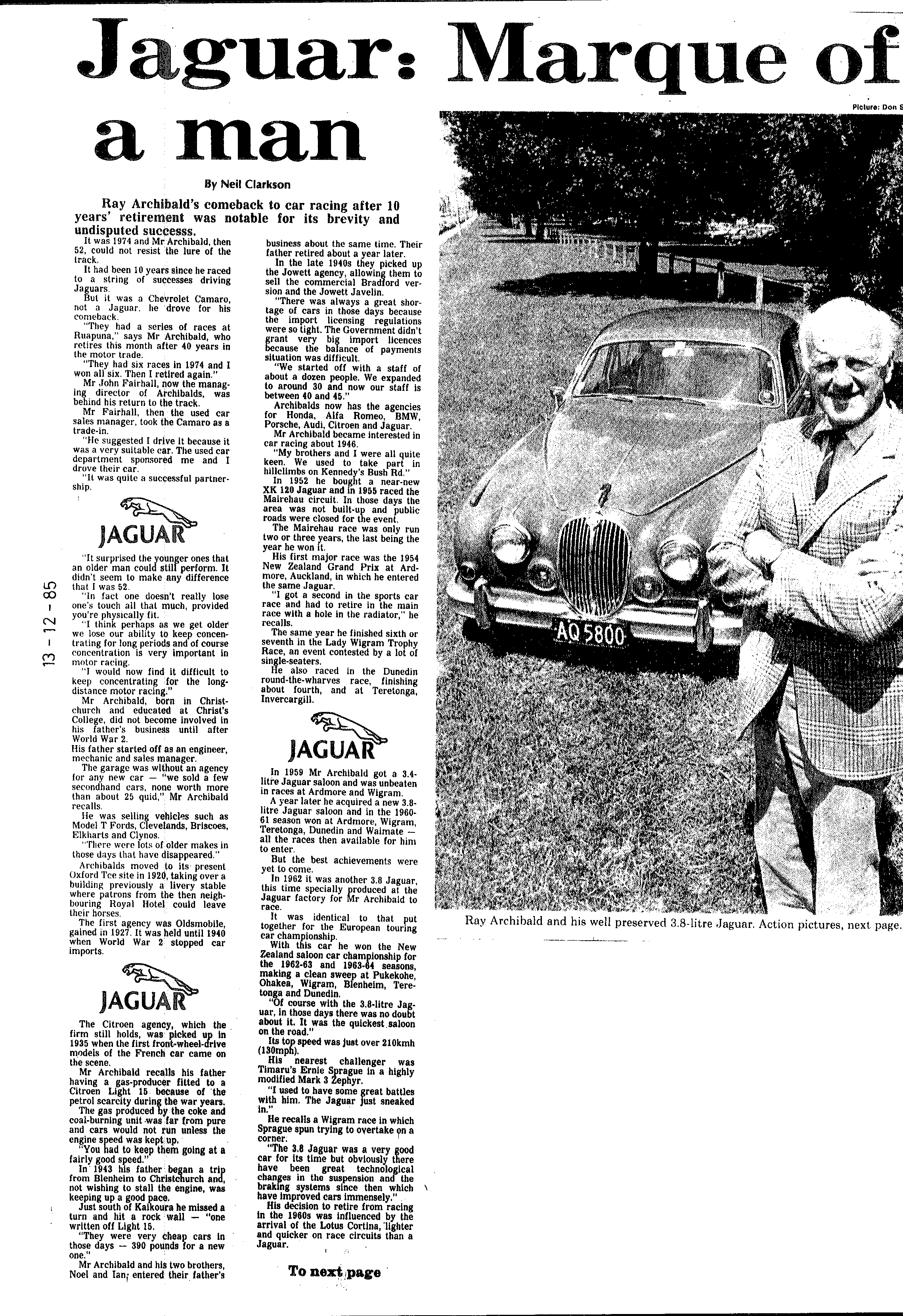
In 1962 it was another 3.8 Jaguar,
lis time specially produced at the
vaguar lactory for Mr Archibald to
race.
It was identical to that put
together for the European touring
car championship.
With this car he won the New
Zealand saloon car championship for
the 1962-63 and 1963-64 seasons,
making a clean sweep at Pukekohe,
Ohakea, Wigram, Blenheim, Teretonga and Dunedin.
"Of course with the 3.8-litre Jaguar, in those days there was no doubt
about it. It was the quickest. saloon
on the road."
Its top speed was just over 210kmh
(130mph).
His nearest challenger was
Timaru's Ernie Sprague in a highly
modified Mark 3 Zephyr.
"I used to have some great battles
with him. The Jaguar just sneaked
in."
He recalls a Wigram race in which
Sprague spun trying to overtake on a
corner:
"The 3.8 Jaguar was a very good
car for its time but obviously there
have been great technological
changes in the suspension and the
braking systems since then which
have improved cars immensely."
His decision to retire from racing
in the 1960s was influenced by the
arrival of the Lotus Cortina, 'lighter
and quicker on race circuits than a
Jaguar.
To next page
Ma
roue
IO
Picture: Don f
-AQ 5800
Ray Archibald and his well preserved 3.8-litre Jaguar. Action pictures, next page.
Summaries and tables are machine-read from the scan and may contain errors: the scan is the record.