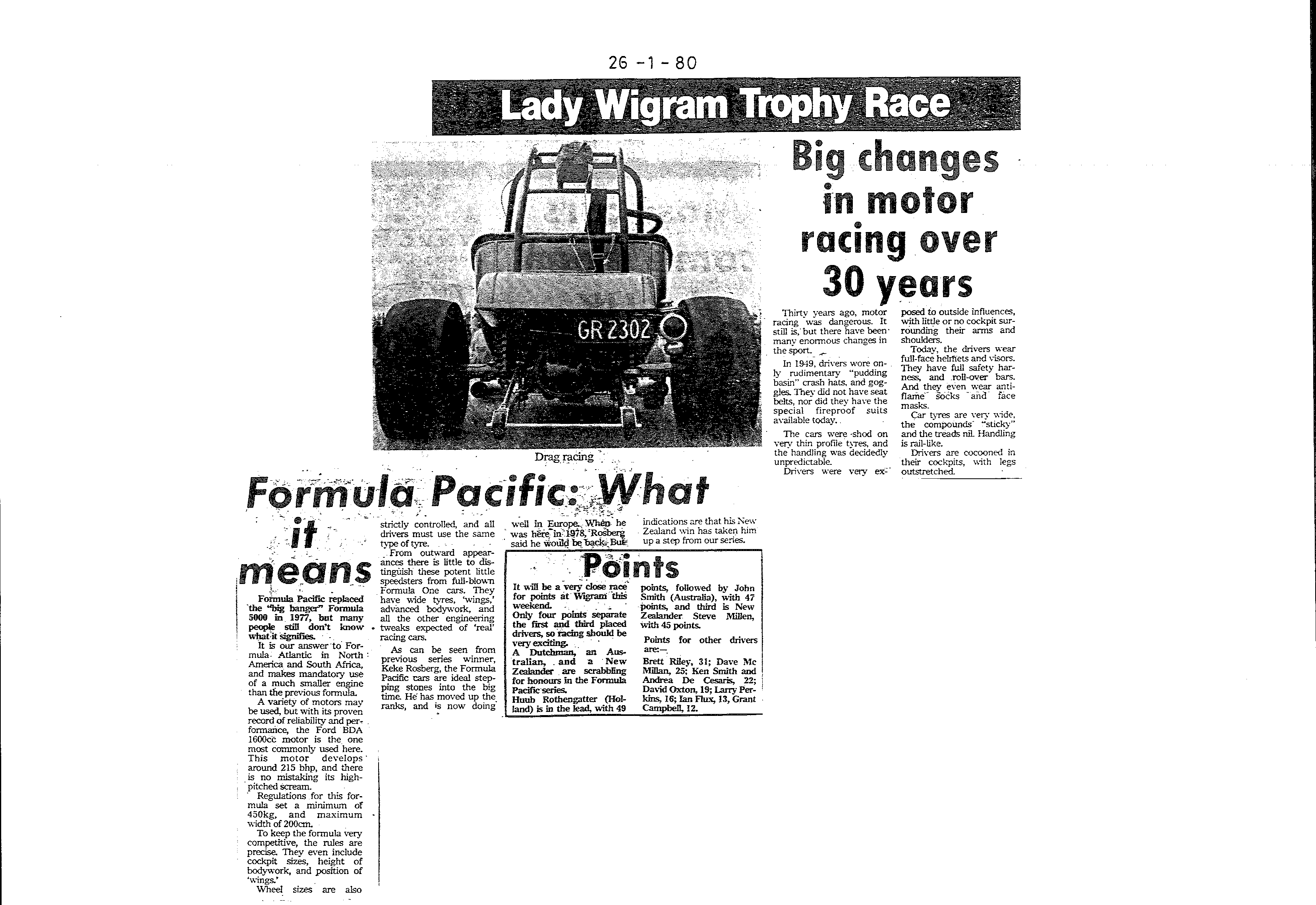
featureFormula Pacific: what it means
Explains Formula Pacific, which replaced Formula 5000 in 1977 as NZ's answer to Formula Atlantic, using the 1600cc Ford BDA engine (around 215 bhp). Rules specify a 450 kg minimum weight and 200 cm maximum width with controlled wheels and a single tyre type. Keke Rosberg is cited as a series winner who moved up to Europe.
Facts
- Formula Pacific replaced Formula 5000 in New Zealand in 1977.
- The Ford BDA 1600cc engine used in Formula Pacific develops around 215 bhp.
- Formula Pacific rules set a minimum weight of 450 kg and a maximum width of 200 cm.
previewPoints race tight
Only four points separate the Formula Pacific top three before Wigram: Rothengatter 49, John Smith 47, Steve Millen 45.
Facts
- Series points before Wigram 1980: Rothengatter 49, John Smith 47, Millen 45, Brett Riley 31, Dave McMillan 25, Ken Smith and Andrea de Cesaris 22, David Oxton 19, Larry Perkins 16, Ian Flux 13, Grant Campbell 12.
featureBig changes in motor racing over 30 years
Compares 1949 racing, with pudding-basin helmets, no belts and thin tyres, to 1980's full-face helmets, harnesses, roll bars and wide sticky tyres.
Facts
- In 1949 Wigram racing drivers wore only basic crash hats and goggles without seat belts or fireproof suits.
Read the OCR text
26-1-80
Lad
y Wigram
Trophy Race
GR 2302
Drag racing
Formu
means
Formuia Pacific replaced
"the "big banger" Formula
5000 in 1977, but many
people still don't know
what it signifies.
It is our answer to Formula: Atlantic in North :
America and South Afnca,
and makes mandatory use
of a much smaller engine
than the previous formula.
A variety of motors may
be used, but with its proven
record of reliability and performance, the Ford BDA
1600cc motor is the one
most commonly used here.
This motor develops
around 215 bhp, and there
is no mistaking its highpitched scream.
Regulations for this formula set a minimum of
450kg, and maximum
width of 200cm.
To keep the formula very
competitive, the rules are
precise. They even include
cockpit sizes, height of
bodywork, and position of
wings.'
Wheel sizes are also
la Pac
strictly controlled, and all
drivers must use the same
type of tyre.
. From outward appearances there is little to distinguish these potent little
speedsters from full-blown
Formula 1
have wide te ca les
advanced bodywork, and
all the other engineering
tweaks expected of 'real
racing cars.
As can be seen from
previous series winner,
Keke Rosberg, the Formula
Pacific cars are ideal stepping stones into the big
time. He has moved up the
ranks, and is now doing
ific: W
well in Europe, When he
was here in 1978, Rosberg
said he would be back. But
hat
indications are that his New
Zealand win has taken him
up a step from our series.
Poi
It will be a very close race
for points at Wigram this
weekend.
Only four points separate
the first and third placed
drivers, so racing shouk be
very exciting.
A Dutchman, Aus
tralian, . and a New
Zealander are scrabbling
for honours in the Formula
Pacific series.
Huub Rothengatter (Holland) is in the lead, with 49
nis
points, followed by John
Smith (Australia), with 47
points, and third is New
Zealander Steve Milen,
with 45 points.
Points for other drivers
are:-
Brett Riley, 31; Dave Mc
Millan, 25; Ken Smith and
Andrea De Cesaris, 22;
David Oxton, 19; Larry Perkins, 16; lan Flux, 13, Grant
Campbell, 12.
Big changes
in motor
racing over
30 y
Thirty years ago, motor
racing was dangerous. It
still is, but there have been
many enormous changes in
the sport. - -
In 1949, drivers wore only rudimentary "pudding
basin" crash hats, and goggles. They did not have seat
belts, nor did they have the
special fireproof suits
available today..
The cars were -shod on
very thin profile tyres, and
the handling was decidedly
unpredictabie.
Drivers were very ex-
ears
posed to outside influences,
with little or no cockpit surrounding their arms and
shoulders.
Today, the drivers wear
full-face heltets and visors.
They have full safety harness, and roll-over bars.
And they even wear antiflame™ SOCKS and face
masks.
Car tyres are very wide,
the compounds "sticky"
and the treads nil. Handling
is rail-like.
Drivers are cocooned in
their cockpits, with legs
outstretched.
Summaries and tables are machine-read from the scan and may contain errors: the scan is the record.