featureRules for Formula Pacific precise
Explains what a Formula Pacific car is: minimum weight 450kg, maximum width 200cm, 1600cc Ford BDA engines and identical tyres for all. The formula began in Britain nine years earlier as Formula Atlantic and was seen as cheaper than F2, though overseas drivers could spend up to $30,000 on the five-race series.
Facts
- Formula Pacific cars have a minimum weight of 450kg and maximum width of 200cm, and use Ford BDA 1600cc engines.
- A Formula Pacific engine could cost about $8000 and tyres and wheels about $3000; overseas drivers could spend up to $30,000 on the five-race series.
- Formula Atlantic had died in Britain by the end of 1976 but continued elsewhere; New Zealand had previously raced Formula 5000.
Photos
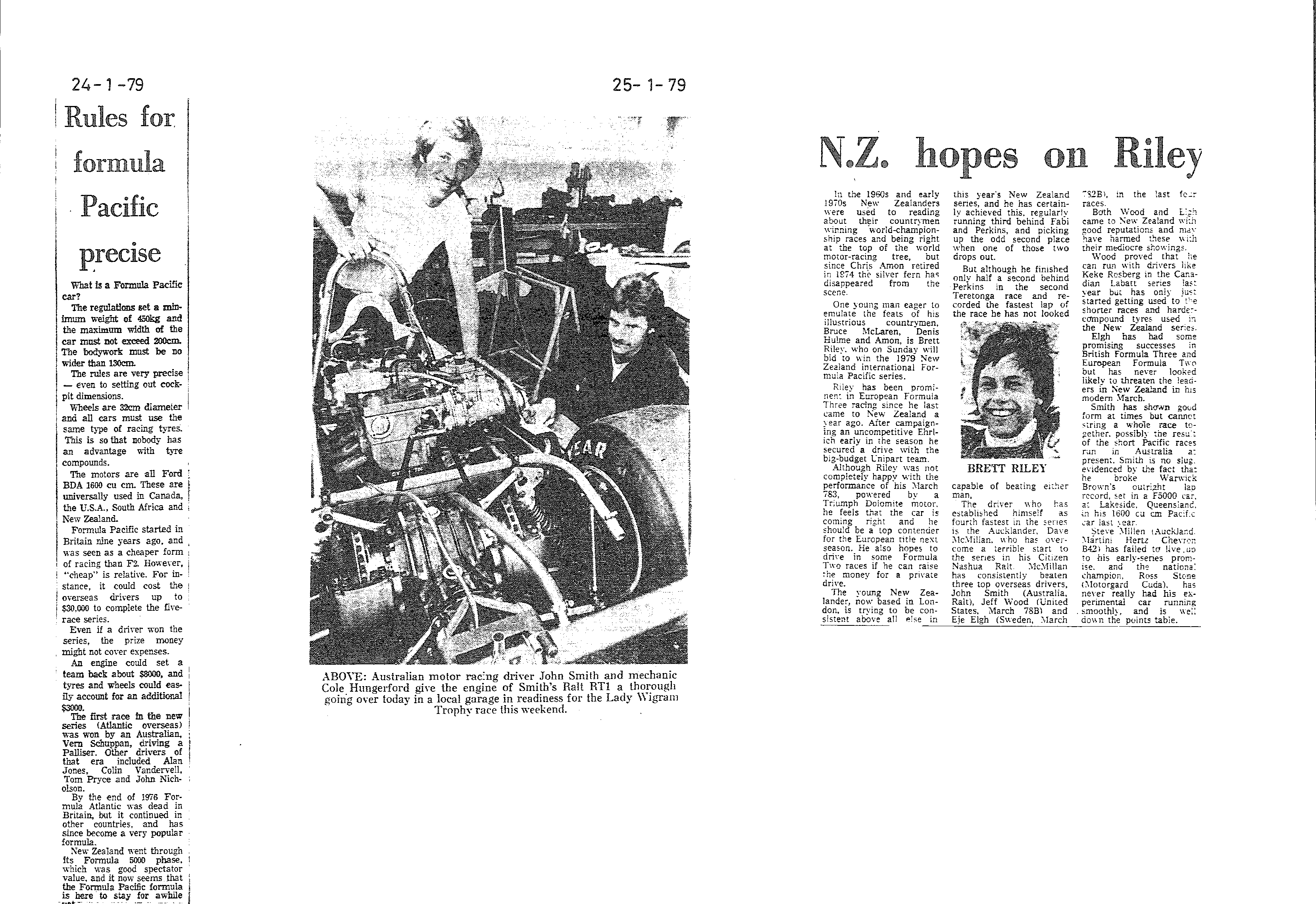
- Australian driver John Smith and mechanic Cole Hungerford give the engine of Smith's Ralt RT1 a thorough going over in a local garage in readiness for the Lady Wigram Trophy race this weekend.
previewN.Z. hopes on Riley
Brett Riley was bidding to win the 1979 NZ Formula Pacific series, though he had regularly run third behind Fabi and Perkins. Dave McMillan had established himself as fourth fastest in the series, consistently beating John Smith, Jeff Wood and Eje Elgh, while Steve Millen and Ross Stone had not lived up to expectations.
Lap times
- Brett Riley: fastest race lap
Facts
- Since Chris Amon retired in 1974 no New Zealander had been at the top of world motor racing, the piece says.
Read the OCR text
24-9-79 25-1-79
Rules for
formula
Pacific
precise
What is a Formula Paclic
car?
The regulations set a minimum weight of 450kg and
the maximum width of the
car must not exceed 200cm.
The bodywork must be 1o
wider than 130cm.
The rules are very precise
- even to setting out cockpit dimensions.
Wheels are 32cm diameler
and all cars must use the
same type of racing tyres
This is so that nobody has
an advantage with tyre
compounds.
The motors are all Ford!
BDA 1600 cu cm. These are
universally used in Canada,
the U.S.A., South Africa and
New Zealand.
Formula Pacific staried in
Britain nine years ago, and
was seen as a cheaper form
of racing than F2 howerer,
"cheap" is relative. For instance, it could cost the
overseas drivers up to
$30,000 to complete the five
race series.
Even if a driver on the
series, the prize money
might not cover expenses.
An engine could set a
team back about $8000, and
tyres and wheels could easily account for an additional
$3000.
The first race in the new
series (Atlantic overseas
was won by an Australian,
Vern Schuppan, driving a
Paliser. Other drivers of
that era included Alan
Jones, Colin Vandervell,
Tom Pryce and John Nicholson.
By the end of 1976 Formula Atlantic was dead in
Britain, but it continued in
other countries, and
since become a very popular
formula.
New Zealand ment through
its Formula 5000 phase,
which was good spectator
value, and it now seems that
the Formula Pacific formula
is here stay for awhile
.-•
LAR
ABOVE: Australian motor racing driver John Smith and mechanic
Cole Hungerford give the engine of Smith's Ralt RT1 a thorough
going over today in a local garage in readiness for the Lady Wigram
Trophy race this weekend.
N.Z. hopes or
In the 1960s and early
1970s New Zealanders
here used to reading
about their countrymen
winning world-championship races and being right
at the top of the world
motor-racing tree, but
since Chris Amon retired
in 1974 the silver fern has
disappeared from the
One young man eager to
emulate the feats of his
illustrious countrymen,
Bruce McLaren, Denis
Hulme and Amon, is Brett
Rile!: who on Sunday will
bid to win the 1979 New
Zealand international Formula Pacific series.
Riley has been prominent in European Formula
Three racing since he last
came to New Zealand a
year ago. After campaigning an uricompetitive Ehrlich early in the season he
secured a drive with the
big-budget L nipart team.
Although Riley was not
completely happy with the
performance of his March
783, powered by a
Triumph Doiomite motor.
he feels that the car is
coming right and he
should be a top contender
for the European title next
season. He also hopes to
drive in some Formula
Two races if he can raise
the money for a private
drive.
The young New Zealander, now based in London, is trying to be consistent above •all else in
this year's New Zealand
seres, and he has certainly achieved this, regularly
running third behind : Fabi
and Perkins, and picking
the odd second place
when one of those two
drops out.
But although he finished
oniv hail a second behind
Perkins in the second
teretonga race and recorded the fastest lap of
the race he has not looked
BRETT RILEY
capable of beating either
man,
The driver uho has
established himself as
fourth fastest in the series
15 the Aucklander, Dave
NeVilian, who has overcome a ierribie siart to
the series in his Citizen
Nashua Ralt. McMillan
has consistently beaten
three top overseas drivers,
John Smith (Australia,
Ralt), Jeff Wood (United
States, March 78B) and
Eje Eigh (Sweden, March
• Riley
"32B), in the last four
races.
Both Wood and Eigh
came to New Zealand with
good reputations and na!
have harmed these with
their mediocre showings.
Wood proved that he
can run with drivers like
Keke Resberg in the Canadian Labatt series ias:
year bui has only jus:
started getting lised to the
shorter races and harde:compound tyres used in
the New Zealand series.
Eigh has had some
promising successes in
British Formula Three and
Eur eas Bermula Two
has never looked
likely to threaten the leaders in New Zealand in his
modern March.
Smith has shown goud
form at times but cannet
string a whole race together. possibly the resu:
of the short Pacific races
run Australia
preseni. Smith is no slug.
evidenced by the fact tha:
he broke Warwick
Brown's outright laD
record, set in a F5000 car,
Lakeside, Queensiand.
in his 1600 cu cm Pacific
car last sear.
Steve Millen Auckland.
Martini Hertz Chesten
B42) has failed to live. up
to his early-series prom-
Ise. and the nationa
champion, Ross Stone
(Notorgard Cuda). has
never really had his experimentai car running
smoothly, and is well
down the points table.
Summaries and tables are machine-read from the scan and may contain errors: the scan is the record.