preview · Russell JonesWigram race promises to be exciting
Russell Jones previews the 1977 Wigram round, the last of the Stuyvesant series, now run for evenly matched Formula Pacific cars with 1600cc BDA Ford engines. With series winner Keke Rosberg already decided, slipstreaming battles are expected, notably with Tom Gloy's Tui which is faster on the straights than Rosberg's Chevron B34. Setting up gear ratios, suspension and aerofoils for the fast airfield circuit will be critical.
Facts
- The 1977 Wigram Lady Wigram Trophy was run over 160 km for Formula Pacific cars.
- Formula Pacific cars in 1977 all used a 1600cc four-cylinder twin-cam BDA Ford engine producing over 200 bhp at over 9000 rpm.
- Formula Pacific rules limited competitors to one type of hard-compound slick tyre and the same five-speed gearbox.
- Wigram corners were taken at around 160 km/h in 1977; no one had raced a Pacific car there before.
- The Motorsport Association of New Zealand changed the national formula from F5000 to Formula Pacific, which was cheaper and attracted more entries.
Photos
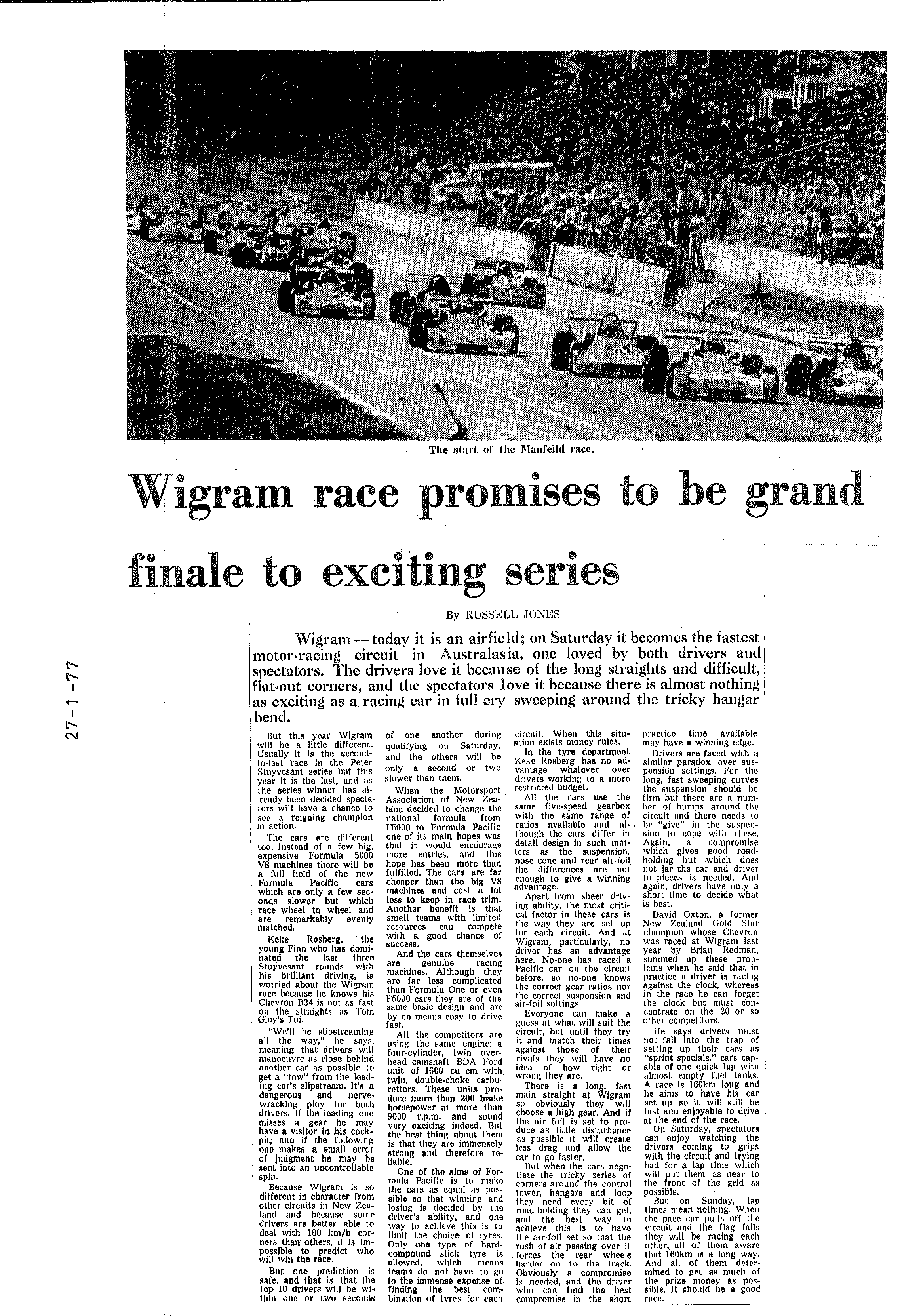
- The start of the Manfeild race.
Read the OCR text
The start of the Manfeild race
fir
-77
stones
27 -
igram
race
prom
ises to
be g
ale to
exciting
series
By RUSSELL JONES
Wigram motor-racing
spectators. The
flat-out corners,
as exciting as a
bend.
- today it is an airfie
ircuit in Australas
drivers love it becau
and the spectators l
racing car in full ery
But this year Wigram
will be a little different.
Usually it is the secondto-last race in
Stuyvesant series but this
year it is the last, and as
the series winner has already been decided spectators will have a chance to
see a reigaing champion
in action.
The cars are different
too. Instead of a few big,
expensive Formula 5000
V8 machines there will be
a full field of the new
Formula Pacific cars
which are only a few seconds slower but which
race wheel to wheel and
are remarkably evenly
matched.
Keke Rosberg, the
young finn who has dominated the last three
Stuyvesant rounds with
his brilliant is
worried about the Wigram
race because he knows his
Chevron B34 is not as fast
on the straights as Tom
Gloy's Tui.
"We'll be slipstreaming
all the way, he says,
meaning that drivers , will
manoeuvre as close behind
another car as possible lo
get a "tow" from the leading car's slipstream. It's a
dangerous and nervewracking ploy for both
drivers. If the leading one
misses gear he may
have a visitor in his cock-
: pit; and if the following
one makes a small error
of judgment he may be
sent into an uncontrollable
'spin.
Because Wigram is so
different in character from
other circuits in New Zealand and because some
drivers are better able to
deal with 160 km/h cor.
ners than others, it is impossible to predict who
will win the race.
But one prediction is
safe, and that is that the
top 10 drivers will be within one or two seconds
of one another during
qualifying on Saturday,
and the others will be
only second or two
slower than them.
When the Motorsport
Association of New Zealand decided to change the
mational formula from
I5000 to Formula Pacific
one of its main hopes was
that it would encourage
more entries, and this
hope has been more than
fulfilled. The cars are far
cheaper than the big V8
machines and cost a lot
less to keep in race trim.
Another benefit that
small teams with limited
resources can compete
with good chance
success.
And the cars themselves
are genuine racing
machines. Although they
are far less complicated
than Formula One or even
F5000 cars they are of the
same basic design and are
by no means easy to drive
fast.
All the competitors are
using the same engine: a
four-cylinder, twin overhead camshaft BDA Ford
unit of 1600 cu cm with.
twin, double-choke carburettors. These units produce more than 200 brake
horsepower at more than
9000 I.p.m. and sound
very exciting indeed. But
the best thing about them
is that they are immensely
strong and therefore reliable.
One of the alms of Formula Pacific is to make
the cars as equal as possible so that winning and
losing is decided by the
driver's ability, and one
way to achieve this is to
limit the choice of tyres.
Only one type of hardcompound slick tyre is
allowed, which meatis
teams do not have to go
to the immense expense of
finding the best combination of tyres for each
Id; on Saturday it becomes the fastest
ia, one loved by both drivers and
se of the long straights and difficult,
ove it because there is almost nothing
sweeping around the tricky hangar
circuit. When this situ
ation exists money rules.
In the tyre department
Keke Rosberg has no advantage whatever over
drivers working to a more
restricted budget.
All the cars Use the
same five-speed gearbox
with the same range of
ratios avallable and although the cars ditter in
detail design in such malters as the suspension,
nose cone and rear air-foil
the differences are not
enough to give a winning
advantage.
Apart from sheer driving ability, the most critical factor in these cars is
the way they are set up
for each circuit. And at
Wigram, particularly,
driver has an advantage
here. No-one has raced a
Pacific car on the circuit
before, so no-one knows
the correct gear ratios nor
the correct suspension and
air-foil settings.
Everyone can make a
guess at what will suit the
circuit, but until they try
it and match their times
against those of their
rivals they will have no
idea of how right or
wrong they are,
There is long, fast
main straight at Wigram
SO obviously they will
choose a high gear. And if
the air foll is set to produce as little disturbance
as possible it will create
less drag and allow the
car to go faster.
But when the cars negoliate the tricky series of
corners around the control
tower, hangars and loop
they need every bit of
and hole the way Bet, way
achieve this is to have
the air-foil set so that the
rush of air passing over it
• forces the lear wheels
harder on to the track.
Obviously a compromise
is needed, and the driver
who can find the best
compromise in the short
practice time available
may have a winning edge.
Drivers are faced with a
similar paradox over suspension settings. for ine
long, fast sweeping curves
the suspension should i he
firm but there are a number of bumps around the
circuit and there needs lo
he "give" in the suspension to cope with these.
Again, compromise
which gives good roadholding but which does
not jar the car and driver
to pieces is needed. And
again, drivers have only d
short time to decide what
is best.
David Oxton, a former
New Zealand Gold Star
champion whose Chevron
was raced at Wigram last
year by Brian Redman,
summed up these problems when he said that in
practice a driver is racing
against the clock, whereas
in the lace he can forget
the clock but must concentrate on the 20 or so
other competitors.
says drivers must
not fall into the trap of
setting up , their cars as
"sprint specials," Cars capable of one quick lap with
almost empty fuel tanks.
A race is 160km long and
he aims to have his car
set up so it will stil be
fast and enjoyable to drive
at the end of the race.
On Saturday, spectators
enjoy watching the
drivers coming to grips
with the circult and trying
had for a lap time which
will put them as near 1o
the front of the grid as
possible.
But on Sunday, lap
times mean nothing. When
the pace car pulls off the
circuit and the flag falls
they will be racing each
other, all of them aware
that 160km is a long way.
And all of them determined to get as much of
the prize money as possible, It should be a good
race.
rand
Summaries and tables are machine-read from the scan and may contain errors: the scan is the record.