Wigram TrophyMotor racing at Wigram airfield · Christchurch · 1949–2000
Home › Archive › 1976 › Stuyvesant series lacks strength in the field
← 19 Jan 1976All 1976 pages24 Jan 1976 →
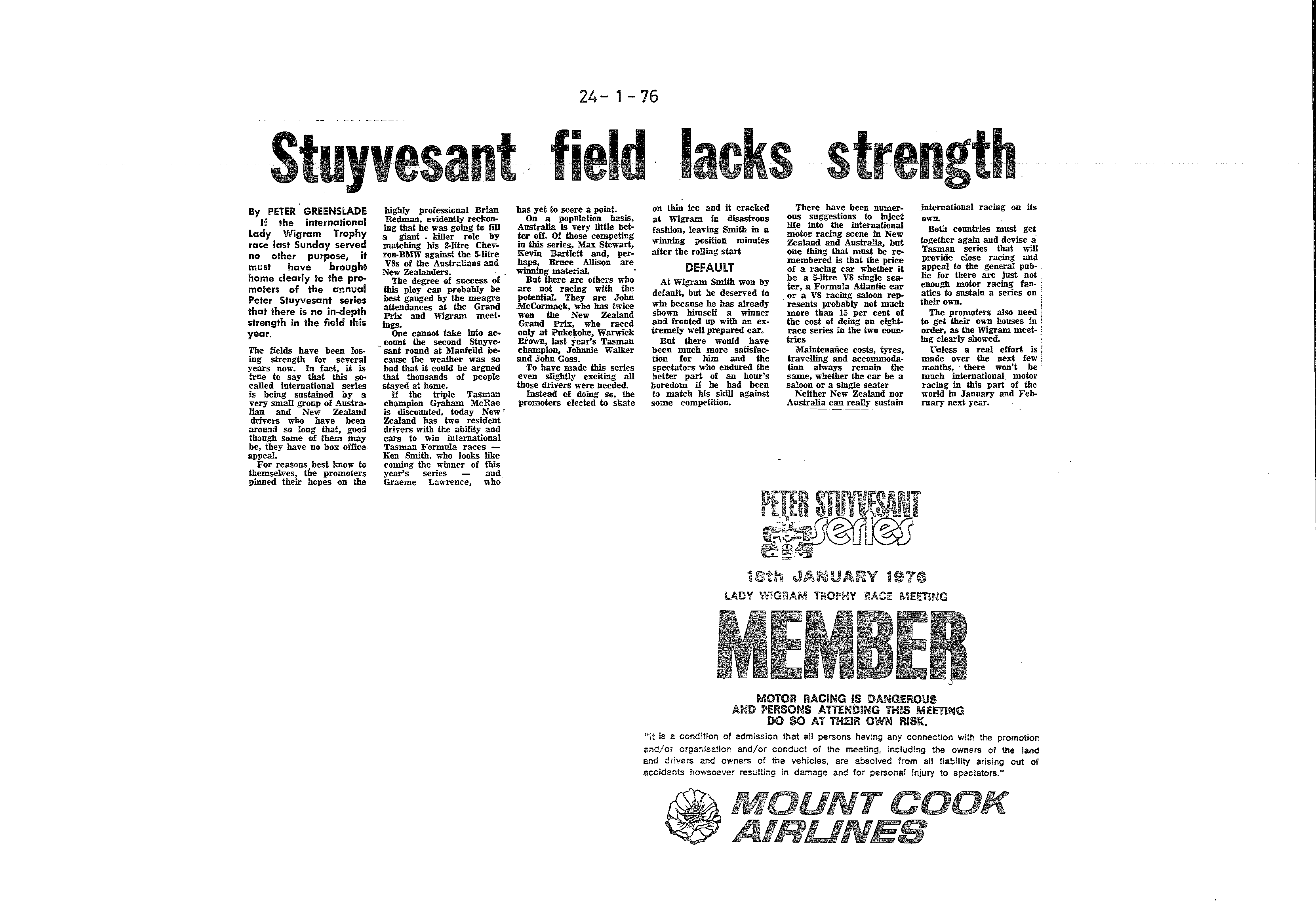
Scan of the clipping page, 24 January 1976
↗
Drag to move · scroll or pinch to zoom
feature · Peter Greenslade

Stuyvesant series lacks strength in the field

Peter Greenslade argues that the 1976 Lady Wigram Trophy showed the Peter Stuyvesant series has no depth, being kept going by a small group of Australian and New Zealand drivers with little box-office appeal. Promoters pinned hopes on Brian Redman's 2-litre Chevron-BMW, and attendances at the Grand Prix and Wigram were meagre. He calls for a new Tasman series and says promoters must get their houses in order.

Facts

  • Ken Smith won the 1976 Lady Wigram Trophy by default after the other favourites dropped out minutes after the rolling start.
  • The second round of the 1976 Peter Stuyvesant series at Manfeild was hit by bad weather.
  • A racing car represents only about 15 per cent of the cost of an eight-race Tasman series, according to Greenslade in 1976.
  • The 1976 Wigram meeting programme carried a standard liability waiver stating that motor racing is dangerous.
programme

Lady Wigram Trophy race meeting 1976 programme page

Programme page for the Lady Wigram Trophy race meeting with Peter Stuyvesant series branding and a standard admission condition warning that motor racing is dangerous.

Read the OCR text
24-1-76 Stuy By PETER GREENSLADE If the international Lady Wigram Trophy race last Sunday served no other purpose, it must have brought home clearly to the promoters of the annual Peter Stuyvesant series that there is no in-depth strength in the fieid this year. The fields have been losing strength for several years now. In fact, it is true to say that this socalled international series is being sustained by very small group of Australiar and New Zealand drivers whe have been around so long that, good though some of them may be, they have no box office appeal. For reasons best know to themsebres, the promoters pinned their hopes on the vesail highly professional Brian ing that he was going to ul giant - killer role by matching his 2 litre Cherron-BMW against the 5-litre V8s of the Australians and New Zealanders. The degree of success of this ploy can probably be best gauged by the meagre attendances at the Grand Prix and Wigram meetings. One cannot take into account the second Stuyve sant round at Manfeild because the weather was so bad that it could be argued that thousands of people stayed at home. If the triple Tasman champion Graham McRae is discounted, today New Zealand has two resident drivers with the ability and cars to win international Tasman Formula races - Ken • Smith, who looks like coming the winner of this year's series and Graeme Lawrence, who field has yet to score a point. On a population basis, Australia is very little better off. Of those competing in this series, Mas Stewart, Kevin Bartlett and, pernaps, Bruce Allison are winning material. But there are others rho are not racing with the potential. They are Join McCormack, who has twice won the New Zealand Grand Prix, who raced only at Pukekone, Warwick Brown, last year's Tasman champion, Jonnnie Walker and John Goss. To have made this series even slightly exciting all those drivers were needed. Instead of doing so, the promoters elected to skate acks stre ngth on thin ice and it cracked at Wigram in disastrous fashion, leaving Smith in a winning position minutes after the rolling start DEFAULT At Wigram Smith won by default, but he deserved to win because he has already shown himself a winner and fronted up with an extremely well prepared car. But there would have been much more satisfaction for him and the spectators who endured the better part of an hour's boredom if he had been to match his skill against some competition. There have been numerous suggestions to inject life into the international motor racing scene in New Zealand and Australia, but one thing that must be remembered is that the price of a racing car whether it be a 5-litre V8 single seater, a Formula Atlantic car or a V8 racing saloon represents probably not much more than 15 per cent of the cost of doing an eightrace series in the two coutries Maintenañce costs, tyres, travelling and accommodation always remain the same, whetier the car be a saloon or a single seater Neither New Zealand nor Australia can really sustain international racing on its 0RLL. Both countries must get together again and devise a Tasman series that will provide close racing and appeal to the general public for there are just not enough motor racing fanaties to sustain a series on their own. The promoters also need to get their own houses in order, as the wigram meeting clearly showed. Unless a real effort is made over the next few there won't be much month interational motor racing in this part of the world in January and February next rear. PETER SIUY SALT senles 8th JANUARY LADY WIGRAM TROPHY RACE MEETING ME MBER MOTOR RACING IS DANGEROUS AND PERSONS ATTENDING THIS MEETING DO SO AT THEIR OWN RISK. "it is a condition of admission that all persons having any connection with the promotion and/or organisation and/or conduct of the meeting, including the owners of the land and drivers and owners of the vehicles, are absolved from all liability arising out of accidents howsoever resulting in damage and for personal injury to spectators." MOUNT COOK AIRLINES

Summaries and tables are machine-read from the scan and may contain errors: the scan is the record.