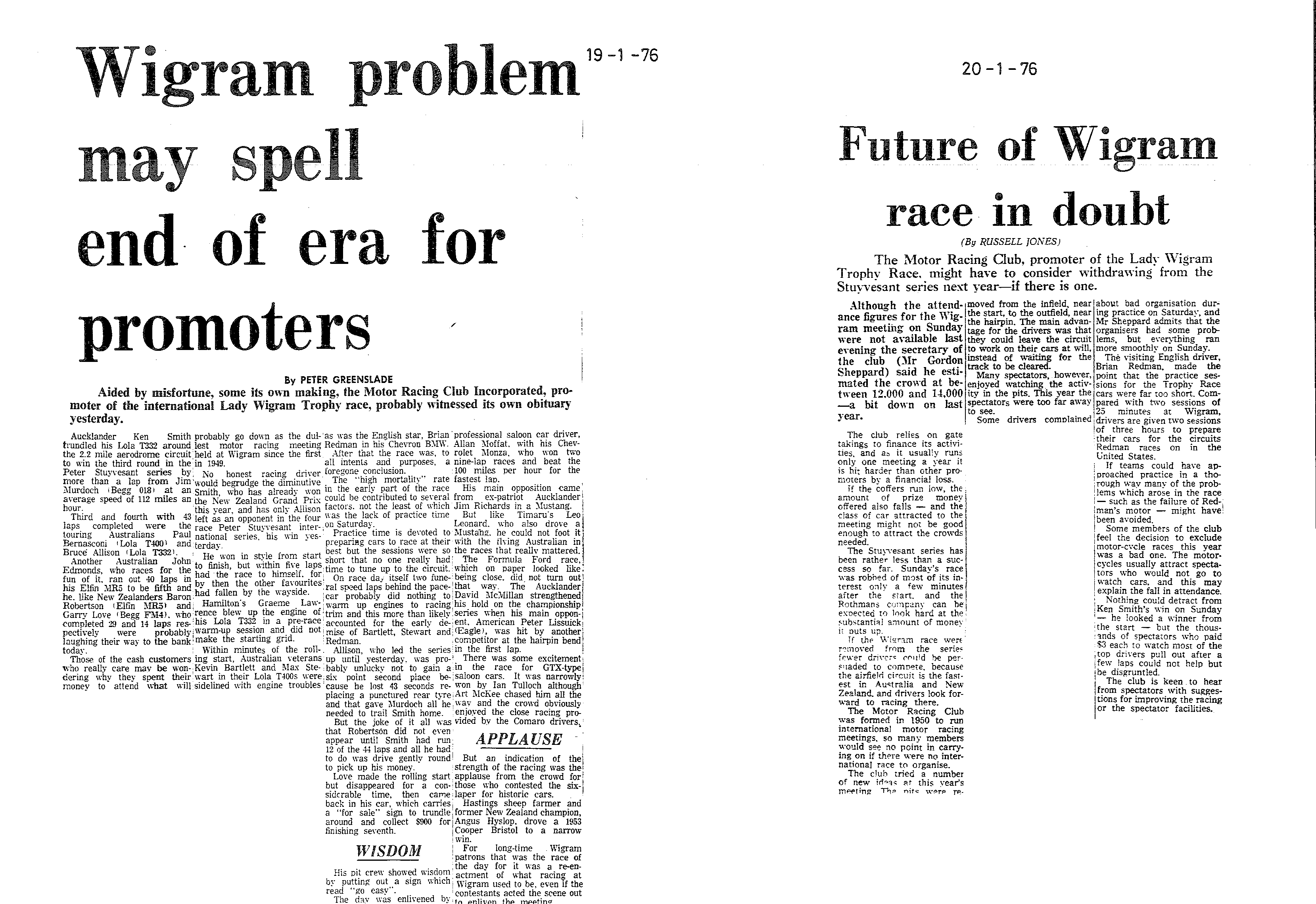
race report · Peter GreensladeWigram problem may spell end of era for promoters
Peter Greenslade reports that Ken Smith (Lola T332) won the Lady Wigram Trophy, third round of the Peter Stuyvesant series, by more than a lap from Jim Murdoch at an average of 112 mph, after the other favourites fell out early. It was probably the dullest meeting since the first in 1949. Allan Moffatt (Chev Monza) won two nine-lap saloon races and beat 100 mph for the fastest saloon lap, and Angus Hyslop won the historic car race.
Lady Wigram Trophy (Peter Stuyvesant series, round 3)
| 1 | Ken Smith (Auckland) | Lola T332 | |
| 2 | Jim Murdoch | Begg 018 | |
| 3 | Paul Bernasconi (Australia) | Lola T400 | 43 laps |
| 4 | Bruce Allison (Australia) | Lola T332 | 43 laps |
| 5 | John Edmonds (Australia) | Elfin MR5 | 40 laps |
| 6 | Baron Robertson (New Zealand) | Elfin MR5 | 29 laps |
| 7 | Garry Love (New Zealand) | Begg FM4 | 14 laps |
| DNF | Kevin Bartlett (Australia) | Lola T100 | |
| DNF | Max Stewart (Australia) | Lola T100 | |
| DNF | Brian Redman (England) | Chevron BMW | |
| DNS | Graeme Lawrence (Hamilton) | Lola T332 | |
GTX-type saloon cars
| 1 | Ian Tulloch | Camaro | |
| 2 | Art McKee | Camaro | |
Historic cars, six laps
| 1 | Angus Hyslop (Hastings) | 1953 Cooper Bristol | |
Lap times
- Allan Moffatt (Chevrolet Monza): over 100 mph fastest race lap
Facts
- The 1976 Lady Wigram Trophy was described as probably the dullest meeting at Wigram since the first in 1949.
- The Wigram circuit in 1976 was 2.2 miles around the aerodrome.
- Motor-cycle races were excluded from the 1976 Wigram meeting.
- Ken Smith had already won the 1976 New Zealand Grand Prix before the Lady Wigram Trophy.
- Practice time on the Saturday before the 1976 Lady Wigram Trophy was very short, with two funeral-speed laps behind the pace car before the start.
- Allison lost 43 seconds replacing a punctured rear tyre, handing second place to Murdoch.
news · Russell JonesFuture of Wigram race in doubt
The Motor Racing Club, promoter of the Lady Wigram Trophy, might have to consider withdrawing from the Stuyvesant series next year because it relies on gate takings and Sunday's race lost interest soon after the start. Club secretary Gordon Sheppard estimated the crowd at 12,000 to 14,000, down on 1975, and the pits were moved to the outfield near the hairpin.
Facts
- Crowd at the 1976 Lady Wigram Trophy meeting was estimated at 12,000 to 14,000, a bit down on 1975; admission was $3.
- The Motor Racing Club was formed in 1950 to run international motor racing meetings.
- The Wigram airfield circuit was described in 1976 as the fastest in Australia and New Zealand.
- Practice at Wigram in 1976 consisted of two 25-minute sessions, compared with two three-hour sessions in the United States.
- The pits were moved in 1976 from the infield near the start to the outfield near the hairpin.
Read the OCR text
Wi
gram
prob
19-9-76
em
may
spell
ena ol
era
IOr
promoters
Aided by misfortune,
moter of the international
yesterday.
By PETER GREENSLADE
some its own making, the Motor Racing Club Incorporated, pro-
Lady Wigram Trophy race, probably witnessed its own obituary
Aucklander Ken Smith
trundled his Lola T332 around
the 2.2 mile aerodrome circuit
to win the third round in the
Peter Stuyvesant series by
more than a lap from Jim
Murdoch i Begg 018) at an
average speed of 112 miles an
hour.
Third and fourth with 43
laps completed were the
touring Australians Paul
Bernasconi ( Lola T400) and
Bruce Allison (Lola T332).
Another Australian John
Edmonds, who races for the
fun of it, ran out 40 laps in
his Elfin MR5 to be fifth and
he. like New Zealanders Baron
Robertson (Elfin MR5) and
Garry Love 'Begg FM4), who
completed 29 and 14 laps res
pectively were probably
laughing their way to the bank
today.
Those of the cash customers
who really care may be wondering why they spent their
money to attend what will
probably go down as the dullest motor racing meeting
held at Wigram since the first
in 1949.
No honest racing driver
would begrudge the diminutive
Smith, who has already won
the New Zealand Grand Pris
this year, and has only Allison
left as an opponent in the four
race Peter Stuyvesant international series, his win resterday.
He won in style from start
to finish, but within five laps
had the race to himself. for
by then the other favourites
had fallen by the wayside.
Hamilton's Graeme Lawrence blew up the engine of
this Lola T332 in a pre-race
: warm-up session and did not:
make the starting grid.
Within minutes of the rolling start, Austrailan veterans
Kevin Bartlett and Max Stewart in their Lola T100s were
sidelined with engine troubles
as was the English star, Brian
Redman in his Chevron BMW.
After that the race was, to
all intents and purposes, a
foregone conclusion.
The "high mortality" rate
in the early part of the race
could be contributed to several
factors. not the least of which
mas the lack of practice time
on Saturday.
Practice time is devoted to
preparing cars to race at their
best but the sessions were so
short that no one really had
time to tune up to the circut.
On race day itself two fune-
•ral speed laps behind the pace-
(car probably did nothing to
warm up engines to racing
trim and this more than likely
accounted for the early de-
: mise of Bartlett, Stewart and
: Redman.
• Allison, who led the series
up until yesterday, was probably unlucky not to gain a
Six point second place because he lost 43 seconds replacing a punctured rear tyre
and that gave Murdoch all he
needed to trail Smith home.
But the joke of it all was
that Robertson did not even
appear until Smith had run
12 of the 41 laps and all he had
to do was drive gently round
to pick up his money
Love made the rolling start
but disappeared for a considcrable time, then came
back in his car, which carries
a "for sale" sign to trundle
around and collect $900 for
finishing seventh
WISDOM
His pit crew showed wisdom
br putting out sign which
read
The dav was enlivened by
professional saloon car driver,
Allan Moffat, with his Chevrolet Monza. who won two
nine-lap races and beat the
:100 miles per hour for the
fastest lap.
His main opposition came
from ex-patriot Aucklander!
Jim Richards in a Mustang.
But like Timans Leo
Leonard. who also drove a
Mustang. he could not foot it
with the flying Australian in!
the races that really mattered.
The Formula Ford race,!
: which on paper locked like:
i being close. did . not turn outi
that way. The Aucklander
David McMillan strengthened
his hold on the championship!
series when his main oppon-l
ent, American Peter Lissuicki
(Eagle), was hit by another
competitor at the hairpin bend!
in the first lap.
There was some excitement: the race
for GTX-type
saloon cars. It was narrowly!
won by Ian Tulloch although
¡Art Mckee chased him all the
way and the crowd obviously
enjoved the close racing pro
vided by the Comaro drivers.
APPLAUSE
But an indication of the
strength of the racing was the!
applause from the crowd for!
those who contested the six-i
¡laper for historic cars.
Hastings sheep farmer and
former New Zealand champion,
Angus Hyslop, drove a 1953
Cooper Bristol to a narrow
win.
For long-time • Wigram
patrons that was the race of
the day for it was a re-enactment of what racing at
Wigram used to be, even if the
contestants acted the scene out
ita onlinor tha mastino
20-1-76
Future
of Wigram
race in
doubt
(By RUSSELL JONES)
The Motor Racing Club, promoter of the Lady Wigram
Trophy Race, might have to consider withdrawing from the
Stuyvesant series next year—if there is one.
Although the attendance figures for the Wigram meeting on Sunday
were not available last
erening the secretary of
the club (NIr Gordon
Sheppard) said he estimated the crowd at between 12.000 and 14,000
-a bit down on last
year.
¡moved from the infield, near
the start, to the outfield, near
the hairpin. The main advantage for the drivers was that
they could leave the circuit
to work on their cars at will,
instead of waiting for the
track to be cleared.
Many spectators, howerer,
enjoyed watching the activity in the pits. This year the
spectators were too far away
to see.
Some drivers complained
The club relies on gate
takings to finance its activities, and as it usually runs
only one meeting a year it
is hit harder than other promoters by a financial loss.
if the coffers run low, the
amount of prize money
offered also falls — and the
class of car attracted to the
meeting might noi be good
enough to attract the crowds
needed.
The Stuyvesant series has
been rather less than a success so far. Sunday's race
was robned of most of its interest only a few minutes
after the start. and the
Rothmans company can bel
expected to look hard at the:
substantial amount of mone!
it puts up.
If the Wigram race wert
removed from the series
fewer drivers could be persuaded to compete, because
the airfieir circuit is the fasiest in Australia and New
Zealand and drivers look forward to racing there.
The Motor Kacıng Club
was formed in 1950 to run
international motor racing
meetings, so many members
would see no point in carrying on if there were no international race to organise.
The cluh tried a number
of new ideas at this vears
meeting The nite I'ATA Te.
•labout bad organisation during practice on Saturday, and
Mr Sheppard admits that the
organisers had some prob
lems, but everything ran
more smoothly on Sunday.
The visiting English driver,
Brian Redman, made the
point that the practice sessions for the Trophy Race
cars were far too short. Compared with two sessions of
:25 minutes at Wigram,
drivers are given two sessions
of three hours to prepare
their cars for the circuits
Redman races on in the
United States.
If teams could have approached practice in a tho-
¡rough way many of the problems which arose in the race
- such as the failure of Red-:
Iman's motor - might have:
been avoided
Some members of the club
feel the decision to exclude
motor-cvcle races this year
was a bad one. The motorcycles usually attract spectators who would not go to
watch cars, and this шау
explain the fall in attendance.
Nothing could detract from
Ken Smith's win on Sunday
'- he looked a winner from
the start - but the thous-
: ands of spectators who paid
$3 each to watch most of the
¡top arivers pull out after a
(few laps could not help but
¡be disgruntled
The club is keen to hear
from spectators with suggestions for improving the racing
or the spectator facilities.
Summaries and tables are machine-read from the scan and may contain errors: the scan is the record.