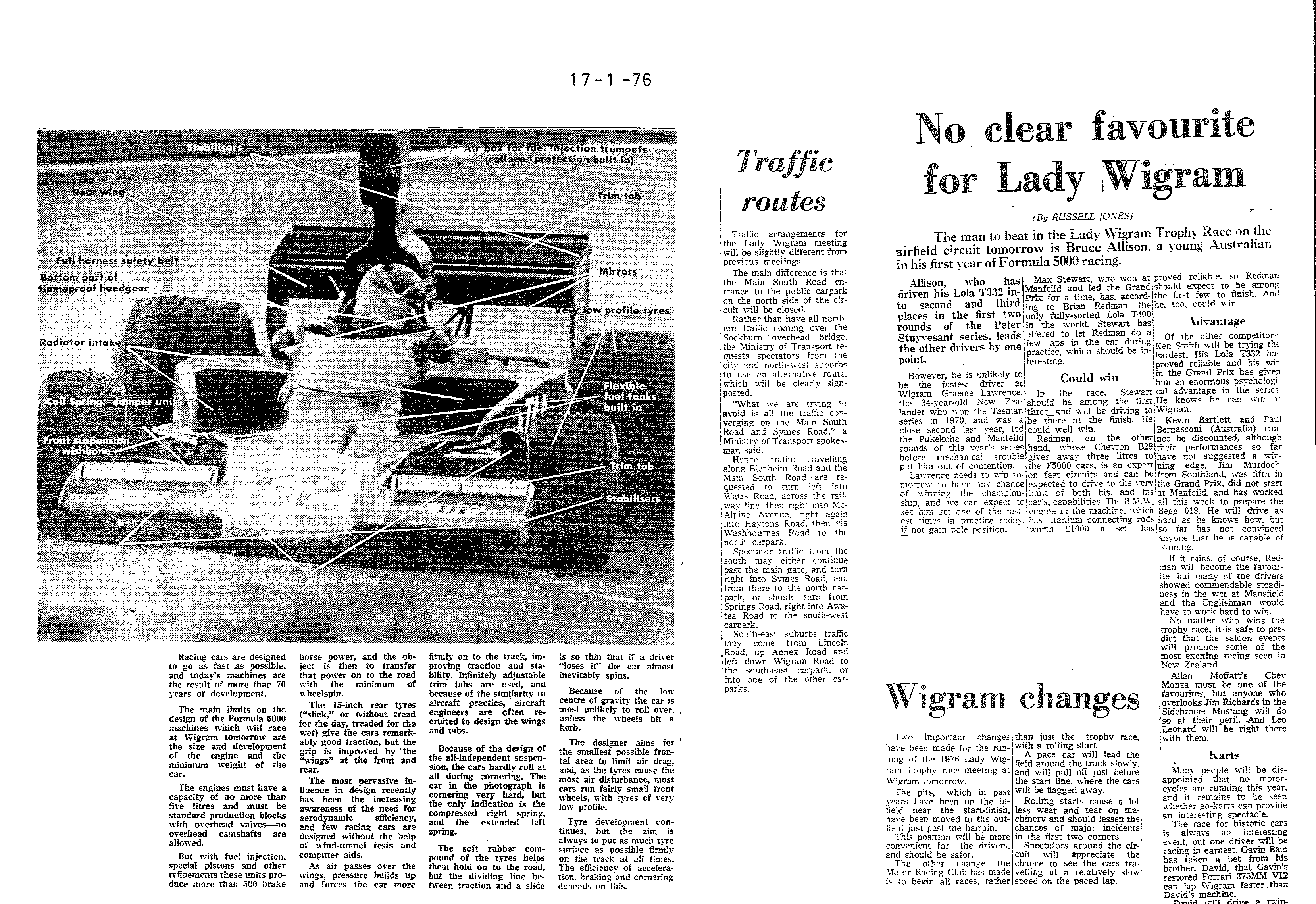
featureFormula 5000 car design
Explanation of Formula 5000 racing car design: engines limited to five litres with standard production blocks and overhead valves, producing over 500bhp with fuel injection; 15-inch rear tyres; wings and trim tabs for downforce; all-independent suspension; low centre of gravity and low profile tyres.
Facts
- Formula 5000 engines were limited to five litres, standard production blocks with overhead valves (no overhead camshafts), producing more than 500 brake horsepower in 1976.
newsTraffic routes
Traffic arrangements for the 1976 Lady Wigram meeting were slightly different: the Main South Road entrance to the north carpark was closed and spectators were asked to use an alternative signposted route.
preview · Russell JonesNo clear favourite for Lady Wigram
Bruce Allison, in his first year of F5000 racing, is the man to beat in the 1976 Lady Wigram Trophy, one point ahead of Smith, Stewart and Redman, although Max Stewart (Lola T400) and Brian Redman have a good chance. Graeme Lawrence needs to win to have any chance of the series. If it rains Redman becomes the favourite. Gavin Bain has a bet that his Ferrari 375MM V12 will lap Wigram faster than his brother David's car.
Facts
- No motorcycles raced at the 1976 Lady Wigram meeting; sidecars and go-karts took their place.
newsWigram changes
Two important changes for the 1976 Lady Wigram meeting: the pits moved from the infield near the start-finish to the outfield just past the hairpin, and all races (not just the trophy race) start with a rolling start behind a pace car.
Facts
- For the 1976 Lady Wigram meeting the pits moved from the infield to the outfield just past the hairpin, and all races began with a rolling start behind a pace car.
Read the OCR text
17-9-76
Stobilisers Air so sor elinection trumpets
rolle en protection built in)
Rect YonS Trim teb
Full harness safety beit
Mirrors
Bottom part of
lameproof headgear
low profile tyres
Radiator inteke
Flexible
call Spring fuel tanks
amper uni built in
Front suspanslo wishbon
Trim tab
¿Stabilisers
Racing cars are designed
to go as fast as possible.
and today's machines are
the result of more than 70
years of development.
The main limits on the
design of the Formula 5000
machines which will race
at Wigram tomorrow are
the size and derelopment
the engine and
minimum weight of the
car.
The engines must have a
capacity of no more than
five litres and must be
standard production blocks
with overhead valves-no
overhead camshafts are
allowed.
But with fuel injection.
special pistons and other
refinements these units produce more than 500 brake
horse power, and the object is then to transfer
that power on to the road
with the minimum of
heeispin.
The 15-inch rear tyres
("slick," or without tread
for the day, treaded for the
wet) give the cars remarkably good traction, but the
grip is improved by the
"prings" at the front and
reat.
The most pervasive influence in design recently
has been the increasing
awareness of the need for
aerodynamic efficiency,
and few racing cars are
designed without the help
of wind-tunnel tests and
computer aids.
As air passes over the
wings, pressure builds up
and forces the car more
firmly on to the track, improving traction and stability. Infinitely adjustable
trim tabs are used, and
because of the similarity to
aireraft practice, aircraft
engineers are often recruited to design the wings
and tabs.
Because of the design of
the all-independent suspension, the cars hardly roll at
all during cornering. The
car in the photograph is
cornering very hard, but
the only indication is the
compressed right spring,
and the extended left
spring.
The soft rubber compound of the tyres helps
them hold on to the road,
but the dividing line between traction and a slide
is so thin that if a driver
"loses it" the car almost
inevitably spins.
Because of the low
centre of gravity the car is
most unlikely to roll over,
unless the wheels hit a
kerb.
The designer aims for
the smallest possible frontal area to limit air drag,
and, as the tyres cause the
most air disturbance, most
cars run fairiy small front
wheels, with tyres of very
Iow profile.
Tyre development continues, but the aim is
always to put as much tyre
surface as possible firmly
on the track at all times.
The efficieney of acceleration, braking and cornering
denends on this.
Traffic
routes
Traffic arrangements for
the Lady Wigram meeting
will be slightly different from
previous meetings.
The main difference is that
the Main South Road Enttrance to the public carpark
on the north side of the circuit will be closed.
Rather than have all northlemn traffic coming over the
Sockburn overhead bridge,
the Ministry of Transport re-
¡ quests spectators from the
city and north-west suburos
to use an alternative route.
which will be clearly signposted.
'What we are trying 1o
avoid is all the traffic converging on the Main South
Road and Symes Road," a
Ministry of Transport spokesman satd.
Hence traffic travelling
along Blenheim Road and the
Main South Road • are requested to turn left into
Watis Road. across the railway line. then right into Mc-
: Alpine Avenue. right again
; into Haytons Road, then via
Washbournes Road to
north carpark.
Spectator traffic irom the
I south may either continue
past the main gate, and turn
right into Symes Road, and
from there to the north caripark. or should tum from
i Springs Road. right into Awatea Road to the south-west
carpark.
South-east suburbs traffic
may come trom Lincoln
¡Road, up Annex Road and
ileft down Wigram Road to
the south-east carpark,
into one of the other carparks.
No clear
favourite
for Lady Wigram
By RUSSELL JONES)
The man to beat in the Lady Wigram
airfield circuit tomorrow is Bruce Allison.
in his first year of Formula 5000 racing.
Trophy Race on the
a young Australian
Allison, who _Max Stewart, who won atiproved reliable. so Recinan
driven his Lola T332 in-l Manfeild and led the Grand should expect to be among
second and third Prix for a time, has, accord the first few to finish. And
to ing to: Brian Redman. theihe, ton. could win.
places in the first twel only fully-sorted Loia T400
rounds of the Peter world. Stewart has! Advantage
Stuyresant series, leads offered to let Redman do al Of the other competitor:
the other drivers by one few laps in the car during: Ken Smith will be trying the
practice, which should be in- ¡hardest. His Lola 1332 hapoint. teresting. proved reliable and his wir
However, he is unlikely to in the Grand Priz has given
at Could win Thim an enormous psychologibe the fastest driver
Wigram. Graeme Lawrence. the тасе. Stewartical advantage in the series
the 34-year-old New Zea-should be among the first He knows he can min
lander who iron the Tasman three, and will be driving to Wigram.
series in 1970. and Kevin Bartlett and Paul
close second last year, was albe there at the finish. Fle could well win. Bernasconi (Australia) canthe Pukekohe and Redman. on the othet|not be discounted, although
rounds of this rear's semes hand. whose Chevron Be their performances so far
before mechanical troubie gives away three litres to bave not suggested a winput him out of contention. the F5000 cars, is an expertining edge. Jim Murdoch.
Lawrence needs to win to-jen last circuits and can be from Southland, was fifth in fast circuits and
morrow to hare any chance expected to drive to the veryithe Grand Prix, did not start
of winning the champion limit of both his, and • histar Manfeild, and has worked
to car's, capabilities. The BMW
see him set one of the fast-!engine in the machine, nich Sego 018. He will drive as
est times in practice today, has titanium connecting rods hard as ne knows now. but
if not gain pole position. 21900 a set. has!so far has not convinced
anyone that he is capable of
Wigram changes
Tito important change.
have been made for the running of the 1976 Lady Wigram Trophy race meeting at
Wigram tomorron.
The pits, which in past
years have been on the infield near the start-finish,
have been moved to the outfield just past the hairpin.
This position will be more
convenient for the drivers.
and should be safer.
The other change the
Motor Racing Club has made
is to begin all races, rather
than just the trophy race,
with a rolling start.
pace car will lead the
field around the track slowly,
and will put ot just belore
the start line, where the cars
will be flagged away.
Rolling starts cause a lot
less wear and tear on machinery and should lessen the
chances of major incidents
in the first two corners.
Spectators around the circuit will appreciate the
chance to see the cars travelling at a relatively slow
Ispeed on the paced lap.
winning.
If it rains, of course, Redman will become the favourite. but many of the drivers
showed commendable steadiness in the wet at Mansfield
and the Englishman would
have to work hard to win.
No matter who wins the
trophy race, it is safe to preevents
most exciting racing seen in
New Zealand.
Allan Moffatt's Cher
:Monza must be one of the
favourites, but anyone who
overlooks Jim Richards in the
Sidchrome Mustang will do
Iso at their peril. And Leo
Leonard will 'be right there
with them.
Marte
Many people will be disappointed that motorcycles are running this year.
and remains to be seen
whether go-karts can provide
an interesting spectacle.
•The race for historic cars
is always interesting
event, but one driver will be
racing in earnest. Gavin Bain
has taken a bet from his
brother, David, that Gavin's
restored Ferrari 375MM V12
can lap Wigram faster than
David's machine.
Summaries and tables are machine-read from the scan and may contain errors: the scan is the record.