Wigram TrophyMotor racing at Wigram airfield · Christchurch · 1949–2000
Home › Archive › 1974 › Aerodynamics vital
← 17 Jan 1974All 1974 pages17 Jan 1974 →
Scan of the clipping page, 17 January 1974
↗
Drag to move · scroll or pinch to zoom
feature · The Press

Aerodynamics vital

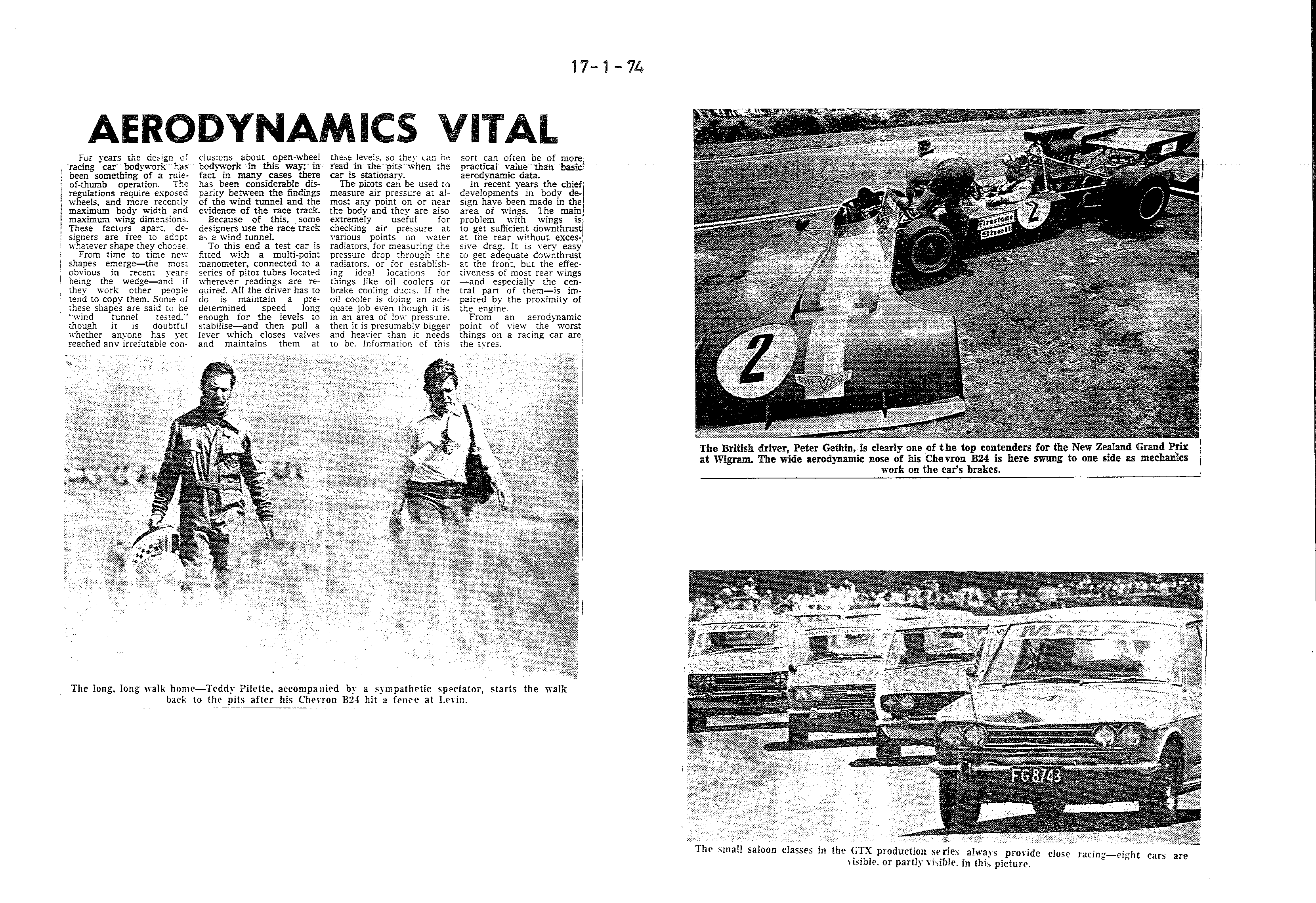
Technical feature on racing-car bodywork design: designers use the track as a wind tunnel with pitot tubes and manometers to measure air pressure, and wings must give rear downthrust without excessive drag. The tyres are the worst aerodynamic elements of the car.

Photos

  • The long, long walk home: Teddy Pilette, accompanied by a sympathetic spectator, starts the walk back to the pits after his Chevron B24 hit a fence at Levin.
  • The British driver Peter Gethin is clearly one of the top contenders for the NZ Grand Prix at Wigram. The wide aerodynamic nose of his Chevron B24 is swung to one side as mechanics work on the car's brakes.
  • The small saloon classes in the GTX production series always provide close racing; eight cars are visible in this picture.
Read the OCR text
17-1-74 AERODYNAMICS VITAL Fur years the design of racing car bodywork has been something of a ruleof-thumb operation. The regulations require exposed wheels, and more recently maximum body width and maximum wing dimensions. These factors apart. designers are free to adopt whatever shape they choose. From time to time new shapes emerge-the most obvious recent years being the wedge-and they work other people tend to copy them. Some of these shapes are said to be "wind tunnel tested." though is doubtful whether anyone has yet reached anv irrefutable con- clusions about open-wheel bodywork in this way; in faci in many cases there has been considerable disparity between the findings of the wind tunnel and the evidence of the race track. Because of this, some designers use the race track as a wind tunnel. To this end a test car is fitied with a multi-point manometer, connected to a series of pitot tubes located wherever readings are required. All the driver has to do is maintain a predetermined speed long enough for the levels to stabilise-and then pull a lever which closes valves and maintains them at these levels, so the! can ne read in the pits when the car is stationary. The pitots can be used to measure air pressure at almost any point on or near the body and they are also extremely useful for checking air pressure at various points water radiators, for measuring the pressure drop through the radiators. or for establishing ideal locations tor things like oil coolers or brake cooling ducts. if the oil cooler is doing an adequate job even though it is in an area of low pressure. then it is presumably bigger and heavier than it needs to be. Information of this sort can often be of more practical value than basic aerodynamic data. In recent years the chief developments in body design nave been made in the area of wings. The main problem with wings is to get sufficient downthrust at the rear without exces-i sive drag. It is very easy to get adequate downthrust at the front, but the effectiveness of most rear wings —and especially the central part of them—is impaired by the proximity of the engine. From an aerodynamic point of view the worst things on a racing car are the tyres. The long. long walk home—Teddy Pilette, accompanied by a sympathetic spectator, starts the walk ck to the pits after his Cherron Bit hit a fenee at Levin. Shell The British driver, Peter Gethin, is clearly one of the top contenders for the New Zealand Grand Prix at Wigram. The wide aerodynamic nose of his Chevron B24 is here swung to one side as mechanics work on the car's brakes. FG 8743 The small saloon classes in the GTX production series always provide close racing-eight ears are visible. or partly visible. in this picture.

Summaries and tables are machine-read from the scan and may contain errors: the scan is the record.