Read the OCR text
17-9-74
F5000
comes of
In its four years of
history in Europe, the
Tasman-style formula,
Formula 5000, with its
use of 5-litre stockblock V8 engines, , has
seemed the right formula for close, exciting,
and relatively inexpensire racing. But somehow, it never quite
seemed to «click."
Then last year everything came right, and the
31-year-old Belgian driver
Teddy Pilette WOn the
European championship, in
Chevron B24, after a
battle as close as it bad
- been in Formula 1.
More than that, in at
least two major meetings
Formula 5000 cars and
drivers showed they had at
last achieved the pace to
stay with, and even beat,
Formula 1 machinery.
Ace-O.S.C.A.
One of the features at
Wigram will be the Ace-
O.S.C.A. saloon race, the
fourth round in the South
Island series, and possibly
- because of the fuel
crisis : - the second-last
round as well.
The series is led by
Kevin Haig (Mustang) with
24 points to the 10 of Tre+
VOI Crowe (Corolla
Chevrolet), and the nine of
Graham Baker (P.D.L. Mus+
tang).
The series began as the
O.S.C.A. series in the 1971-
72 series, with R. McPhail,
the Open Saloon Car Association's president, putting
up the money himself to
get the series under way.
At the end of the season,
E. W. Pidgeon and Company of Christchurch, mar
keters of Ace products,
took ap the sponsorship,
and the series became the
Ace-O.S.C.A. series. It has
gone from strength to
strength, offering exciting
and competitive racing at a
realistic price to competitors.
The formula had come of out on the title by just one
age. placing in the final race.
In winning the European Keith Holland of Britain
title, Pilette — now here to was third, with 116 points,
contest the New Zealand
Grand Prix at Wigram, and and another Stuyvesant
the Stuyvesant $100,000 series contender, Steve
series in New Zealand and Thompson, finished fifth in
Australia - took his Team the series.
VDS car to two wins, three Why did the formula
seconds, two thirds, and a suddenly "come right"? Acfourth for a total of 136 cording to the experts, bepoints. cause there were at last sui-
Tony Dean, of England, ficient really competitive
drivers who were capable
was second in the series of racing a big F5000 car
with 133 points, missing rather than just driving it.
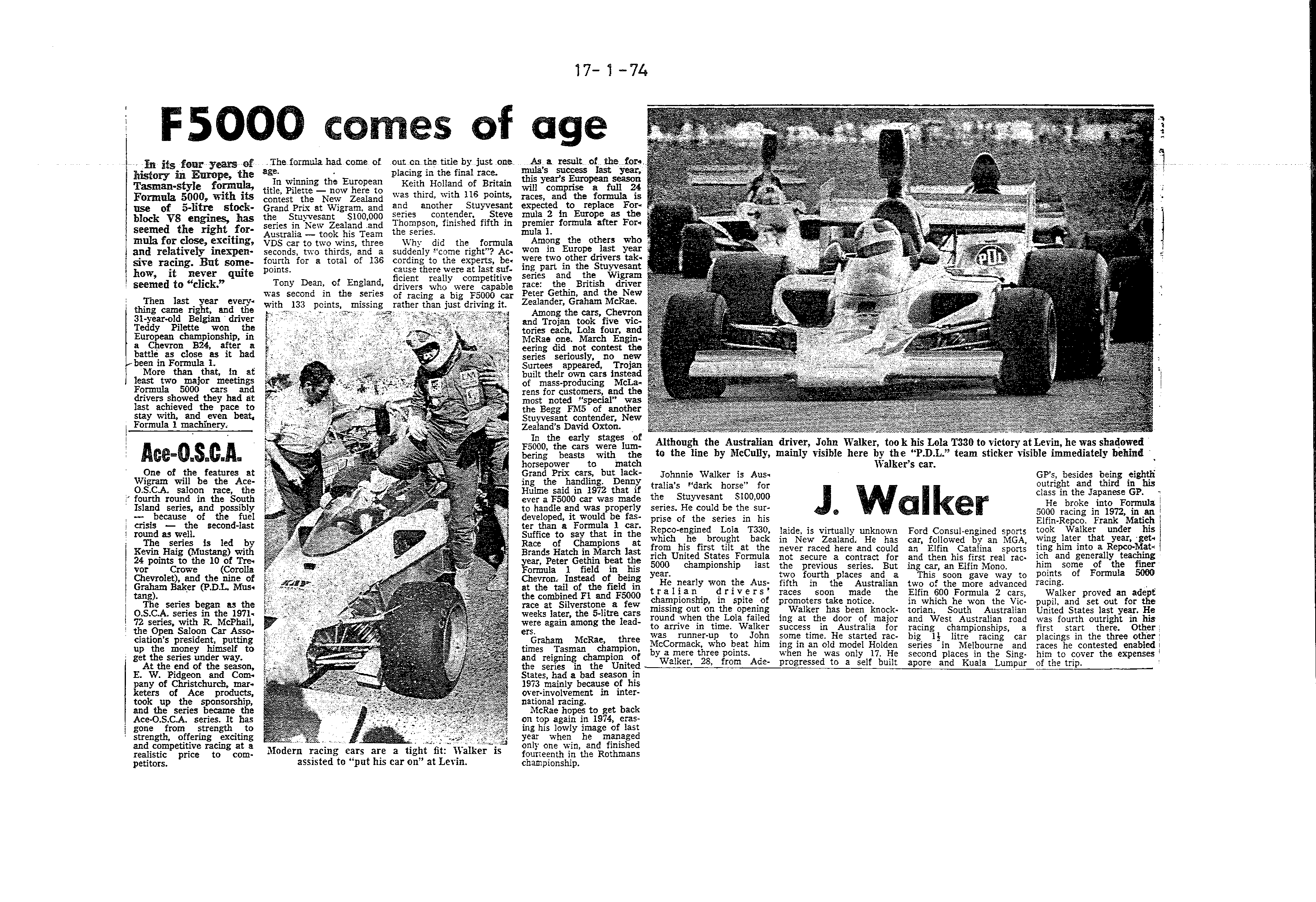
Modern racing cars are a tight fit: Walker is
assisted to "put his car on" at Levin.
age
As a result of the Lore
mula's success • last year;
this year's European season
will comprise a full 24
races, and the formula is
expected to replace Formula 2 in Europe as the
premier formula after For*
mula 1.
Among the others who
won in Europe last year
were two other drivers taking part in the Stuyvesant
senes and the Wigram
race: the British driver
Peter Gethin, and the New
Zealander, Graham McRae.
Among the cars, Chevron five vicand Trojan took
tories each, Lola four, and
McRae one. March Engineering did not contest the
series seriously,
Surtees appeared, Trojan
built their own cars instead
of mass-producing McLatens for customers, and the
most noted "special was
the Begg FM5 of another
Stuyvesant contender, New
Zealand's David Oxton.
In the early stages
F5000, the cars were lumbering beasts with the
horsepower to match
Grand Prix cars, but lacking the handling. Denny
Hulme said in 1972 that if
ever a F5000 car was made
to nandie ana was proper-s
developed, it would be taster than & Formula 1 car.
Suffice to say that in the
Race of Champions
Brands Hatch in March last
year, Peter Gethin beat the
Formula 1 field his
Chevron. Instead of being
at the tail of the field in
the combined Fi and F5000
race at Silverstone a few
weeks later, the 5-litre cars
were again among the leaders.
Graham McRae, three
times Tasman champion,
and reigning champion of
the series in the United
States, had a bad season in
1973 mainly because of his
over-involvement in international racing.
McRae hopes to get back
on top again in 1974, erasing his lowly image of last
year when managed
only one win, and finished
fourteenth in the Rothmans
championship.
Although the Australian
to the line by MeCully,
Johnnie Walker is Australia's "dark horse" for
the Stuyvesant $100,000
series. He could be the surprise of the series in his
Repco-engined Lola 1330,
which he brought back
from his first tilt at the
rich United States Formula
5000 championship last
year.
He nearly won the Australian drivers"
missing out on the opening championship, in spite
round when the Lola failed
to arrive in time. Walker
was runner-up to John
McCormack, who beat him
by a mere three pomts.
walker, 2o, trom Ade-
driver, John Walker, took his Lola T330 to victory at Levin, he was snadowed
mainly visible here by the «P.D.L." team sticker visible immediately behind
Walker's car.
GP's, besides being eighth
outright and third in his
class in the Japanese GP.
J. Walker Elfin-Repco. 5000 racing in 1972, in an He broke into Formula Frank Matich
laide, is virtually unknown Ford Consul-engined sports took Walker under his
in New • Zealand. He has car, followed by an MGA, wing later that year, gett
never raced here and could an Elfin Catalina sports ting him into a Repco-Matnot secure a contract for and then his first real rac- ich and generally teaching
the previous series. But ing car, an Elfin Mono. him some of the finer
two fourth places and This soon gave way to points of Formula 5000
fifth in the Australian two of the more advanced Iacing.
races soon made the Elfin 600 Formula 2 cars, Walker proved an adept
promoters take notice. in which he won the Vic- pupil, and set out for the
Walker has been knock- torian, South Australian United States last year. He
ing at the door of major and West Australian road was fourth outright in his
success in Australia for racing championships, first start there. Other
some time. He started rac- big 14 litre racing car placings in the three other
ing in an old model Holden series in Melbourne and races he contested enabied
when he was only 17. He second places in the Sing- him to cover the expenses
progressed to a self built apore and Kuala Lumpur of the trip.
Summaries and tables are machine-read from the scan and may contain errors: the scan is the record.