Wigram TrophyMotor racing at Wigram airfield · Christchurch · 1949–2000
Home › Archive › 1968 › Motor racing is now strictly controlled
← 16 Jan 1968All 1968 pages16 Jan 1968 →
Scan of the clipping page, 16 January 1968
↗
Drag to move · scroll or pinch to zoom
feature

Motor racing is now strictly controlled

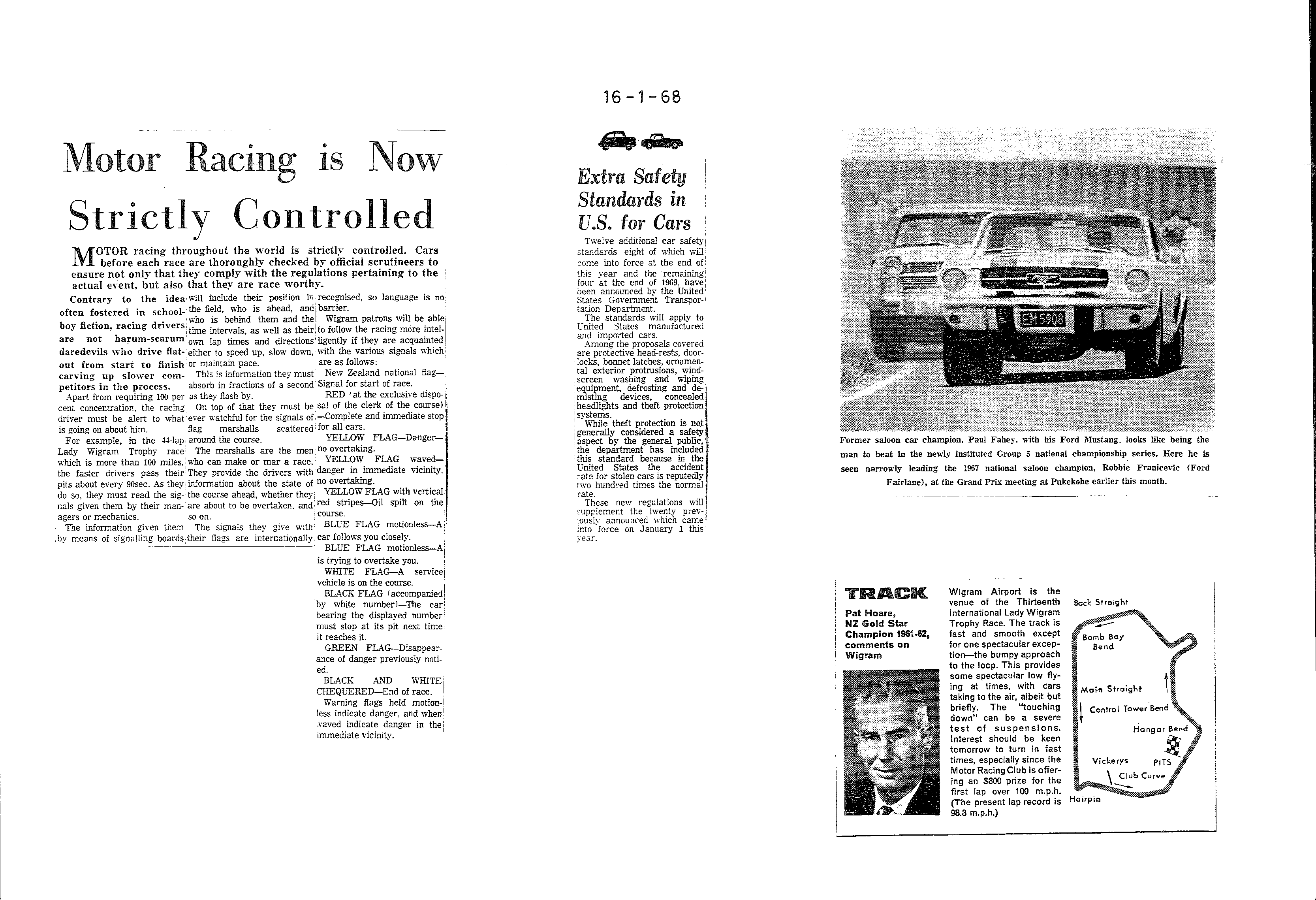
Explainer for Wigram spectators on how racing is controlled: cars are checked by scrutineers, faster drivers pass their pits about every 90 seconds in the 44-lap, 100-mile Lady Wigram Trophy and read pit signals, and marshals use internationally recognised flags. The flag meanings (start, red, yellow, blue, white, black, green and chequered) are listed.

Facts

  • In the 44-lap Lady Wigram Trophy race the faster drivers passed their pits about every 90 seconds.
news

Extra safety standards in U.S. for cars

Twelve additional US car safety standards, eight effective at the end of 1968 and four at the end of 1969, were announced covering head-rests, door locks, bonnet latches and other items, supplementing twenty announced earlier.

photo

Former saloon champion Paul Fahey's Ford Mustang looked the man to beat in the new Group 5 national championship series, shown narrowly leading Robbie Francevic's Ford Fairlane at the Grand Prix meeting at Pukekohe in January 1968.

Facts

  • A new Group 5 national saloon championship series was instituted for 1968; Robbie Francevic was the 1967 national saloon champion.

Photos

  • Former saloon car champion Paul Fahey, with his Ford Mustang, looks like being the man to beat in the newly instituted Group 5 national championship series, narrowly leading the 1967 national saloon champion Robbie Francevic (Ford Fairlane) at the Grand Prix meeting at Pukekohe earlier this month.
feature · Pat Hoare

Pat Hoare, NZ Gold Star champion 1961-62, comments on Wigram

Pat Hoare describes Wigram as a fast, smooth circuit except for a bumpy approach to the loop where cars can briefly become airborne, testing suspensions. He notes the Motor Racing Club's $800 prize for the first lap over 100 mph, with the lap record then 98.8 mph.

Lap times

  • : 98.8 mph lap record

Facts

  • The Motor Racing Club offered an $800 prize for the first lap over 100 mph at Wigram.
  • The Wigram lap record was 98.8 mph at the time of writing; corners included Bomb Bay Bend, Hangar Bend, Vickerys, Club Curve, the Hairpin and Control Tower Bend.
Read the OCR text
16-1-68 Motor Strict Vlot racing in M before each rac ensure not only that th actual event, but also Contrary to the idea: often fostered in schoolboy fiction, racing drivers are not harum-scarum daredevils who drive flatout from start to finish carving up slower competitors in the process. Apart from requiring 100 per cent concentration, the racing driver must be alert to what is going on about him. For example, in the 44-lap; Lady Wigram Trophy race which is more than 100 miles, the faster drivers pass their pits about every 90sec. As they do so, they must read the signals given them by their managers or mechanics. The information given them by means of signalling boards Racing is Now y Controlled roughout the world is strietly are thoroughly checked by offici hey comply with the regulations that they are race worthy. controlled. Cars ial scrutineers to pertaining to the will include their position in the field, who is ahead, and who is behind them and the time intervals, as well as their own lap times and directions either to speed up, slow down, or maintain pace. This is information they must absorb in fractions of a second as they flash by. On top of that they must be ever watchful for the signals of flag marshalis scattered around the course. The marshalis are the men who can make or mar a race. They provide the drivers with information about the state of the course ahead, whether they are about to be overtaken, and so on. The signals they give with their flags are internationally recognised, so language is no barrier. Wigram patrons will be able; to follow the racing more intel-i 'ligently if they are acquainted with the various signals which are as follows: New Zealand national flag- Signal for start of race. RED fat the exclusive dispo-i sal of the clerk of the course! —Complete and immediate stop for all cars. YELLOW FLAG-Dangerno overtaking. YELLOW FLAG waved danger in immediate vicinity, no overtaking. YELLOW FLAG with vertical red stripes-Oil spilt on the course. BLUE FLAG motionless-A car follows you ciosely. BLUE FLAG motionlessA is trying to overtake you. WHITE FLAG-A service vehicle is on the course. BLACK FLAG (accompanied by white number-The car! bearing the displayed number must stop at its pit next time: it reaches it. GREEN FLAG-Disappearance of danger previously notieli. BLACK AND WHITE CHEQUERED-End of race. Warning flags held motion-! less indicate danger, and when vaved indicate danger in thei immediate vicinity. Extra Safety Standards in U.S. for Cars Twelve additional car safety! standards eight of which will come into force at the end of! this vear and the remaining four at the end of 1969, have; been announced by the United' States Government Transpor-i tation Department. The standards will apply to United States manufactured and imported cars. Among the proposals covered are protective head-rests, door- • locks, bonnet latches, ornamental exterior protrusions, windscreen washing and wiping equipment, defrosting and de misting devices, concealed: headlights and theft protection systems. While theft protection is not generally considered a safety aspect by the general public, the department has included this standard because in the United States the accident rate for stolen cars is reputedly two hundred times the normal rate. These new regulations will supplement the twenty previously announced which camel into force on January 1 this rear. Former saloon car champion, Paul Fahey, with his Ford Mustang, looks like being the man to beat in the newly instituted Group 5 national championship series. Here he is seen narrowly leading the 1967 national saloon champion, Robbie Franicevie (Ford Fairlane), at the Grand Prix meeting at Pukekohe earlier this month. Pat Hoare, NZ Gold Star Champion 1961-62, comments on Wigram Wigram Airport is the venue of the Thirteenth International Lady Wigram Trophy Race. The track is fast and smooth except for one spectacular exception-the bumpy approach to the loop. This provides some spectacular low flying at times, with cars taking to the air, albeit but briefly. The "touching down" can be a severe test of suspensions. Interest should be keen tomorrow to turn in fast times, especially since the Motor Racing Club is offering an $800 prize for the first lap over 100 m.p.h. (The present lap record is 98.8 m.p.h.) Back Straight Bomb Bay Bend Main Straight Control Tower Bend Hangar Bend Vickerys PITS Club Curve Hairpin

Summaries and tables are machine-read from the scan and may contain errors: the scan is the record.