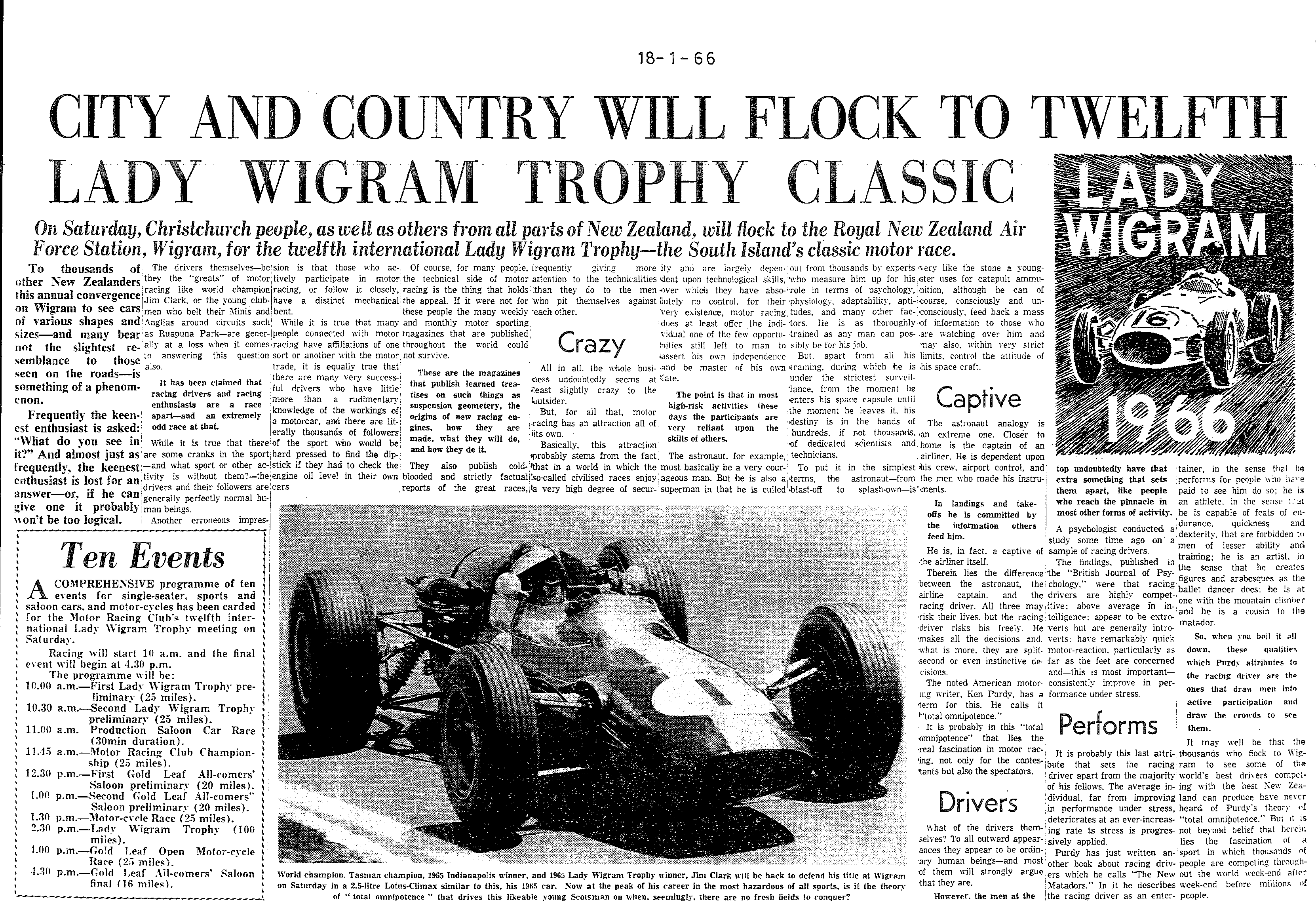
featureCity and country will flock to Lady Wigram Trophy classic
Pre-race feature asking why people are drawn to motor racing, arguing that racing offers a rare chance to be master of one's own fate (Ken Purdy's 'total omnipotence') compared with astronauts or airline pilots. It also cites a psychological study of racing drivers and notes Jim Clark would defend his title in a 2.5 litre Lotus-Climax.
Facts
- The 1966 Lady Wigram Trophy was the twelfth international race and was called the South Island's classic motor race.
- Jim Clark returned to Wigram in January 1966 as world champion, Tasman champion, 1965 Indianapolis 500 winner and defending Lady Wigram winner.
Photos
- World champion, Tasman champion, 1965 Indianapolis winner, and 1965 Lady Wigram Trophy winner, Jim Clark will be back to defend his title at Wigram on Saturday in a 2.5 litre Lotus-Climax similar to this, his 1965 car.
programmeTen events
Programme of ten events for single-seater, sports and saloon cars and motor-cycles at the twelfth Lady Wigram Trophy meeting on Saturday 22 January 1966, racing from 10 am to 4.30 pm: two 25-mile trophy preliminaries, production saloons, club championship, two Gold Leaf all-comers heats, two motor-cycle races, the 100-mile trophy and the Gold Leaf all-comers final.
Facts
- The 1966 Wigram programme: two 25-mile trophy preliminaries at 10.00 and 10.30, the 100-mile Lady Wigram Trophy at 2.30 pm and a 16-mile all-comers saloon final at 4.30 pm.
Read the OCR text
18-9-66
CITY
AND
COUNTRY
WILL
FLOCK
TO T
LADY
WIGRAM
TROPHY
CLASSIC
On Saturday, Christchurch people, as well as others from all parts of New Zealand, will flock to the Royal New Zealand Air
Force Station, Wigram, for the twelfth international Lady Wigram Trophy-the South Island's classic motor race.
To thousands of
other New Zealanders
this annual convergence
on Wigram to see cars
of various shapes and
sizes-—and many bear
unt the slightest resemblance to those
seen on the roads-is
something of a phenomenon.
Frequently the keenest enthusiast is asked:
The drivers themselves-be
they the "greats" of motor
racing like world champion
Jim Clark, or the young clubmen who belt their Minis and
'Anglias around circuits such!
as Ruapuna Park-are gener-
'ally at a loss when it comes.
to answering this question
It has been claimed that
racing drivers and racing
enthusiasts аге • гасе
apart-and an extremely
odd race at that.
"What do you see in
it?" And almost just as
frequently, the keenest
enthusiast is lost for an
answer- or, if he can
give one it probably
won't be too logical.
While it is true that there
'are some cranks in the sport
-and what sport or other activity is without them?-the
drivers and their followers are
generally perfectly normal human beings.
Another erroneous impres-
Ten Events
A COMPRESSIVE programme of ten events for single-seater, sports and
saloon cars, and motor-cycles has been carded
for the Motor Racing Club's twelfth international Lady Wigram Trophy meeting on
Saturday.
Racing will start 10 a.m. and the final
event will begin at 4.30 p.m.
The programme will be:
10.00 a.m.—First Lady Wigram Trophy preliminary (25 miles).
10.30 a.m.—Second Lady Wigram Trophy
preliminary (25 miles).
11.00 a.m. Production Saloon Car Race
(30min duration).
11.15 a.m.—Motor Racing Club Championship (25 miles).
12.30 p.m.—First Gold Leaf All-comers'
Saloon preliminars (20 miles).
1.00 p.m.—Second Gold Leaf All-comers"
Saloon preliminars (20 miles).
1.30 p.m.-Motor-cvele Race (25 miles).
2.30 p.m.—Lady Wigram Trophy (100
miles).
1.00 p.m.-Gold Leaf Open Motor-eyele
Race (25 miles).
4.30 p.m.—Gold Leaf All-comers' Saloon
final (16 miles).
sion is that those who ac-
¡tively participate in motor
racing, or follow it closely,
have a distinct mechanical
i bent.
1! While it is true that many
- people connected with motor
racing have affiliations of one
sort or another with the motor
¡trade, it is equally true that
there are many very successful drivers who have littie
more than a rudimentary
knowledge of the workings of
a motorcar, and there are literally thousands of followers
lof the sport who would be
hard pressed to find the dipstick if they had to check the
jengine oil level in their own
cars
Of course, for many peopie,
the technical side of motor
racing is the thing that holds
the appeal. If it were not for
tese people the many weekly
and monthly motor sporting
magazines that are published
throughout the world could
not survive.
These are the magazines
that publish learned trea
tises on such things as
suspension geomelery, the
origins of new racing enzines. how they are
made, what they will do,
and now they de it.
They aiso publish coldblooded and strictly factual
reports of the great races,.
frequently giving more
attention to the technicalities
• than they do to the men
who pit themselves against
reach other.
Crazy
All in all, the whole business undoubtedly seems at
¡least slightly crazy to the
utsider.
But, for ail that. motor
racing has an attraction all of
• its own.
Basically. this attraction
*that ila tens in the face
('so-called civilised races enjoy
la very high degree of secur-
ity and are largeiy dependent upon technological skills,
over which they have abso
dutely no control, for their
very existence, motor racing
does at least offer the individual one of the few opportumities still left to man to
tassert his own independence
•and be master of his own
The point is thai in most
high-risk activities these
days the participants are
very reliant upon the
skills of others.
The astronaut, for example,
must basically be a very courageous man. But he is also a
superman in that he is culled
out from thousands by experts
who measure him up for his
¡role in terms of psychology,
physiology, adaptability, aptitudes, and many other factors. He is as thoroughly
trained as any man can possily be for his job.
But, apart from ali his
*raining, during which he is
under the strictest surveillance, from the moment he
enters his space capsule until
the moment he leaves it. his
destiny is in the hands of
hundreds, if not thousands.
of dedicated scientists and
technician
To put it in the simplest
i terms, the astronaut-from
•blast-off to splash-own-is
World champion, Tasman champion, 1965 Indianapolis winner, and 1965 Lady Wigram Trophy winner, Jin Clark will be back to defend his title at Wigram
on Saturday in a 2.5 litre Lotus-Climax similar lo this, his 1965 car. Now at the peak of his career in the most hazardous of all sports, is it the theory
of "total omnipotence " that drives this likeabie voung Scotsman on when, seemingly, there are no fresh fields to conquer?
very like the stone a young-
„ster uses for catapult ammu-
•nition, although he can of
course, consciously and un-
'consciously. feed back a mass
of information to those who
are watching over him and
mar aiso, within very strict
limits, control the attitude of
•his space craft.
Captive
• The astronaut analogy is
an extreme one. Closer TO
[home is the captain of an
: airliner. He is dependent upon
his crew, airport control, and
the men who made his instru-
(ments.
In landings and takeoffs he is committed by
the information others
feed him.
He is, in fact, a captive of
the airliner itself.
Therein lies the difference
between the astronaut, the
airline captain. and the
racing driver. All three may
risk their lives. but the racing
driver risks his freely. He
'makes all the decisions and.
what is more, they are splitsecond or even instinctive de
cisions
The noted American motoring writer, ken Purdy. has a
term for this. He calls it
"'total omnipotence."
It is probably in this "total
omnipotence" that lies the
real fascination in motor rac-
'ing. not only for the contestants but also the spectators.
Drivers
What of the drivers themseives? To all outward appearances they appear to be ordinary human beings and most
of them will strongly argue
that they are.
However, the men at the
'WELFTH
LADY
NIGRAM
top undoubtedly have that
extra something that sets
them apart, like people
who reach the pinnacie in
most other forms of activity.
A psychologist conducted a
study some time ago on a
sample of racing drivers.
The findings, published in
the "British Journal of Psyi chology." were that racing
drivers are highiy competitive: above average in inteiligence: appear to be extrnverts but are generally intro
verts: have remarkably quick
motor-reaction. particulariy as
far as the feet are concerned
and-this is most importantconsistently improve in performance under stress.
Performs
It is probably this last attri-
Ibute that sets the racing
driver apart from the majority
of his fellows. The average individual, far from improving
in performance under stress,
deteriorates at an ever-increasing rate is stress is progresi sively applied.
Purdy has just written another book about racing drivers which he calls The New
Matadors." In it he describes
the racing driver as an enter-
tainer, in the sense thai he
performs for people who bare
paid to see him do so; he is
an athlete, in the sense 1:at
he is capable of feats of endurance. quickness and
dexterity. that are forbidden in
men of lesser ability and
training; he is an artist, in
the sense that he creats
figures and arabesques as the
ballet dancer does: he is at
one with the mountain climber
'and he is a cousin to the
matador.
So. when you boil it all
down, these qualities
which Purd attributes
the racing driver are the
ones that draw men info
active participation and
draw the crowds to see
then.
It may well be that the
thousands who fock to Wigram to see some of the
world's best drivers compeiing with the best New Zealand can produce have never
heard of Purdy's theory «E
"total omnipotence. " Buf it is
not beyond belief that herein
lies the fascination nt a
sport in which thousands nf
people are competing throughout the world week-end after
week-end before millions of
people.
Summaries and tables are machine-read from the scan and may contain errors: the scan is the record.