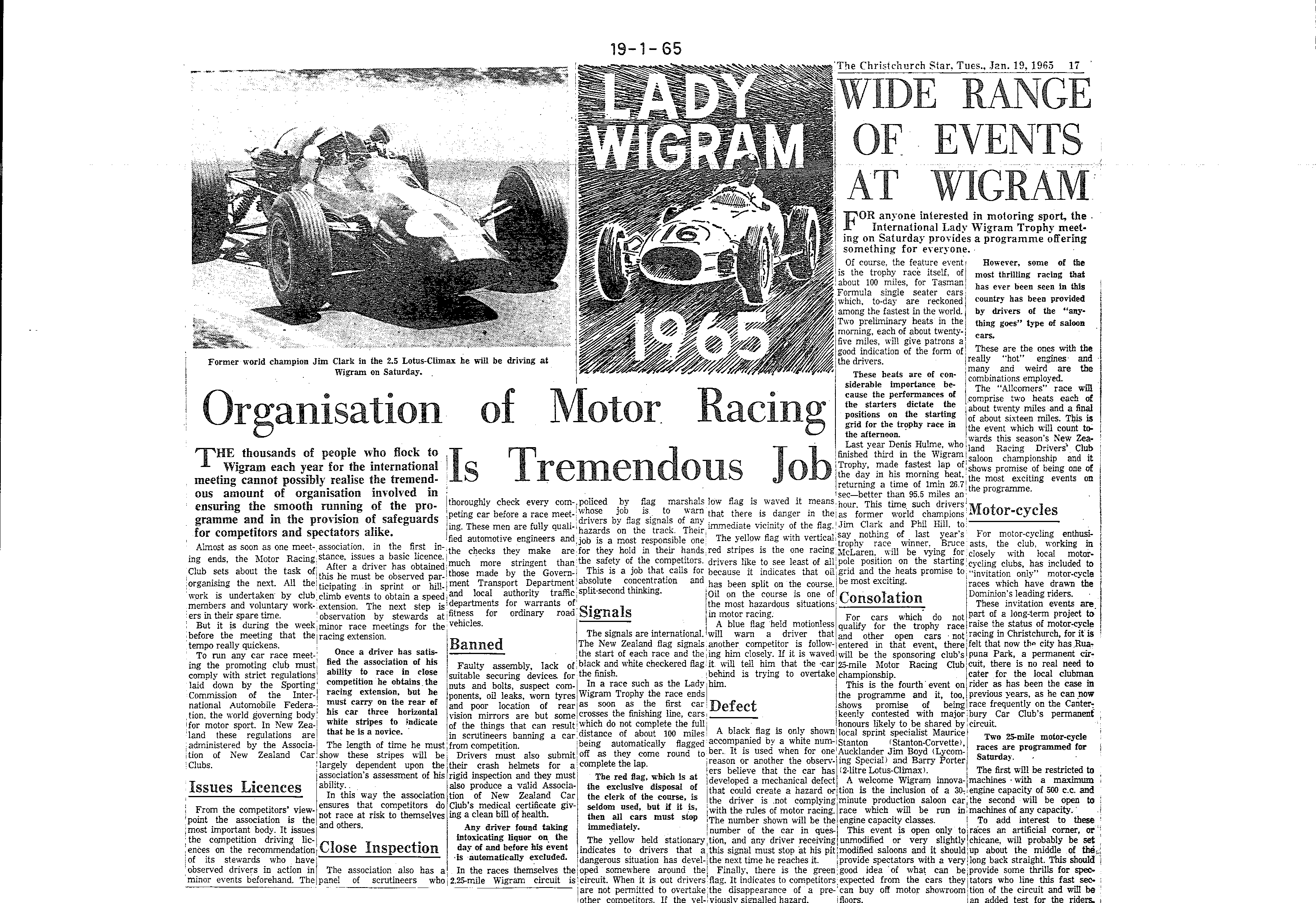
featureOrganisation is tremendous job
Feature on the organisation behind the Lady Wigram Trophy meeting: Motor Racing Club members and volunteers do all the work; the Association of New Zealand Car Clubs issues licences, with novices carrying three white stripes; scrutineers inspect cars and helmets; flag marshals use standard flag signals, and a driver found drinking is excluded.
Facts
- Novice racing drivers in New Zealand carried three horizontal white stripes on the rear of their cars (1965).
- The Wigram circuit was described as 2.25 miles in 1965.
- In the Lady Wigram Trophy the race ends when the winner crosses the line, and cars not completing the distance of about 100 miles are flagged off as they come round.
- Race flags at Wigram: red (clerk of the course only) stop immediately; yellow danger; yellow with red stripes oil on the track; blue another car behind; black with white number stop at pit; green all clear.
Photos
- Former world champion Jim Clark in the 2.5 Lotus-Climax he will be driving at Wigram on Saturday.
previewRange of events at Wigram
Preview of the 1965 Lady Wigram meeting: the 100-mile Trophy race for Tasman Formula cars with two 25-mile morning heats deciding the grid; Clark, Phil Hill and last year's winner McLaren expected to vie for pole. Other events: 25-mile Motor Racing Club championship (Stanton, Boyd, Porter), a new 30-minute production saloon race, all-comers saloons counting towards the NZ Racing Drivers' Club championship, and two 25-mile invitation motor-cycle races.
Lap times
- Denis Hulme (Repco-Brabham-Climax): 1:26.7 fastest race lap
Facts
- The 1965 Lady Wigram meeting introduced a 30-minute production saloon race run in engine capacity classes.
- The 1965 all-comers saloon race (two heats of about 20 miles and a final of about 16 miles) counted towards the NZ Racing Drivers' Club saloon championship.
- In 1965 the Motor Racing Club ran two invitation-only 25-mile motor-cycle races (500cc maximum, then open capacity) as Christchurch now had the permanent Ruapuna Park circuit for clubmen.
- Hulme's 1:26.7 in his 1964 heat was the fastest lap of the day, better than 95.5 mph.
Read the OCR text
19-1-65
son. wow :коак
Former world champion Jim Clark in the 2.5 Lotus-Clim
Wigram on Saturday.
Orga
nisation
THE thousands of people who fock to
Wigram each year for the international
meeting cannot possibly realise the tremendous amount of organisation involved
ensuring the smooth running of the programme and in the provision of safeguards
for competitors and spectators alike.
Almost as soon as one meeting ends, the Motor Racing
Club sets about the task of
organising the next. All the
work is undertaken by club
members and voluntary workers in their spare time.
But it is during the week
before the meeting that the
tempo really quickens.
To run any car race meeting the promoting club must
comply with striet regulations
laid down by the Sporting
Commission of the International Automobile Federation, the world governing body
for motor sport. In New Zea-
'land these regulations are
administered by the Associaition of New Zealand Car Car
Clubs.
Issues Licences
From the competitors' viewpoint the association is the
most important body. It issues
the competition driving lieences on the recommendation
of its stewards have
observed drivers in action in
minor events beforehand. The
association, in the first instance, issues a basic licence.
After a driver has obtained
this he must be observed participating in sprint or hillclimb events to obtain a speed
extension. The next step is
observation by stewards at
minor race meetings for the
racing extension.
Once a driver has satisfied the association of his
ability to race in close
competition he obtains the
racing extension, but he
must carry on the rear of
his car three horizontal
white stripes to indicate
that he is a novice.
The length of time he must
show these stripes will be
largely dependent upon the
association's assessment of his
ability..
In this way the association
ensures that competitors do
not race at risk to themselves
and others.
Close Inspection
The association also has a
panel of scrutineers who
ax he will be driving at
Is Tre
thoroughly check every competing car before a race meeting. These men are fully quali-
fied automotive engineers and
the checks they make are
much more stringent than
those made by the Government Transport Department
and local authority traffic
departments for warrants of
fitness for ordinary road
i vehicles.
Banned
Faulty assembly, lack of
suitable securing devices for
nuts and bolts, suspect components, of leaks, worn tyres
and poor location of rear
vision mirrors are but some
of the things that can result
in scrutineers banning a car
from competițion.
Drivers must also submit
their crash helmets for a
rigid inspection and they must
also produce a valid Association of New Zealand Car
Club's medical certificate giving a clean bill of health.
Any driver found taking
intoxicating liquor on the
day of and before his event
• is automatically excluded.
In the races themseives the
2.25 mile Wigram circuit is
LADY
WIGRAM
1902
lotor
Racing
mendous Job
policed by flag marshals
whose job is. to warn
drivers by flag signals of any
hazards on the track. Their
job is a most responsible one
for they hold in their hands
the safety of the competitors.
This is a job that calls for
absolute concentration
split-second thinking.
Signals
The signals are international.
The New Zealand flag signals
the start of each race and the
black and white checkered fiag
the finish.
In a race such as the Lady
Wigram Trophy the race ends
as soon as the first car
crosses the finishing line, cars
which do not complete the full
distance of about 100 miles
being automatically flagged
off as they come round to
complete the lap.
The red flag, which is at
the exclusive disposal of
the clerk of the course, is
seldom used, but if it is,
then all cars must stop
immediately.
The yellow heid stationary
indicates to drivers that a
dangerous situation has developed somewhere around the
circuit. When it is out drivers
are not permitted to overtake
nther comnatitors If the vel.
low flag is waved it mea
that there is danger in the
immediate vicinity of the flag
The yellow flag with vertica
red stripes is the one racing
drivers like to see least of all
because it indicates that oi
has been split on the course.
Oil on the course is one of
the most hazardous situations
in motor racing.
A blue flag held motionless
will warn a driver that
another competitor is following him closely. If it is waved
it will tell him that the car
behind is trying to overtake
him.
Defect
A black flag is only shown
accompanied by a white number. It is used when for one
reason or another the observers believe that the car has
developed a mechanical defect
that could create a hazard or
the driver is not complying
with the rules of motor racing.
The number shown will be the
number of the car in ques
tion, and any driver receiving
this signal must stop at his pit
the next time he reaches it.
Pinally, there is the green
flag. It indicates to competitors
the disappearance of a pre-
The Christchurch Star, Tues.,
32n. 19, 1965 17
ANGE
OF EVENTS
AT WIGRAM
OR anyone interested in motoring sport, the
International Lady Wigram Trophy meeting on Saturday provides a programme offering
something for everyone.
Of course, the feature event
is the trophy race itself, of
about 100 miles, for Tasman
Formula single seater cars
which, to-day are reckoned
among the fastest in the world.
Two preliminary heats in the
morning, each of about twentyfive miles, will give patrons al
good indication of the form of
the drivers.
These beats are of considerable importance because the performances of
the starters dictate the
positions on the starting
grid for the trophy race in
the afternoon.
Last year Denis Hulme, who
finished third in the Wigram!
Trophy, made fastest lap of;
the day in his morning heat,
returning a time of 1min 26.7
1 sec-better than 95.5 miles an
hour. This time such drivers
las former world champions
Jim Clark and Phil Hill. to:
, say nothing of last year's
trophy race winner, Bruce
will be vying • for
¡pole position on the starting.
grid and the heats promise to
be most exciting.
Consolation
For cars which do not
qualify for • the trophy racel
and other open cars not
entered in that event, there
will be the sponsoring club's
25-mile Motor Racing Club
championsbip.
This is the fourth event on
the programme and it, too,
shows promise of being
keenly contested with major
honours likely to be shared by
local sprint specialist Maurice
Stanton (Stanton-Corvette),
Aucklander Jim Boyd (Lycom-
¡ing Special and Barry Porter
(2-litre Lotus-Climax).
A welcome Wigram innovation is the inclusion of a 30minute production saloon car
race which will be run in
engine capacity classes.
This event is open only to
unmodified or very slightly
modified saloons and it should
provide spectators with a very
good idea of what can be
expected from the cars they
can buy off motor showroom
However, some of the
most thrilling racing that
has ever been seen in this
country has been provided
by drivers of the "anything goes" type of saloon
cars.
These are the ones with the
really "hot" engines and
many and weird are the
combinations employed.
The "Allcomers" race will
comprise two heats each of
about twenty miles and a final
of about sixteen miles. This is
the event which will count to
wards this season's New Zealand Racing Drivers' Club
saloon championship and it
shows promise of being one of
the most exciting events on
the programme.
Motor-cycles
For motor-cycling enthusiasts, the club, working in
closely with local motorcycling clubs, has included to
"invitation only" motor-cycle
races which have drawn the
Dominion's leading riders.
These invitation events are
part of a long-term project to
raise the status of motor-cycle
racing in Christchurch, for it is
felt that now the city has Ruapuna Park, a permanent citcuit, there is no real need to
cater for the local clubman
rider as has been the case in
previous years, as he can now
race frequently on the Canterbury Car Club's permanent
circuit.
Two 25-mile motor-cycle
races are programmed for
Saturday.
The first will be restricted to
machines • with a maximum
engine capacity of 500 c.c. and
the second will be open to
machines of any capacity.
To add interest to these
races an artificial corner, or
chicane, will probably be set
long back straight. This should up about the middle of the
¡provide some thrills for spectators who line this fast seco
tion of the circuit and will be
an added fast for the riders.
Summaries and tables are machine-read from the scan and may contain errors: the scan is the record.