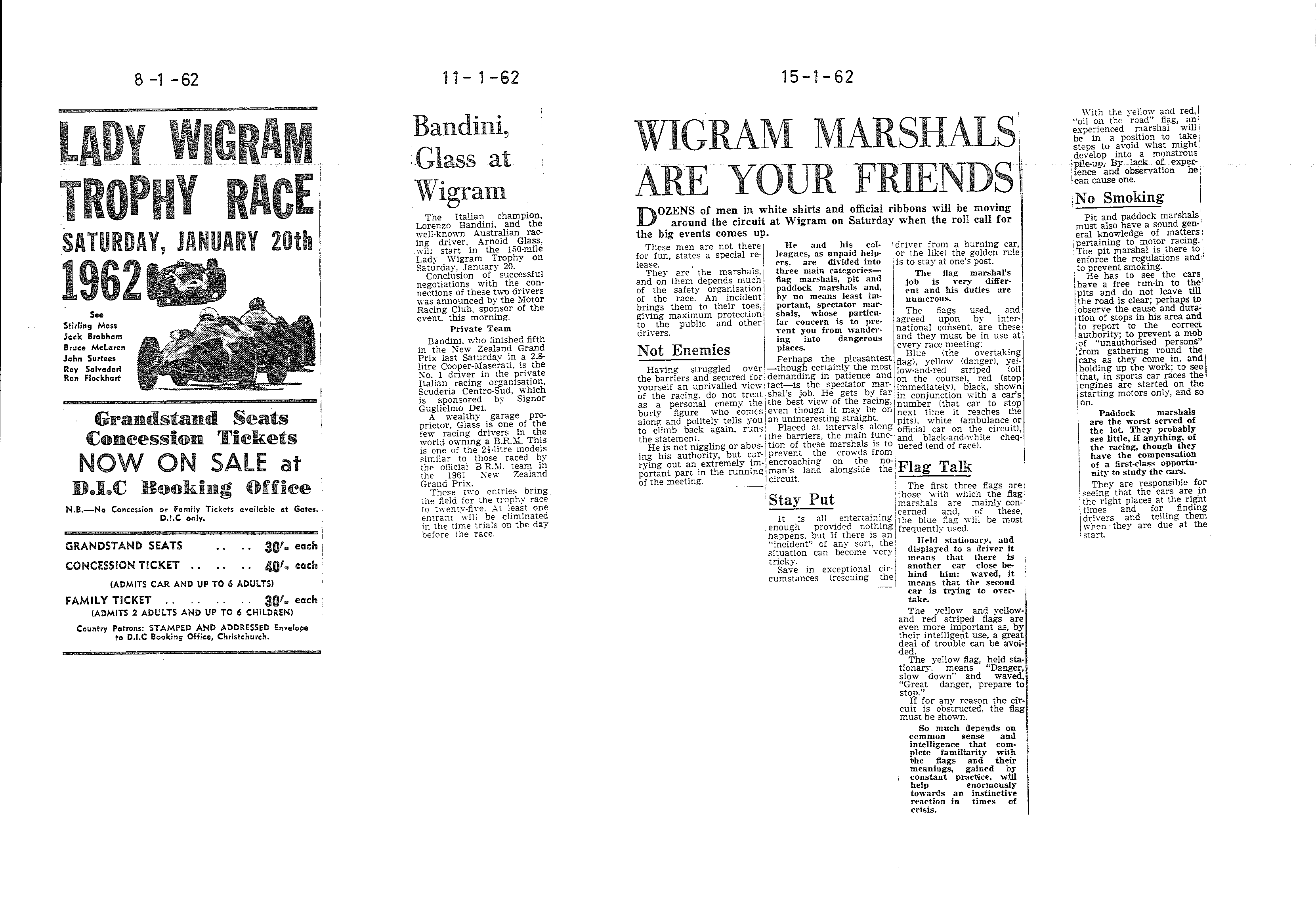
advertLady Wigram Trophy Race, Saturday January 20th 1962
Advert for the 1962 Lady Wigram Trophy race with Moss, Brabham, McLaren, Surtees, Salvadori and Flockhart; grandstand seats and concession tickets on sale at the D.I.C. booking office, family ticket admits 2 adults and up to 6 children.
newsBandini, Glass at Wigram
Italian champion Lorenzo Bandini and Australian Arnold Glass joined the 1962 Lady Wigram Trophy field, bringing it to twenty-five. Bandini finished fifth in the NZ Grand Prix in a 2.8-litre Cooper-Maserati for Scuderia Centro-Sud; Glass owns a 2.5-litre BRM.
Facts
- Lorenzo Bandini finished fifth in the January 1962 New Zealand Grand Prix in a 2.8-litre Cooper-Maserati.
- The 1962 Lady Wigram Trophy field reached twenty-five entries with the addition of Bandini and Glass, with at least one to be eliminated in time trials.
featureWigram marshals are your friends
Explains the roles of unpaid marshals at Wigram: spectator marshals, flag marshals and pit and paddock marshals, and the meaning of the blue, yellow, yellow-and-red striped, red, black, white and chequered flags.
Facts
- Marshals at Wigram in 1962 were unpaid volunteers split into flag, pit and paddock, and spectator categories.
Read the OCR text
8-1-62 19-1-62 15-1-62
LADY
WIGRAM
TROPHY RACE
SATURDAY, JANUARY 20th
19620
See
Stirling Moss
Jack Brabham
Bruce Melaren
John Surtees
Roy Sairadori
Ron Flockhart
Grandstand eats
Concession lickets
NOW ON SALE at
DIC Booking Office
N.B.—No Concession or Family Tickets available at Gates.
D.I.C only.
GRANDSTAND SEATS
.. • •
CONCESSION TICKET
® 01 each
(ADMITS CAR AND UP TO & ADULTS)
FAMILY TICKET • • 30' each
(ADMITS 2 ADULTS AND UP TO 6 CHILDREN)
Country Patrons: STAMPED AND ADDRESSED Envelope
to D.I.C Booking Office, Christchurch.
Bandini. •9,
Glass at
Wigram
The Italian champion,
Lorenzo Bandini, and the
well-known Australian racing Arnold Glass,
will start drivel in the 150 mile
Lady Wigram Trophy
Saturday, January 20.
Conclusion of successiul
negotiations with the connections of these two drivers
was announced by the Motor
Racing Club, sponsor of the
event. this morning.
Private Team
Bandini, who finished fifth
in the New Zealand Grand
Prix last Saturday in a 2.8litre Cooper-Maserati, is the
No. 1 driver in the private
Italian racing organisation,
Scuderia Centro-Sud, which
is sponsored by Signor
Guglielmo Del.
A wealthy garage pro
prietor, Glass is one of the
few racing drivers in the
world owning a B.R.M. This
is one of the 22 litre modeis
similar to those raced by
the official B.R.M. team in
the 1961 New Zealand
Grand Prix.
These entries bring
the field for the trophy race
to twenty-five. At least one
entrant will be eliminated
in the time trials on the day
before the race.
WIGRAM
MARSHALS
ARE YOUR
FRIENDS
DOZENS of men in white shirts and official r
around the circuit at Wigram on Saturday
the big events comes up
These men are not there!
for fun, states a special re
lease.
They are the marshals,
and on them depends much
of the safety organisation
of the тасе. An incident
brings them to their toes,
giving maximum protection
the public and other
drivers.
Not Enemies
Having struggled over
the barriers and secured for
yourself an unrivalled view
of the racing. do not treat
as personal enemy the
burly figure who comes
along and politely telis you
to climb back again, rans
the statement.
He is not niggling or abusing his authority, but carrying out an extremely important part in the running
of the meeting.
He and his colleagues, as unpaid helpers, are divided into
three main categoriesflag marshals, pit and
paddock marshals and,
by no means least important, spectator marshals, whose particular concern is to prevent you from wandering into dangerous
places.
Perhaps the pleasantest
-though certainly the most
demanding in patience and
tact—is the spectator marshal's job. He gets by far
the best view of the racing,
even though it may be on
an uninteresting straight.
Placed at intervals along
i the barriers, the main tunction of these marshals is to
prevent the crowds from
encroaching on the по-
¡man's land alongside the
circuit.
Stay Put
It is all entertaining
enough provided • nothing
happens, but if there is an
"incident" of any sort, the
situation • can become very
tricky.
Save in exceptional circumstances (rescuing the
ibbons will be moving
when the roll call for
driver from a burning car,
or the like) the golden rule
is to stay at one's post.
The flag marshal's
job is very different and his duties are
numerous.
The and
agreed upon flags used, inter- by
national consent. are these
and they must be in use at
every race meeting:
Blue (the overtaking
flag), yellow (danger), yeilow-and-red striped foil
on the course), red (stop
immediately). black, shown
in conjunction with a car's
number (that car to stop
next time it reaches the
pits). white ambulance or
official car on the circuit,
and black-and-white chequered (end of race).
1
Flag Talk
The first three flags are!
those with which the flag
marshals are mainly concerned and, these,
the blue flag will be most
frequently used.
Held stationary, and
displajed to a uriver it
means that there
another car close behind him; waved, it
means that the second
car is trying to overtake.
The yellow and yellowand red striped flags are
even more important as, by
their intelligent use, a great
deal of trouble can be avoided.
The yellow fag, "Danger, held stationary. means
slow down" and waved
"Great danger, prepare to
stop.
If for any reason the circuit is obstructed, the fiag
must be shown.
So much depends on
common sense and
intelligence that com.
plete familiarity with
the flags and their
meanings, gained br
constant practice, will
help enormously
towards an instinctive
reaction in tinies of
crisis.
With the yellow and red,!
"oil on the road" flag, an
experienced marshal will
be in a position to take
Steps to avoid what might develop into a monstrous
pile up. By lack of exper-
Fence and observation
can cause one.
No Smoking
Pit and paddock marshals
must also have a sound general knowiedge of matters
pertaining to motor racing.
The pit marshal is there to
enforce the regulations and:
o prevent smoking.
He has to see the cars
have a free run-in to the
pits and do not leave till
the road is clear; perhaps to
observe the cause and dura-
(tion of stops in his area and
to report to the correct
authority; to prevent a mob
"unauthorised persons"
from gathering round the
cars as they come in, and
holding up the work; to see
that, in sports car races the!
¡engines are started on the
i starting motors only, and so
on.
Paddock marshals
are the worst served of
the • lot. They probably
see little, if anything, of
the racing, though they
have the compensation
of a first-class opportunity to study the cars.
They are responsible for
seeing that the cars are in
the right places at the right
times and finding
drivers and telling them
when they are due at the
i start.
Summaries and tables are machine-read from the scan and may contain errors: the scan is the record.