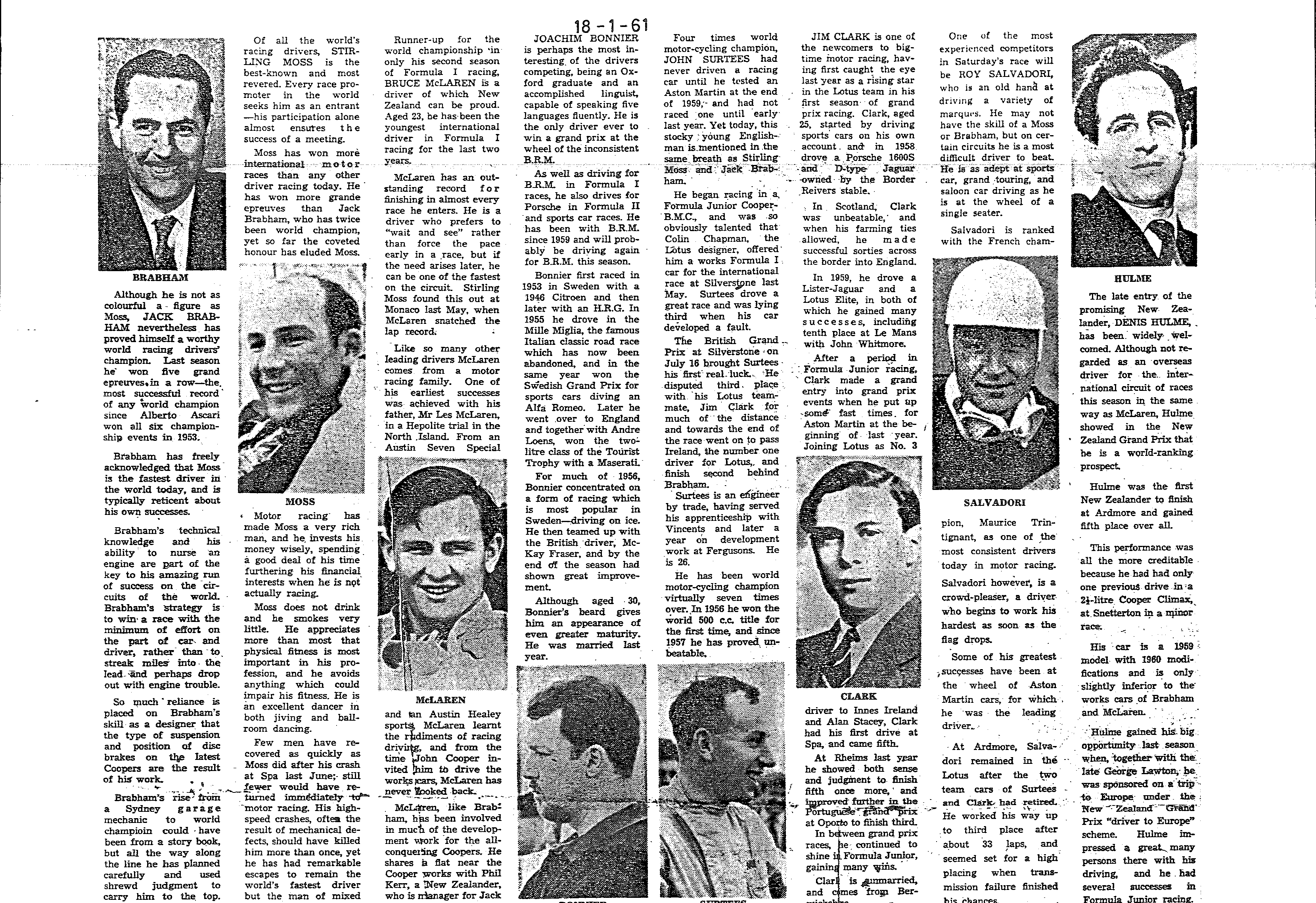
featureBrabham
Profile of reigning world champion Jack Brabham, who won five grandes epreuves in a row last season, a record since Alberto Ascari in 1953. A careful strategist and engineer-driver, he designed the suspension and disc brake position on the latest Coopers.
Facts
- Jack Brabham won five grandes epreuves in a row in 1960, the best run by a world champion since Alberto Ascari won all six in 1953.
- Brabham designed the suspension and the position of the disc brakes on the latest Cooper Formula One cars.
featureMoss
Profile of Stirling Moss, the best-known driver in the world and a drawcard for any promoter, with more international race wins than any other active driver but no world championship. He recovered quickly from his crash at Spa in June 1960.
Facts
- Stirling Moss crashed at Spa in June 1960 and recovered quickly, returning to racing immediately.
- As of January 1961 Moss had won more grandes epreuves than Jack Brabham yet had never been world champion.
featureMcLaren
Profile of Bruce McLaren, 23, runner-up for the world championship in only his second Formula One season and the youngest international driver in Formula One for two years. He is known for finishing almost every race and snatched the lap record from Moss at Monaco.
Facts
- Bruce McLaren was runner-up in the 1960 world championship in only his second Formula One season, aged 23.
- McLaren took the lap record at Monaco in May 1960, passing Stirling Moss's mark.
- McLaren learned racing in an Austin Seven Special and an Austin Healey before joining the Cooper works team.
featureBonnier
Profile of Swedish driver Joachim Bonnier, an Oxford graduate who speaks five languages and is the only driver to win a grand prix in a BRM. He had been with BRM since 1959 and began racing in 1953 in Sweden.
Facts
- Joachim Bonnier was the only driver ever to win a grand prix in a BRM, as of January 1961.
- Bonnier won the 1955 Swedish Grand Prix for sports cars in an Alfa Romeo and drove in the Mille Miglia that year.
featureSurtees
Profile of John Surtees, four-times world motor-cycling champion who had never driven a racing car until he tested an Aston Martin late in 1959. He raced Formula Junior Cooper-BMC, then a works Lotus, and finished second to Brabham in the 1960 British Grand Prix at Silverstone.
Facts
- John Surtees finished second behind Jack Brabham in the 1960 British Grand Prix at Silverstone on July 16, passing Innes Ireland near the end.
- Surtees won the world 500cc motor-cycling title in 1956 and was unbeatable from 1957.
featureClark
Profile of 25-year-old Scot Jim Clark, a newcomer to big-time racing who began in the Lotus team in 1960 with grand prix finishes of fifth at Spa, fifth at Rheims and third in the Portuguese GP at Oporto. He drove Border Reivers Porsche and D-type Jaguar in 1958.
Facts
- Jim Clark finished tenth at Le Mans in 1959 with John Whitmore in a Lotus Elite.
- In 1960 Clark finished fifth at Spa, fifth at Rheims and third in the Portuguese Grand Prix at Oporto.
featureSalvadori
Profile of Roy Salvadori, one of the most experienced competitors in the Wigram field, a versatile and crowd-pleasing driver with many successes in Aston Martins. At the Ardmore NZ Grand Prix he rose to third in a Lotus after the Surtees and Clark cars retired, before transmission failure ended his race.
Facts
- Roy Salvadori was third after about 33 laps at the 1961 NZ Grand Prix at Ardmore in a Lotus when transmission failure ended his race.
featureHulme
Profile of Denis Hulme, late entry for Wigram, who was the first New Zealander to finish at Ardmore, fifth overall, in a 2.5-litre Cooper Climax after only one previous drive in such a car. He had been sponsored to Europe with the late George Lawton under the NZ Grand Prix driver-to-Europe scheme.
Facts
- Denis Hulme was first New Zealander and fifth overall in the 1961 New Zealand Grand Prix at Ardmore.
- Hulme's Wigram Cooper Climax was a 1959 model with 1960 modifications, slightly inferior to the works cars of Brabham and McLaren.
Read the OCR text
BRABHAM
Although he is not as
colourful a - figure as
Moss, JACK BRAB-
HAM nevertheless has
proved himself a worthy
world racing drivers
champion. Last season
he won five grand
epreuves, in a row-the.
most successful record"
of any world champion
since Alberto Ascari
won all six championship events in 1953.
Brabham has freely
acknowledged that Moss
is the fastest driver in
the world today, and is
typically reticent about
his own successes.
Brabham's technical
knowledge and his
ability™ to nurse an
engine are part of the
key to his amazing run
of success on the circuits of the world.
Brabham's strategy is
to win' a race with the
minimum of effort on
the part of car. and
driver, rather than to
streak miles into. the
Iead.and perhaps drop
out with engine trouble.
So mach reliance is
placed on Brabham's
skill as a designer that
the type of suspension
and position of disc
brakes on the latest
Coopers are the result
of his work.
Brabham's rise from
a Sydney garage
mechanic to world
champioin could - have
been from a story book,
but all the way along
the line he has planned
carefully and used
shrewd judgment to
carry him to the top.
Of all the world's
racing drivers, STIR-
LING MOSS is the
best-known and most
revered. Every race promoter in the world
seeks him as an entrant
-his participation alone
almost ensures the
success of a meeting.
Moss has won morè
international motor
races than any other
driver racing today. He
has won more grande
epreuves than Jack
Brabham, who has twice
been world champion,
yet so far the coveted
honour has eluded Moss.
MOSS
* Motor racing has
made Moss a very rich
man, and he invests his
money wisely, spending
a good deal of his time
furthering his financial
interests when he is npt
actually racing.
Moss does not drink
and he smokes very
little. He appreciates
more than most that
physical fitness is most
important in his profession, and he avoids
anything which could
impair his fitness. He is
an excellent dancer in
both jiving and ballroom dancing.
Few men have recovered as quickly as
Moss did after his crash
at Spa last June; still
fewer would have. returned immediately tob
"motor racing. His highspeed crashes, oftes the
result of mechanical defects, should have killed
him more than once, yet
he has had remarkable
escapes to remain the
world's fastest driver
but the man of mixed
Runner-up for the
world championship in
oniy his second season
of Formula I racing,
BRUCE MCLAREN is a
driver of which New
Zealand can be proud.
Aged 23, be has been the
youngest international
driver in Formula I
racing for the last two
years.
McLaren has an outstanding record for
finishing in almost every
race he enters. He is a
driver who prefers to
"wait and see" rather
than force the pace
early in a race, but if
the need arises later, he
can be one of the fastest
on the circuit. Stirling
Moss found this out at
Monaco last May, when
McLaren snatched the
lap record.
Like so many other
Jeading drivers McLaren
comes from a motor
racing family. One of
his earliest successes
was achieved with his
father, Mr Les McLaren,
in a Hepolite trial in the
North Island. From an
Austin Seven Special
MeLAREN
and tan Austin Healey
sports, McLaren learnt
the radiments of racing
drivis, and from the
time ¿John Cooper invited him to drive the
works cars, McLaren bas
never Booked back. ....
McLaren, like Brab:
ham, has been involved
in much of the develop.
ment wrork for the allconquering Coopers. He
shares b flat near the
Cooper works with Phil
Kerr, a New Zealander,
who is manager for Jack
18-9-61
JOACHIM BONNIER
is perhaps the most interesting. of the drivers
competing, being an Oxford graduate and an
accomplished linguist,
capable of speaking five
languages fluently. He is
the only driver ever to
win a grand prix at the
wheel of the inconsistent
BRM.
As well as driving for
BR.M. in Formula I
Foes he also drives it
'and sports car races. He
has been with B.R.iv.
since 1959 and will probably be driving again
for B.R.M. this season.
Bonnier first raced in
1953 in Sweden with a
1946 Citroen and then
later with an H.R.G. In
1955 he drove in the
Mille Miglia, the famous
Italian classic road race
which has now been
abandoned, and in the
same year won the
Swedish Grand Prix for
sports cars diving an
Alfa Romeo. Later he
went over to England
and together with Andre
Loens, won the twolitre class of the Tourist
Trophy with a Maserati.
For much of 1956,
Bonnier concentrated on
a form of racing which
is most popular
Sweden-driving on ice.
He then teamed up with
the British driver, Mc-
Kay Fraser, and by the
end of the season had
ment. great improve-
Although aged 30,
Bonnier's beard gives
him an appearance of
even greater maturity.
He was married last
year.
Four times world
motor-cycling champion,
JOHN SURTEES had
never driven a racing
car until he tested an
Aston Martin at the end
of 1959;- and had not
raced one until early
last year. Yet today, this
stocky: young English-:
man is mentioned in the
same breath as Stirling
Moss and Jäck Brabham.
He began racing in a
Formula Junior Cooper-
B.M.C., and was -SO
obviously talented that
Colin Chapman, the
Lotus designer, offered
him a works Formula I:
car for the international
race at Silverstone last
May. Surtees drove a
great race and was lying
third when his car
developed a fault.
The British Grand.
Prix at Silverstone • on
July 16 brought Surtees.
his first real luck. He
disputed third. place
with his Lotus teammate, Jim Clark for
much of the distance
and towards the end of
the race went on to pass
Ireland, the number one
driver for Lotus,, and .
finish second behind
Brabham.
Surtees is an engineer
by trade, having served
his apprenticeship with
Vincents and later a
year on development
work at Fergusons. He
is 26.
He has been world
motor-cycling champion
virtually seven times
over. in 1956 he won the
world 500 c.c. title for
the first time, and since
1957 he has proved unbeatable,
JIM CLARK is one of
the newcomers to bigtime motor racing, having first caught the eye
last year as a rising star
in the Lotus team in his
first season of grand
prix racing. Clark, aged
25, started by driving
sports cars on his own
account. and in 1958
drove a Porsche 1600S
-and D-type Jaguar
• owned by the Border
Reivers stable.
: In. Scotland, Clark
was unbeatable, and
when his farming ties
allowed, he made
successful sorties across
the border into England.
In 1859, he drove s
Lister-Jaguar and
Lotus Elite, in both of
which he gained many
successes, including
tenth place at Le Mans
with John Whitmore.
After a period in
: Formula Junior racing,
" Clark made a grand
entry into grand prix
events when he put sp
-some fast times. for
Aston Martin at the beginning of last year.
Joining Lotus as No. 3
CLARK
driver to Innes Ireland
and Alan Stacey, Clark
had his first drive at
Spa, and came fifth.
At Rheims last year
he showed both sense
and judgment to finish
fifth once more,' and
improved further in the
Portuguese grand prix
at Oporto to finish third.
In between grand prix
= races, be: continued to
shine is Formula Junior,
gaining many gins.
Clari Is airmarried,
and cemes from Ber-
One of the most
experienced competitors
in Saturday's race will
be ROY SALVADORI,
who is an old hand at
driving a variety of
marques. He may not
have the skill of a Moss
or Brabham, but on certain circuits he is a most
difficult driver to beat.
He is as adept at sports
car, grand touring, and
saloon car driving as he
is at the wheel of a
single seater.
Salvadori is ranked
with the French cham-
SALVADORI
pion, Maurice Trintignant, as one of the
most consistent drivers
today in motor racing.
Salvadori however, is a
crowd-pleaser, a driver
who begins to work his
hardest as soon as the
flag drops.
Some of his greatest
¡ sucçesses have been at
the wheel of Aston
Martin cars, for which
he was the leading
driver.: .::
• At Ardmore, Salvadori remained thé
Lotus after the two
team cars of Surtees
and Clark had retired.
He worked his way up
to third place after
about 33 laps, and
seemed set for a high
placing when transmission failure finished
HULNE
The late entry of the
promising New Zealander, DENIS HULME,
has been widely. wel
comed. Although not regarded as an overseas
driver for the. international circuit of races
this season in the same
way as McLaren, Hulme
showed in the New
• Zealand Grand Prix that
he is a world-ranking
prospect
Hulme was the first
New Zealander to finish
at Ardmore and gained
fifth place over all.
This performance was
all the more creditable
because he had had only
one previous drive in a
24-litre Cooper Climax,
at Snetterton in a minor
race.
His car is a 1959
model with 1960 modifications and is only
slightly inferior to the
works cars of Brabham
and Mctaren.
Aulme gained his big
opportimity last season
when, together with the
laté George Lawton, be
was sponsored on & trip
to Europe under. the
New - Zealand Grand'
Prix "driver to Europe"
scheme. Hulme impressed a great many
persons there with his
driving. and he. had
several successes in
Summaries and tables are machine-read from the scan and may contain errors: the scan is the record.