Wigram TrophyMotor racing at Wigram airfield · Christchurch · 1949–2000
Home › Archive › 1961 › Pit crews work hard behind the scenes
← 17 Jan 1961All 1961 pages17 Jan 1961 →
Scan of the clipping page, 17 January 1961
↗
Drag to move · scroll or pinch to zoom
feature

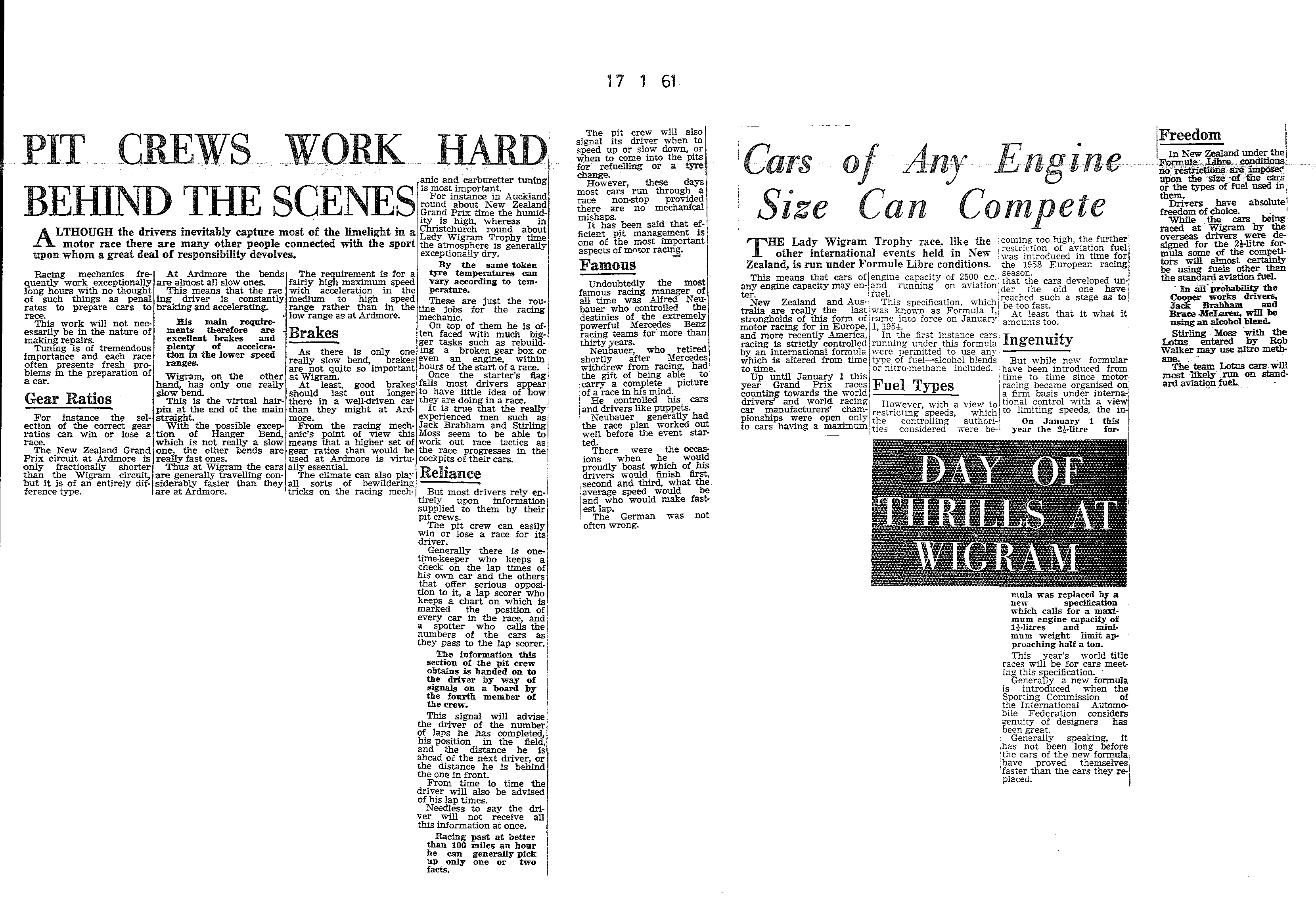
Pit crews work hard behind the scenes

Feature explaining the work of racing mechanics and pit crews at Wigram. It compares Wigram with Ardmore (fast bends and one slow hairpin, so higher gear ratios and less demand on brakes), explains the pit crew roles of timekeeper, lap scorer, spotter and signaller, and recalls the Mercedes-Benz manager Alfred Neubauer.

Facts

  • Wigram has only one really slow bend, the hairpin at the end of the main straight, so higher gear ratios are used than at Ardmore.
  • Pit crews at Wigram are limited to four people: timekeeper, lap scorer, spotter and signaller.
feature

Size of engine: any car can compete

Explains that the Lady Wigram Trophy is run under Formule Libre rules with no engine capacity limit, unlike European Grand Prix racing which changed from 2.5-litre to a 1.5-litre formula on January 1, 1961. Brabham and McLaren would probably use an alcohol blend, Moss possibly nitro methane, and Team Lotus aviation fuel.

Facts

  • The Lady Wigram Trophy was run under Formule Libre conditions, with no engine size or fuel restrictions.
  • On January 1, 1961 the 2.5-litre Formula 1 was replaced by a 1.5-litre formula for world championship races.
Read the OCR text
17 61 PIT CREWS WORK BEHIND THE SCENES A moou ra the drivere inevitably capfure most of the limelightin a motor race there are many other people connected with the sport upon whom a great deal of responsibility devolves. Racing mechanics fre-l At Ardmore the bends! quently work exceptionally are almost all slow ones. long hours with no thought This means that the rac of such things as penal ing. driver is constantly rates to prepare cars to braking and accelerating. race. This work will not nec- His main _ require essarily be in the nature of ments therefore are making repairs. excellent brakes and Tuning is of tremendous plenty of acceleraimportance and each race tion in the lower speed often presents fresh pro ranges. blems in the preparation of Wigram, on the other a car. hand, has only one really slow bend. Gear Ratios This is the virtual hairpin at the end of the main For instance the sel- straight. ection of the correct gear With the possible excep ratios can win or lose a ition of Hanger Bend, race. which is not really a slow The New Zealand Grand one, the other bends are Prix circuit at Ardmore is really fast ones. oniy fractionally shorter| Thus at Wigram the ears than the Wigram circuit, are generally travelling conbut it is of an entirely dif- siderably faster than they ference type. are at Ardmore. The requirement Is I0I a fairly high maximum speed with acceleration in the medium to high speed range rather than in the low range as at Ardmore. Brakes As there is only one really slow bend, brakes are not quite so important at Wigram. At least, good brakes should last out longer there in a well-driven car than they might at Ardmore. From the racing mechanic's point of view this means that a higher set of gear ratios than would i used at Ardmore is virtually essential. The climate can also pla: all sorts of bewildering tricks on the racing mech- HARD anic and carburetter tuning| is most important. For instance in Auckiand round about New Zealand ¡Grand Prix time the humidity is high, whereas Christchurch round about Lady Wigram Trophy time the atmosphere is generally exceptionally dry. the same toker tyre temperatures car vary according to teraperature. These are just the routine jobs for the racing mechanic. On top of them he is of ten faced with much bigger tasks such as rebulic ing broken gear box or even an engine, within hours of the start of a race. Once the starter's flag falls most drivers appear to have little idea of how they are doing in a race. It is true that the really Jape Brabham and string experienced Moss seem to be able to work out race tactics Lace progresses in une cockpits of their cars. Reliance But most drivers rely entirely upon information supplied to them by their pit crews. The pit crew can easily win or lose a race for its driver. Generally there is onetime-keeper who keeps check on the lap times of his own car and the others that offer serious opposi tion to it, a lap scorer who keeps a chart on which is marked position of every car in the race, and spotter who calls the numbers of the cars as they pass to the lap scorer. The information this section of the pit crew obtains is handed on to the driver by way of signals on a board by the fourth member of the crew. This signal will advise driver of the number! of laps he has completed, his position in the field, and the distance he is ahead of the next driver, or the distance he is behind the one in front. From time to time the driver will also be advised of his lap times. Needless to say the dri ver will not receive this information at once. Racing past at better than 100 miles an hour he can generally pick up only one OI two facts. The pit crew will also signal its driver when to speed up or siow down, or when to come into the pits for refuelling or a tyre change. these days most cars However run through" race non-stop provided there are no mechanical mishaps. It has been said that efficient pit management is one of the most important aspects of mntor racing. Famous Undoubtedly the most famous racing manager of all time was Alfred Neubauer who controlled the destinies of the extremely powerful Mercedes Benz racing teams for more than thirty years. Neubauer,, who retired shortly after Mercedes withdrew from racing, had the gift of being able carry a complete picture of a race in his mind. He controlled his cars and drivers like puppets. Neubauer generally had the race plan worked out well before the event startea. There were the occas ions when he would proudly boast which of his drivers would finish first, ¡second and third, what the average speed would and who would make fastest lay German was not The often wrong. Cars Size of A Can ny t Con ngine pete HE Lady Wigram Trophy race, like the coming too high, the further ¡ restriction of aviation fuel other international events held in New was introduced in time for Zealand, is run under Formule Libre conditions. the 1958 European racing This means that cars of any engine capacity may enter. New Zealand and Australia are really the last strongholds of this form of motor racing for in Europe, and more recentiy America, racing is stricty controlled by an international formula which is altered from time to time. Up until January 1 this year Grand Prix races counting towards the world drivers and world racing car manufacturers' championships were open only to cars having a maximum seasc engine capacity of 2500 c.c. that and running on aviation ¡der fuel. ireach This specification, which I be to was known as Formularl came into force on January amot 1. 1054 he cars developed unthe old one have d such a stage as to fast. least that it what it 'In the first instance car: running under this formula were permitted to use an type of fuel--alcohol blend: or nitro-methane included. Fuel Types However, with a view te restricting speeds, whick the controlling authori ties considered were be Ingenuity But while new formular have been introduced from time • to time since motor to limiting speeds, the in- On January I this year the 22-litre for- DAY OF THRILLS AT WIGRAM mula was replaced by a new specification which calls for a maximum engine capacity of 17-litres and minimum weight limit approaching half a ton. This year's world title races will be for cars meetng tas specincation. Generally a new formula is introduced when the Sporting Commission the International Automo bile Federation considers genuity of designers has Deen great Generally speaking, it ‚has not been long before ¡the cars of the new formula have proved themselves! 'faster than the cars they re placed. Freedom In New Zealand under the! Formule Libre conditions no restrictions are imposer upon the size of the cars of the types of fuel used in them, Drivers have absolute ! freedom of choice. While the cars being raced at Wigram by the overseas drivers were designed for the 24-litre formula some of the competitors will almost certainly be using fuels other than the standard aviation fuel. •In at probability tae Cooper works drivers, Jack Brabham and Bruce Mclaren, will be asing an alcohol blend. Stirling Moss with the Lotus. entered by Rob Walker may use nitro methane. The team Lotus cars will most likely rum on standard aviation fuel

Summaries and tables are machine-read from the scan and may contain errors: the scan is the record.