featureThese cars made Wigram
Looks back at the home-built specials that filled the early Lady Wigram Trophy fields from 1949. Hec Green won the 1950 trophy race at 69.79 mph with his Wolseley Special, and Jack Brewer, now secretary of the Motor Racing Club, built cars with names prefixed RA. Green's last car, the RA, was judged the prettiest special and foreshadowed the rear-engined Cooper-Climax.
Facts
- Hec Green won the 1950 Lady Wigram Trophy race at 69.79 mph in his Wolseley Special.
- Home-built specials made up much of the early Lady Wigram Trophy fields from 1949.
Photos
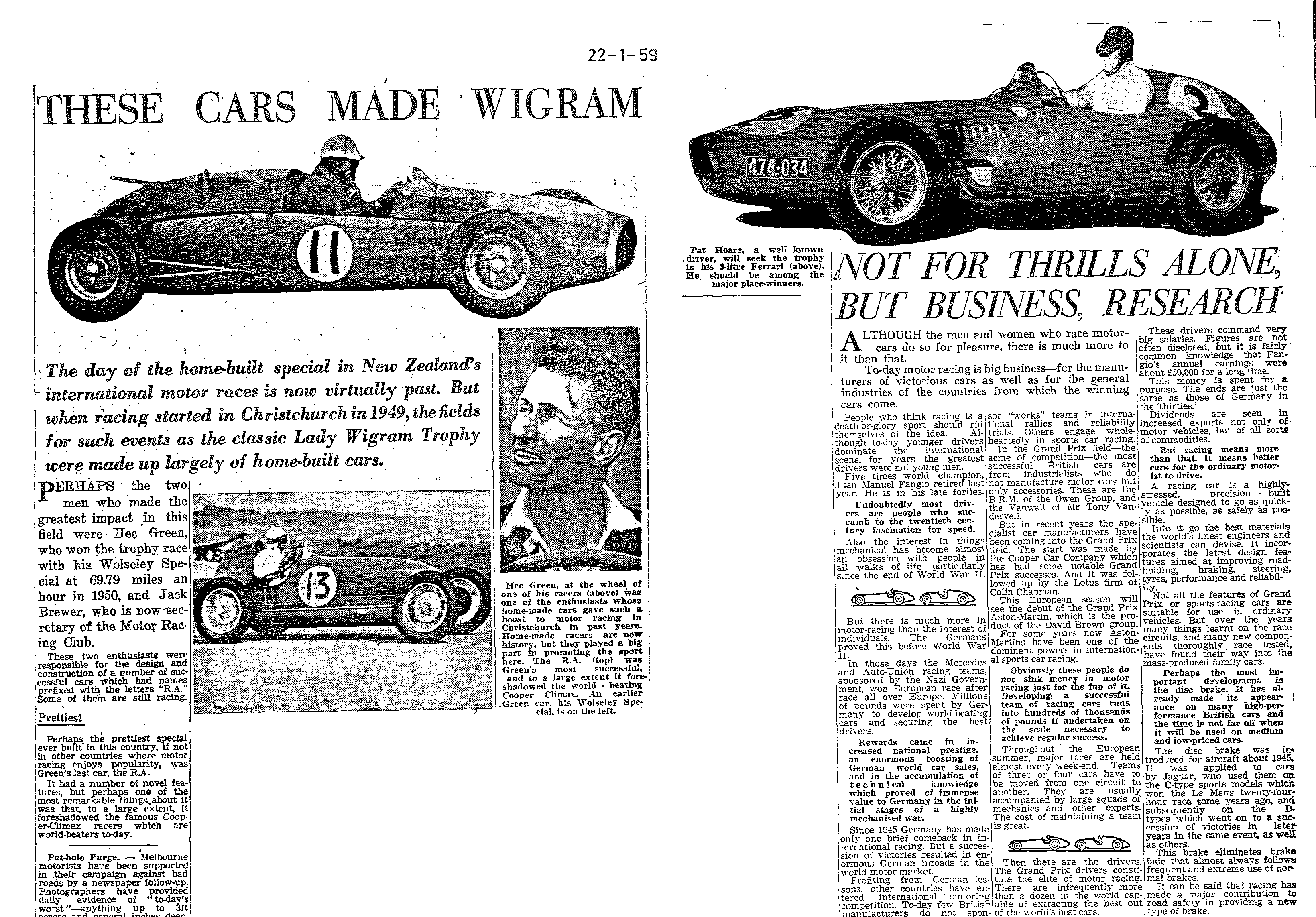
- Hec Green, at the wheel of one of his racers, was one of the enthusiasts whose home-made cars gave such a boost to motor racing in Christchurch in past years.
- Pat Hoare, a well known driver, will seek the trophy in his 3-litre Ferrari. He should be among the major place-winners.
featureNot for thrills alone, but business, research
General feature arguing that motor racing is big business and research: Fangio earned about 50,000 pounds a year, manufacturers such as Cooper, Lotus, Aston Martin, Jaguar and BRM spend heavily, and lessons including the disc brake, introduced for aircraft about 1945 and used on Jaguar's C-type Le Mans winners, passed to ordinary cars.
Facts
- Juan Manuel Fangio, five times world champion, retired in 1958.
- Disc brakes, introduced for aircraft about 1945, were used on Jaguar C-type sports cars that won Le Mans.
Read the OCR text
22-1-59
THESE
CARS
MADE
• WIGRAM
: The day of the home-built special in New Zealand's
international motor races is now virtually past. But
when racing started in Christchurch in 1949, the fields
for such events as the classic Lady Wigram Trophy
were made up largely of home built cars.
PERHAPS the two:
men who made the
greatest impact in this
field were Hee Green,
who won the trophy race
with his Wolseley Special at 69.79 miles an 13 Hec Green, at the wheel of
hour in 1950, and Jack one of his racers (above) was
one of the enthusiasts whose
Brewer, who is now sec- home-made cars gave such
boost to motor racing in
retary of the Motor Rac- Christchurch in past years.
• Home-made racers are now
¡ing Club. history, but they played a big the sport
These two enthusiasts were The R.A. (top) was
responsible for the design and
construction of a number of suc- Green's mosi successiul,
cessful cars which had names and to a large extent it forewith the letters "RA. shadowed the world - beating
preixed 157 Cooper Climax. earlier
Some of them are sti racing.
•Green car, his Wolseley Spe
cial, is on the leit
Prettiest
Perhaps thé prettiest special
ever bullt in this country, If noti
in other countries where motor
racing enjoys popwarity. was!
Green's last car, the ra.
It had a number of novel featutes, but perhaps one of the
most remarkable things about it
was that, to a large extent,
¡foreshadowed the famous Coop-
¡er-Climax racers which are
world-beaters to day.
motorists hare Dories paie been supported
in their campaign against bad
roads by a newspaper follow-up
Photographers have provided
daily evidence to-day's
worst"-anything up to 3ft:
474-034
Pat Hoare, a well known
driver, will seek the trophy
in his 3-litre Ferrari (above).
He, should be among the
major place-winners.
NOT FOR
THRILLS ALONE,
BUT BUSINESS,
RESEARCH
LTHOUGH the men and women who race motor- These drivers command very
big salaries. Figures are not
cars do so for pleasure, there is much more to often disclosed, but it is fairly
common knowiedge that Fanit than that. annual earings were
To-day motor racing is big business—for the manu- gio's
about £50,000 for a long time.
turers of victorious cars as well as for the general This money is spent for a
industries of the countries from which the winning purpose. The ends are just the
same as those of Germany in
cars come. the 'thirties'
Peopie who think racing is a;sor "works" teams in interna- Dividends
death-or-glory sport should rid tional rallies and reliability increased exports not only
themselves of the idea. Al-trials. Others engage whole. motor vehicles, but of all sorts
though to-day younger drivers heartedly in sports car racing. of commodities.
dominate international In the Grand Prix field-the racing means
scene, for years the greatest acme of competition-the most British than that. It means better
drivers were not young men. successful cars for the ordinary motor-
Five times world champion, trom industrialists who ist to drive.
Juan Manuel Fangio retired last not manufacture motor cars but A racing car is a highly.
year. He is in his late forties. only accessories. These are the precision - built
B.P.M. of the Owen Group, Van- and stressed,
Undoubtedly most driv- vehicle designed to go as quickare people who the Vanwall of Mr Tony ly as possible, as safely as posdervell.
cumb to the, twentieth cen- But in recent years the spe- Sible.
tury fascination tor speed. cialist car manuracturers have Into it go the best materials
Also the interest in things been coming into the Grand Prix the world's finest engineers and
scientists can devise. It incormechanical has become almost field. The start was made by -porates the latest design
obsession with people in the Cooper Car Company which Itures aimed at improving roadwalks of life, particularly has had some notable Grand steering,
since the end of World War II.. Prix successes. And it was fol- I holding,
lowed up by the Lotus firm of tyres, performance and reliabil-
This European Not all the features of Grand
see the debut of the Grand Prix Prix or sports-racing cars are
suitable for use ordinary
But there : much more Aston-Martin, which is the pro- vehicles.
motor-racing than the interest of duct of the David Brown group. many things learnt on the race
individuals. Germans For some years now Aston- circuits, and many new compon-
Martins have been one of the thoroughly
proved this before World War dominant powers in internation- ents
have found their way into the
'in those days the Mercedes al sports car racing. mass-produced family cars.
and Auto-Union racing teams, Obviously these people do Perhaps the most
sponsored by the Nazi Govern- not sink money in motor portant development
ment, won European race after racing just for the fan of it. the disc brake. It has alo
all over Europe. Millions Developing successful ready made appear
of pounds were spent by Ger- team of racing cars rins many high-permany to develop world-beating into hundreds of thousands formance British cars and
and securing of pounds if undertaken on the time is not far off when
necessary it will be ased on medium
Rewards came in in- achieve regular success. and low-priced cars.
creased national prestige, Throughout the European disc brake
enormous boosting of summer, major races are troduced for aircraft about 1945.
German sales, almost every weekend. have tol Teams applied
and in the accumulation of of three or four cars by Jaguar, who used them ou
technical knowledge be moved from one circuit to the C-iype sports models which
which proved of immense another. won the Le Mans twenty-fourvalue to Germany in the ini- accompanied by large squads of hour race some years ago, and
a highly mechanics other experts. subsequently
mechanised war. The cost of maintaining a team types which went on to a suc
Since 1945 Germany has made is great. cession of victories in
only one brief comeback in in- years in the same event, as well
ternational racing. But a succes- as otners.
sion of victories resulted in en- This brake eliminates • brake
ormous German inroads in the Then there are drivers. fade that almost always follows
worid motor market. The Grand Prix drivers consti- frequent and extreme use of nor-
Profting German les- tute the elite of motor racing.|mal brakes.
other eountries have en- are infrequently more It can be said that racing has
international motoring than a dozen in the world cap-made a major contribution
(competition. Today few Britishlable of extracting the best out road safety in providing a new manufacturers spon- of the worids best cars. itype of brake.
Summaries and tables are machine-read from the scan and may contain errors: the scan is the record.