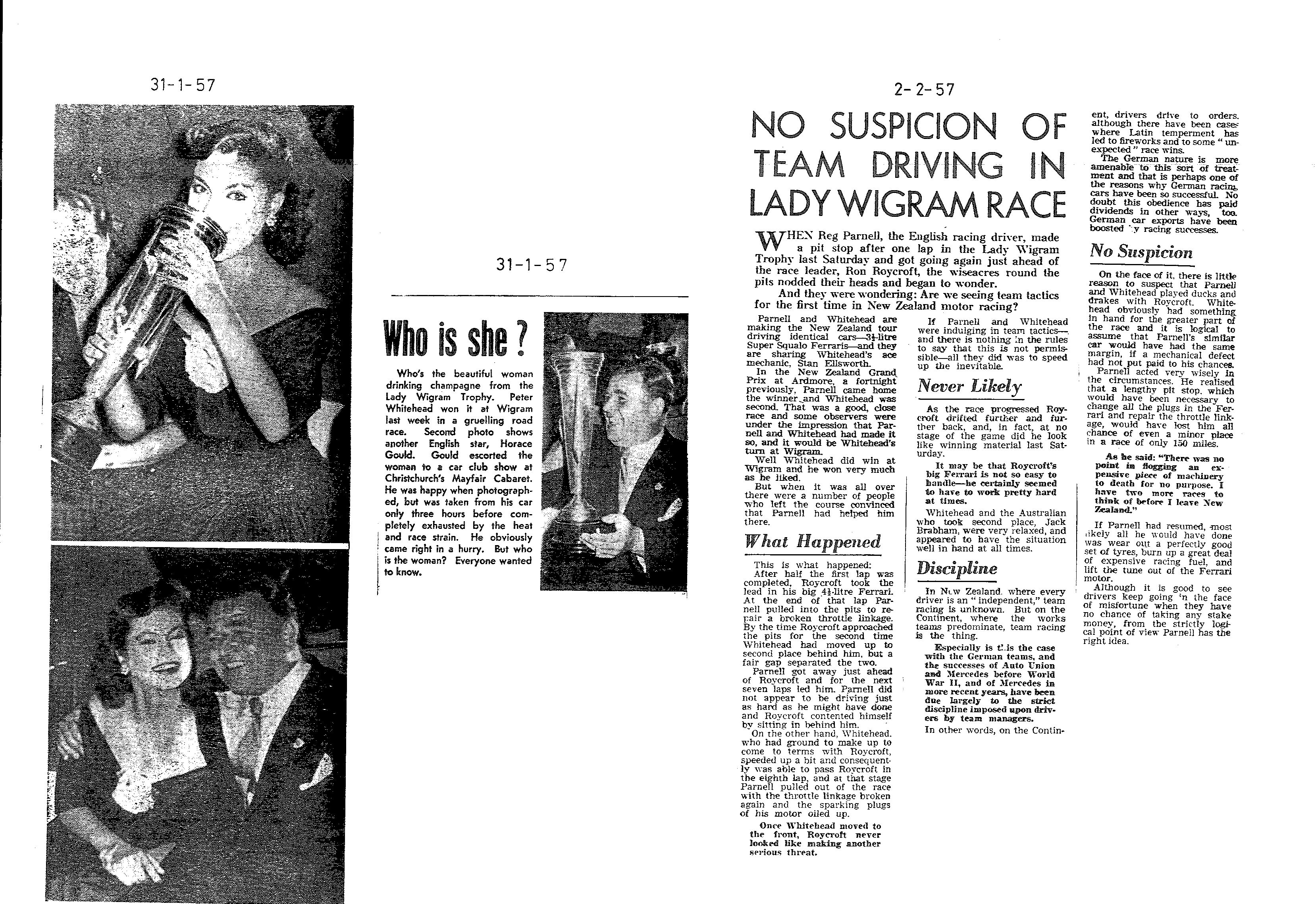
photoWho is she?
A picture item about a woman drinking champagne from the Lady Wigram Trophy won by Peter Whitehead, and Horace Gould, who escorted her to a car club show at Christchurch's Mayfair Cabaret only hours after being taken from his car exhausted by the heat.
Photos
- The woman drinking champagne from the Lady Wigram Trophy, which Peter Whitehead won at Wigram. A second photo shows Horace Gould, who escorted her to a car club show at Christchurch's Mayfair Cabaret.
featureNo suspicion of team driving in Lady Wigram race
An analysis of whether Reg Parnell and Peter Whitehead used team tactics in the 1957 Lady Wigram Trophy. Parnell pitted after one lap with a broken throttle linkage, rejoined just ahead of leader Ron Roycroft and held him up for seven laps, allowing Whitehead to catch and pass Roycroft on lap eight, when Parnell retired. The writer concludes there was no suspicion of foul play, since Whitehead clearly had plenty in hand and Parnell wisely avoided wearing out an expensive car.
Facts
- At the 1957 NZ Grand Prix at Ardmore a fortnight earlier, Parnell won and Whitehead was second, both in identical 3.5-litre Super Squalo Ferraris.
- Parnell had two more races to run in New Zealand after the 1957 Lady Wigram Trophy.
Read the OCR text
31-1-57 2-2-57
31-1-57
Who is she?
Who's the beautiful woman
drinking champagne from the
Lady Wigram Trophy. Peter
Whitehead won it at Wigram
last week in a gruelling road
race. Second photo shows
another English star, Horace
Gould. Gould escorted the
woman to a car club show at
Christchurch's Mayfair Cabaret.
He was happy when photographed, but was taken from his car
only three hours before completely exhausted by the heat
and race strain. He obviously
came right in a hurry. But who
is the woman? Everyone wanted
to know.
NO SUSPICION OF
TEAM
DRIVING IN
LADY WIGRAM RACE
WHa Rest Panell, on English racing driver, made a pit stop after one lap in the Lady Wigram
Trophy last Saturday and got going again just ahead of
the race leader, Ron Roycroft, the wiseacres round the
pils nodded their heads and began to wonder.
And they were wondering: Are we seeing team tacties
for the first time in New Zealand motor racing?
Parnell and Whitehead are
making the New Zealand tour
driving identical cars 3}-litre
Super Squalo Ferraris and they
are sharing Whitehead's ace
mechanic, Stan Ellsworth.
In the New Zealand Grand
Prix at Ardmore, a fortnight
previously, Parnell came home
the winner and Whitehead was
second. That was a good, close
race and some observers were
under the impression that Parnell and Whitehead had made it
so, and it would be Whitehead's
turn at Wigram.
Well Whitehead did win at
Wigram and he won very much
as he liked.
But when it was all over
there were a number of people
who left the course convinced
that Parnell had helped him
there.
What Happened
If Parnell and Whitehead
were indulging in team tactics
and there is nothing in the rules
to say that this is not permis
sible-all they did was to speed
up the inevitable
Never Likely
As the race progressed Roycroft drifted further and further back, and, in tact, at no
stage of the game did he look
like winning material last Saturday.
It may be that Roycroft's
big ferrari is not so easy to
bandle-he certainly seemed
to have to work pretty hard
at times.
Whitehead and the Australian
who took second place, Jack
Brabham, were very relaxed, and
appeared to have the situation
well in hand at all times.
This is what happened:
After half the first lap was
completed, Roycrott took the
lead in his big At the end off-litre Ferrari.
that lap Parnell pulled into the pits to re
fair a broken throttle linkage.
By the time Roycroft approached
the pits for • the second time
Whitehead had moved up to
second place behind him, but a
fair gap separated the two.
of Parnell sot awar ust ahead Roycroft and the next
seven laps led him. Parnell did
not appear to be driving just
as hard as he might have done
and Royeroft contented himself
by sitting in behind him.
On the other hand, Whitehead.
who had ground to make up to
come to terms with Roycroft,
speeded up a bit and consequently was able to pass Rovcroft in
the eignth lap, and at that stage
Parnell pulled out of the race
with the throttle linkage broken
again and the sparking plugs
of his motor oiled up.
Once Whitehead moved to
the front, Roycroft never
Jonked like making another
serious threat.
Discipline
In New Zealand. where every
driver is an " independent," team
racing is unknown. But on the
Continent, where the works
teams predominate, team racing
is the thing.
Especially is t'is the case
with the German teams, and
the successes of Auto Union
and Mercedes before World
War II, and of Mercedes in
more recent years, have been
Largely the strict
discipline imposed upon drivers by team managers.
In other words, on the Contin-
ent, drivers drive to orders.
although there have been case.
where Latin temperment has
led to fireworks and to some " unexpected " race wins.
The German nature is more
amenable to this sort of treatment and that is perhaps one of
the reasons why German racinz
cars have been so successful. No
doubt this obedience has paid
dividends in other ways, too.
German car exports have been
boosted 'y racing successes.
No Suspicion
On the face of it, there is little
reason to suspect that Parnell
and Whitehead played ducks and
drakes with Royeroft. White
head obviously had something
in hand for the greater part of
the race and it is logical to
assume that Parnell's similar
car would have had the same
margin, if a mechanical defect
had not put paid to his chances.
Parnell acted very wisely in
the circumstances. He realised
that a lengthy pit stop. which
would have been necessary to
change all the plugs in the Ferrari and repair the throttle linkage, would have lost him all
chance of even a minor place
in a race of only 150 miles.
As he said: "There was no
point in logging an expeusive piece of machivery
to death for no purpose. I
have two more races to
think of before I leave New
Zealand"
If Parnell had resumed, most
ikely all he would have done
was wear out a perfectly good
set of tyres, burn up a great deal
of expensive racing fuel, and
lift the tune out of the Ferrari
motor.
Although it is good to see
drivers keep going in the face
of misfortune when they have
no chance of taking any stake
money, from the strictly logi
cal point of view Parnell has the
right idea.
Summaries and tables are machine-read from the scan and may contain errors: the scan is the record.