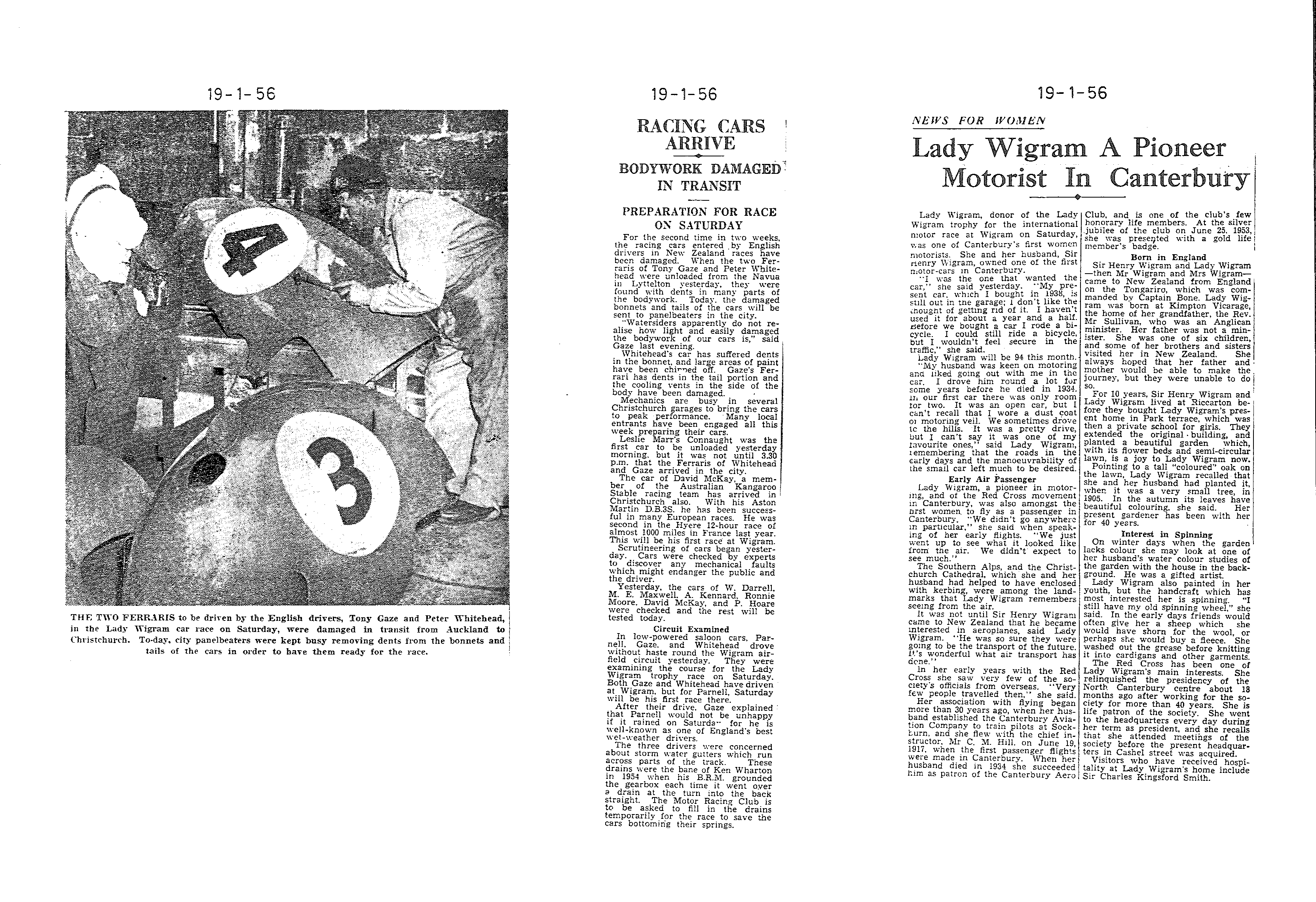
newsRacing cars arrive: bodywork damaged in transit
The Ferraris of Tony Gaze and Peter Whitehead were dented in transit from Auckland and sent to city panelbeaters before the Lady Wigram race. David McKay's Aston Martin DB3S had also arrived, and scrutineering began. Parnell, Gaze and Whitehead toured the circuit in saloon cars and voiced concern about storm-water gutters across the track, which had troubled Ken Wharton's BRM in 1954.
Facts
- Leslie Marr's Connaught was the first of the overseas cars unloaded at Lyttelton; the Ferraris reached Christchurch at 3.30 p.m. on 18 January 1956.
- The Motor Racing Club was asked to temporarily fill in storm-water drains crossing the Wigram track for the 1956 race.
Photos
- The two Ferraris to be driven by Tony Gaze and Peter Whitehead in the Lady Wigram car race were damaged in transit from Auckland to Christchurch; city panelbeaters removed dents from bonnets and tails.
featureLady Wigram: motorist in Canterbury a pioneer
A women's page profile of Lady Wigram, donor of the Lady Wigram Trophy, who would turn 94 that month. She and Sir Henry Wigram owned one of Canterbury's first cars, and she was among the first women to fly as a passenger in Canterbury, on 19 June 1911. She was long associated with the Red Cross and was patron of the Canterbury Aero Club after her husband's death in 1934.
Facts
- Lady Wigram, donor of the Lady Wigram Trophy, was about to turn 94 in January 1956.
- Sir Henry Wigram established the Canterbury Aviation Company to train pilots at Sockburn; first Canterbury passenger flights were on 19 June 1911.
Read the OCR text
19-1-56 19-1-56 19-1-56
THE TWO FERRARIS to be drien by the English drivers, Tony Gaze and Peter Whitehead,
in the Lady Wigram car race on Saturday, were damaged in transit from Auckland to
Christchurch. To-day, city panelbeaters were kept busy removing dents from the bonnets and
tails of the cars in order to bare them ready for the race.
RACING CARS
ARRIVE
BODYWORK DAMAGED
IN TRANSIT
PREPARATION FOR RACE
ON SATURDAY
For the second time in two weeks,
the racing cars entered by English
drivers in New Zealand races have
been damaged. When the two Ferraris of Tony Gaze and Peter Whitehead were unloaded from the Navua
in Lyttelton yesterday, thes were
found with dents in many parts of
the bodywork. Today. the damaged
bonnets and tails of the cars will be
sent to panelbeaters in the city.
"Watersiders apparently do not realise how light and easily damaged
the bodywork of our cars is," said
Gaze last evening.
Whitehead's car has suffered dents
in the bonnet, and large areas of paint
have been chirned off Gaze's Ferrari has dents in the tail portion and
the cooling vents in the side of the
body have been damaged.
Mechanics several
Ches are an en red a 1i.
week preparing their cars.
Leslie Marr's Connaught was
first car to be unloaded yesterday
morning. but it was not until 3.30
p.m. that the Ferraris of Whitehead
and Gaze arrived in the city.
The car of David McKay, a mem-
Australian Kangaroo
Stable racing team has arrived
Christchurch also. With his Aston
Martin D.B.3S. he has been successful in many European races. He was
second in the Hyere 12-hour race of
almost 1000 miles in France last year.
This will be his first race at Wigram.
Scrutineering of cars began yesterday discover Cars were checked by experts
mechanical faults
which might endanger the public and
the driver.
Yesterday. the cars of W. Darrell,
M. E. Maxwell. A • Kennard, Ronnie
Moore, David McKay, and P. Hoare
were checked and the rest will be
tested today.
Circuit Examined
In low-powered saloon cars, Parnell, Gaze. and Whitehead drove
without haste round the Wigram airfield circuit yesterday. They were
examining the course for the Lady
Wigram trophy race on Saturday.
Both Gaze and Whitehead have driven
at Wigram, but for Parnell, Saturday
will be his first race there.
After their drive, Gaze explained
that Parnell would not be unhappy
if it rained on Saturda for he
well-known as one of England's best
wet-weather drivers.
The three drivers were concerned
about storm water gutters which run
across parts of the track. These
drains were the bane of Ken Wharton
in 1954 when his B.R.M. grounded
the gearbox each time it went over
a drain at the turn into the back
straight. The Motor Racing Club is
to be asked to fill in the drains
temporarily for the race to save the
cars bottoming their springs.
NEWS FOR WOMEN
Lady Wigram
Motorist In
A Pioneer
Canterbury
Lady Wigram, donor of the Lady
Wigram trophy for the international
notor race at Wigram on Saturday,
vias one of Canterbury's first women
motorists. She and her husband, Sir
Henry Wigram, owned one of the first
motor-cars in Canterbury.
the one that wanted the
" she said yesterday. "My present car. which I bought in 1938,
still out in the garage; i don't like the
ihought of getting rid of it. I haven't
used it for about a year and a hali
detore we bought a car I rode a bicycle. I could still ride a bicycle,
but t wouldn't feel secure in the
traffic," she said.
Lady Wigram will be 94 this month.-
"My husband was keen on motoring
and liked going out with me in the
car. I drove him round lot for
some years before he died in 1934.
In our first car there was only room
tor two. It was an open car, but I
can't recall that I wore a dust coat
or motoring veil. We sometimes drove
ic the hilis. It was a pretty drive,
but I can't say t was one or my
Lavourite ones," said Lady Wigrant,
remembering that the roads in the
carly days and the manoeuvrability of
the smail car left much to be desired
Early Air Passenger
Lady Wigram, a pioneer in motoring, and of the Red Cross movement
in Canterbury, was also amongst the
arst women to fly as a passenger in
Canterbury. "We didn't go anywhere
in particular, she said when speaking of her early flights. Went up to see what it looked like
air. We didn't expect to
see much."
The Southern Alps, and the Christchurch Cathedral, which she and her
husband had helped to have enclosed
with kerbing, were among the landmarks that Lady Wigram remembers
seeing from the air.
It was not until Sir Henry Wigrar
came to New Zealand that he became
interested in aeroplanes, said Lady
Wigram. •He was so sure they were
going to be the transport of the future.
It's wonderful what air transport has
cene.
1N her early years with the Red
Cross she saw very few of the SOciety's officials from overseas. "Very
tew people travelled then," she said.
Her association with flying began
more than 30 years ago, when her husband established the Canterbury Aviation Company to train pilots at Sockturn, and she flew with the chief instrucior, Mr C. M. Hill. on June 19,
1911, when the hrst passenger flights
were made in Canterbury. When her
husband died in 1934 she succeeded
him as patron of the Canterbury Aero
Club, and is one of the club's few
honorary life members. At the silver
jubilee of the club on • June 25. 1953,
she was presented with a gold life
member's badge.
Born in England
Sir Henry Wigram and Lady Wigram
-then Mr Wigram and Mrs Wigramcame to New Zealand from England
on the Tongariro, which was commanded by Captain Bone. Lady Wigram _ was born at Kimpton Vicarage,
the home of her grandfather, the Rev.
Mr Sullivan, who was an Anglican
minister. Her father was not a minister. She was one of six children,
and some of her brothers and sisters
visited her in New Zealand. She
always hoped that her father and •
mother would be able to make the
journey, but they were unable to do i
For 10 years, Sir Henry Wigram and
Lady Wigram lived at Riccarton before they bought Lady Wigram's present home in Park terrace, which was
then a private school for girls. They
extended the original • building, and
planted a beautiful garden which,
with its flower beds and semi-circular
lawn, is a Joy to Lady Wigram now.
Pointing to a tall "coloured" oak on
the lawn, Lady Wigram recalled that
She and her husband had planted it,
wher it was a very small tree,
1905. In the autumn its leaves have
beautiful colouring. she said. Her
present gardener has been with her
for 40 years.
Interest in Spinning
On winter days when the garden
lacks colour she may look at one of
her husband's water colour studies of
the garden with the house in the background. He was a gifted artist.
Lady Wigram also painted in her
youtn, but the handcraft which has
nost interested her is spinning
still have my old spinning wheel, " she
said. In the early days friends would
often give her a sheep which she
would have shorn for the
perhaps she would buy a fleece.
washed out the grease before knitting
it into cardigans and other garments.
The Red Cross has been one of
Lady Wigram's main interests. She
relinquished the presidency of the
North Canterbury centre about 18
months ago after working for the society for more than 40 years. She is
life patron of the society. She went
to the headquarters every day during
her term as president, and she recalls
that she attended meetings of the
society before the present headquar
ters in Cashel street was acquired.
Visitors who have received hospitality at Lady Wigram's home include
Sir Charles Kingsford Smith.
Summaries and tables are machine-read from the scan and may contain errors: the scan is the record.