Read the OCR text
9-2-50
MOTOR-RACING IS
HARUM-SCARUM
YOUNG
LUNATICS
By Peter Greenslade
AITHOUGH there is little doubt that the crowd of over 20,000 who watched the first New Zealand
road-racing championship held at Wigram in February
last year, will be exceeded when the event is run once
again at the end of this month, there are many more
thousands of people who will not attend.
These people will not attend because they regard
moior-racing as a dangerous harum-scarum spectacle
indulged in by young lunatics, which has no value and
only appeals to the crowd in the same way as dia the
Roman circuses.
WHILE there is no doubt that
some will go to Wigram in the
hope that they will see a spectacular
crash and some blood-letting possibly, the great majority of the spectators will go to see not only a magnificent spectacle, but also to see cool
and careful drivers handling their
I cars in the way fast cars should be
driven, with care, judgment, and
precision,
Motor-racing is not a sport for
roung lunatics. Some of the
‹rivers in the road race mill be
nien of mature years, and there
will be at least one woman conpetitor whose young family will
watch her efforts with interest
and enjoyment. Indeed in
Europe, where motor-racing
attracts crowis of over 200,000
every week-end during the summer months, many of the best
drivers have reached the halfcentury mark and some of them
have been racing cars for orer
thirty years.
There is an airmen's saying that
only the good pilots have grey hair
-the same can be said of the European racing drivers. The wiry little
Italian Tazio Nuvolari-known to
followers of motor sport the world
over as "the Maestro "—still drives
on occasions. although he is now
approaching the ripe old age of 60.
Rigid Control
MOTOR sport is so rigidly controlled in Europe and in New
Zealand that only those competitors
who have reached a high standard
of proficiency are permitted to take
part in major events. This standard
is demanded to saleguard not only
the drivers themselves, but also the
spectators.
The notable feature of most fatalities during motor-racing is that in
» per cent. of the cases they are
caused by the spectators and not by
the competitors. Unruly crowds
break down the protective barriers
and force their way to the edges of
the track. They have not only a
careless disregard for their own
safety, but also for the safety of the
drivers.
Those who intend going to
Wigram in the hope of seeing
cars overturning or gyrating
madir round in circles. or taking
every corner on two wheels
would be well advised to stay
away and make room for persons who will really appreciate
what is going on.
Persons who do go, and see cars
skidding round bends, are not to
think that the driver has lost control
of his car. He has perfect control
over it, and is merely taking the
bend in the fastest and safest way
possible-in a controlled slide. There
is no such thing as skidding in motor
sport.
They should watch how he
does it and learn something which
one day might save their lives or
the lives of others. How many times
have newspaper reports court
actions stated that the driver of a
vehicle involved in a collision said
he approached the bend too fast, or
the road was greasy and he skidded?
somebody was injured or a l
death occurred, it is a fairly safe bet
that it was caused through gross
negligence. All that happened was
that the car skidded and the driver
was unable to control it. In other
words, the driver could not handle
his car properly.
If he could have handled the car
properly that skid would have
become a controlled slide or would
have been corrected immediately,
and in nine cases out of ten the accident would not have happened.
Many motorists are notori-
OuSiy discourteous. For
demonstration of good driving
manners, watch: the racing
drivers. The latter do not cut-in
on other cars, they do not speed
up when another driver has sig
malled his intention to pass, and
they make plenty of room for
faster cars to pass them.
NOT
SFORT FOR
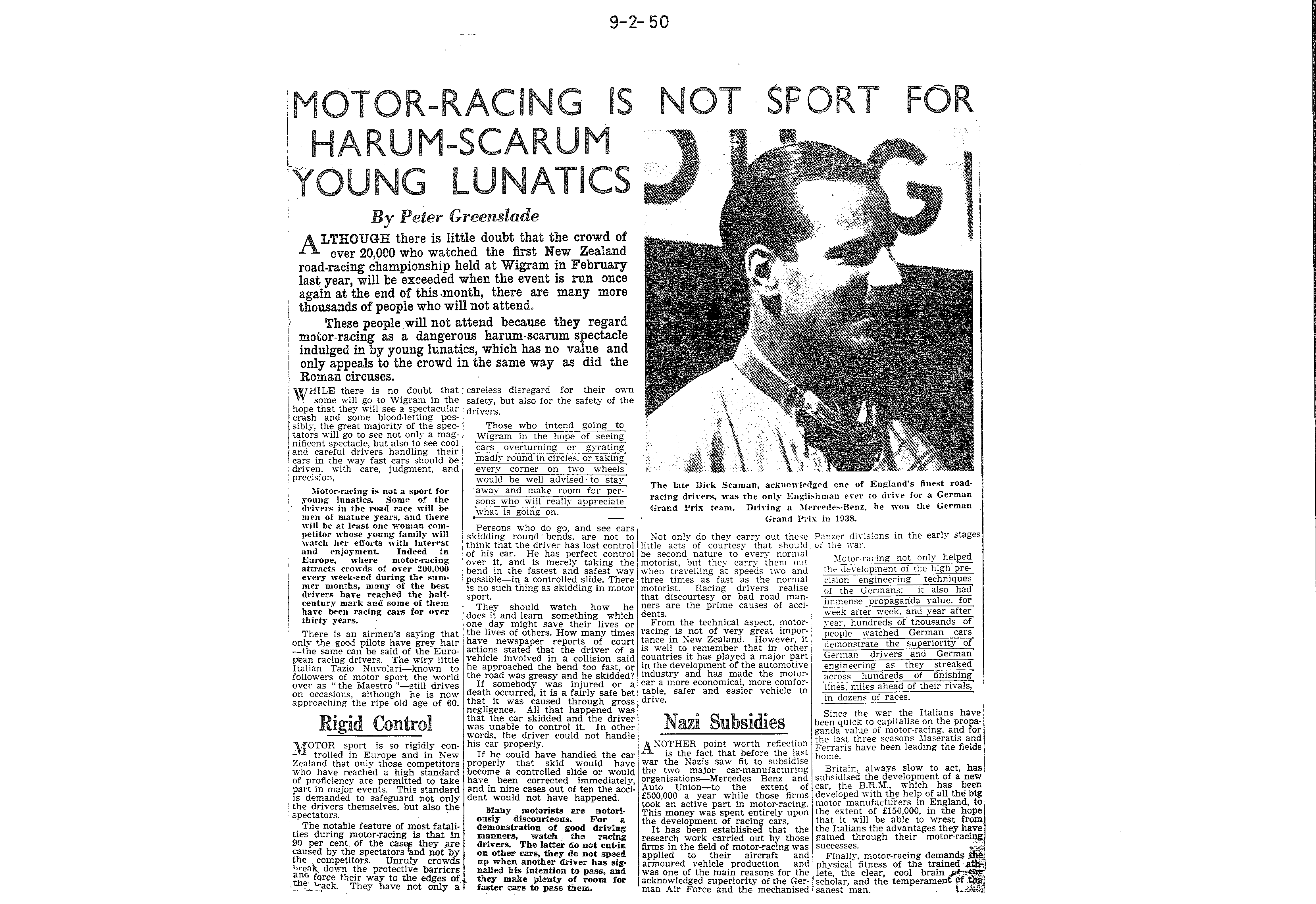
The late Dick Seaman, acknowledged one of England's finest roadracing drivers, was the only Englishman ever to drive for a German
Grand Prix team. Driving a Mercedes-Benz, he won the German
Grand Prix in 1938.
Not only do they carry out these Panzer divisions in the early stages
little acts of courtesy that should ot the war.
be second nature to every normal Motor-racing not only helped
motorist, but they carry them out!
when travelling at speeds two and the development of the high prethree times as fast as the normal cision engineering techniques
motorist. Racing drivers realise of the Germans; it also had
that discourtesy or bad road man- immense propagarida value. for
ners are the prime causes of accidents. week after week. and year after rear, hundreds of thousands of
From the technical aspect, motorracing is not of very great impor- people watched German cars
tance in New Zealand. However, it demonstrate the superiority of
is well to remember that in other
countries it has played a major part German drivers and German
in the development of the automotive engineering as they streaked
industry and has made the motor- across hundreds of finishing
car a more economical, more comfor- lines, miles ahead of their rivals,
table, safer and easier vehicle to
drive. in dozens of races.
Nazi Subsidies
ANoThER point worth refection is the fact that before the last
war the Nazis saw fit to subsidise
the two major car-manufacturing
organisations-Mercedes Benz and
Auto Union-to the extent of
£500,000 a year while those firms
took an active part in motor-racing.
This money was spent entirely upon
the development of racing cars.
It has been established that the
research work carried out by those
firms in the field of motor-racing was
applied to their aircraft and
armoured vehicle production and
was one of the main reasons for the
acknowledged superiority of the German Air Force and the mechanised
Since the war the Italians have
been quick to capitalise on the propa-!
ganda value of motor-racing, and for
the last three seasons Maseratis and
Ferraris have been leading the fields
home.
Britain, always slow to act, has
subsidised the development of a new
car, the B.R.M., which has been
developed with the help of all the big
motor manufacturers in England, to
the extent of £150,000, in the hope
that it will be able to wrest from
the Italians the advantages they have
gained through their motor-racing
successes.
Finally, motor-racing demands the
physical fitness of the trained ath
lete, the clear, cool brain per
scholar, and the temperament
sanest man.
Summaries and tables are machine-read from the scan and may contain errors: the scan is the record.