Read the OCR text
-3-49
-3-49
SPORTSMAN, MARCE 87
MOTOR
RACING
HISTORY MADE
AT WIGRAM
Diana, a Proctor i Bellingtat me die history hen hearsage i first New Zealand ero-mile road racin a few years ago in @ second-hand soleroom
championship with it at Wigram Aerodrome.
In spite of the array of newer cars
lined up against it, experienced racing men before the start looked long
and earnestly at this veteran, wnich
had won a two-day thousand-mile
event on the famous track at Brooklands in the early 1930's.
Undoubtedly. one of the fastest
cars in the race was H. Green's
Wolseley Special, powered by a 14
horsepower motor. Green and his
car have proved a formidable combination in motoring events in Canterbury during the past two years,
and the manner in which he took
the Wolseley to the front in the big
race at Wigram right from the start
made him look dangerous. It was
only pit stops that kept him from
winning.
Proctor and F. B. Bennett, whose
big black Invicta filled second place,
drove throughout without stops,
whereas other cars, many of them
reputed to have more speed than
many of the placed cars, were forced
to call at the pits repeatedly.
Among the latter was a factorybuilt supercharged Austin 7 from
Auckland, entered by the C. and R.
team (C. Chatteris and K. Roycroft),
two well-known racing motorists.
Their car was reputed to have done
120 miles an hour. The Rootes type
supercharger, fitted in the nose, was
much larger than the tiny engine,
which had been tuned to reach
exceptional speeds.
Public interest in the big race had
been mounting in Christchurch for
weeks, and . there was great disappointment when the police announced that they had no statutory
authority to close the roads in Waimairi County, where the fixture was
originally to have been held. Interested parties immediately took the
matter up with the Prime Minister
(Mr. Fraser) and the upshot was
that Wigram Aerodrome was made
available.
ONLY ONE CRASH
When it was learned that only a
flat track around the perimeter of
the aerodrome was available, fear
was widely expressed among the uninformed public that there would be
accidents. Actually it was a tribute
to the skill of the drivers that only
one occurred, and that only a minor
one for all its spectacular appearance.
The driver of the car invoived was
G. J. Parker, of Christchurch. He
was thrown from his M.G. when,
taking a bend in the twenty-first
lap, it failed to respond to the wheel,
ran off the track, hit several bales
of straw strategically placed for the
protection of spectators, and after
several somersaults came to rest
upside down in an open ditch.
Although badly shaken, Parker was
uninjured except for a cut thumb.
..The tense atmosphere at the start
reminded travelled people among the
spectators of the atmosphere at English and Continental tracks during
big fixtures. It became fairly plain
after half a dozen laps that, apart
from accidents or engine trouble,
the issue lay among Roycroft, Bennett, C. A. ' C. Ransley, Green and
Proctor. Ransley had built a racing
body on his Riley, already well-
known in hill-climbing events in the
South Island, for the big race. -
At the end of the fourth circuit,
Green had lapped the field. He had
a great duel with Roycroft, which
provided the main interest of the
race. Green's Wolseley showed terrific speed on the straights and wreat
acceleration out of the bends.
Roycroft in his Austin drove a
great race, hanging grimly on to
Green and Bennett in their much
bigger cars. He passed them time
and again, and then seemed to lose
his advantages, but the only reason
apparent for his dropping back on
many occasions was that in going to
the front he wanted to see if they
had any speed in reserve. He provided one of the thrills of the race by
touching another competitor in the
bend at the top of the straight at 60
miles an hour.
CAR DISAPPOINTS
One car which disappointed was
that of P. M. Hoare, who is chairman
of the Association of New Zealand
Car Clubs. Powered by a Singer
engine of advanced design. it was
owned and raced by the late Jack
Tench, having been built in a workshop in Ferry Road. It has a tubular
steel chassis, independent frontwheel suspension of the wishbone
type. hydraulically damped, and
quarter - elliptic springs. friction
damped. The propeller shaft is connected to the rear axle by an unconventional system of chains and
sprockets.
The clear superiority of a small
proportion of the cars over the
www..uimiti-nitcenov.cos
minnies.
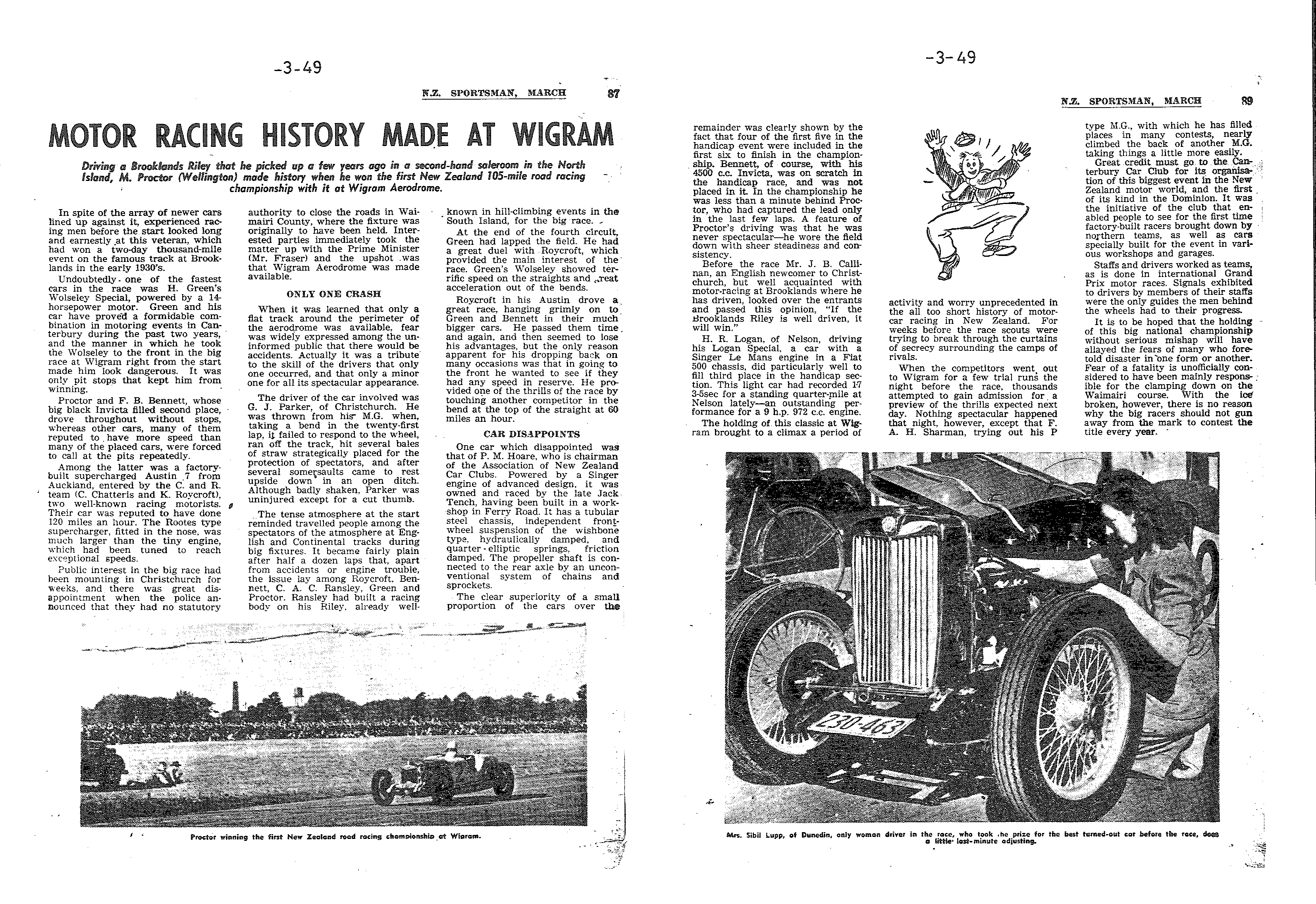
Proctor winning the first New Zealand road racing chompionshio _ot Wiaram.
N.Z. SPORTSMAN, MARCH 89
remainder was clearly shown by the
fact that four of the first five in the
handicap event were included in the
first six to finish in the championship. Bennett, of course, with his
4500 c.c. Invicta, was on scratch in
the handicap race, and was not
placed in it. In the championship he
was less than a minute behind Proctor, who had captured the lead only
the last few laps. A feature of
Proctor's driving was that he was
never spectacular—he wore the field
down with sheer steadiness and consistency.
Before the race Mr. J. B. Callinan, an English newcomer to Christchurch, but well acquainted with
motor-racing at Brooklands where he
has driven, looked over the entrants
and passed this opinion, "If the
Brooklands Riley is well driven, it
will win.
H. R. Logan, of Nelson, driving
his Logan Special, a car with a
Singer Le Mans engine in a Fiat
500 chassis, did particularly well to
fill third place in the handicap section. This light car had recorded 17
3-5sec for a standing quarter-mile at
Nelson lately-an outstanding performance for a 9 h.p. 972 c.c. engine.
The holding of this classic at Wigram brought to a climax a period of
activity and worry unprecedented in
the all too short history of motorcar racing in New Zealand. For
weeks before the race scouts were
trying to break through the curtains
of secrecy surrounding the camps of
rivals.
When the competitors went. out
to Wigram for a few trial runs the
night before the race, thousands
attempted to gain admission for. a
preview of the thrills expected next
day. Nothing spectacular happened
that night, however, except that F.
A. H. Sharman, trying out his
type M.G., with which he has filled
places in many contests, nearly
climbed the back of another M.G.
taking things a little more easily.
Great credit must go to the Canterbury Car Club for its organisation of this biggest event in the New
Zealand motor world, and the first
of its kind in the Dominion. It was
the initiative of the club that enabled people to see for the first time
factory-built racers brought down by
northern teams, as well as cars
specially built for the event in various workshops and garages.
Staffs and drivers worked as teams,
as is done in international Grand
Prix motor races. Signals exhibited
to drivers by members of their staffs
were the only guides the men behind
the wheels had to their progress.
It is to be hoped that the holding
of this big • national championship
without serious mishap wil have
allayed the fears of many who fore
told disaster in 'one form or another.
Fear of a fatality is unofficially considered to have been mainly respons
ible for the clamping down on the
Waimairi course. With the ice
broken, however, there is no reason
why the big racers should not gun
away from the mark to contest the
title every year.
230-46
Bars. Sibil Lupp, of Dunedin, only womon driver in the face last-tood adjusize for the best turned-out cor before itse rose, dees
Summaries and tables are machine-read from the scan and may contain errors: the scan is the record.