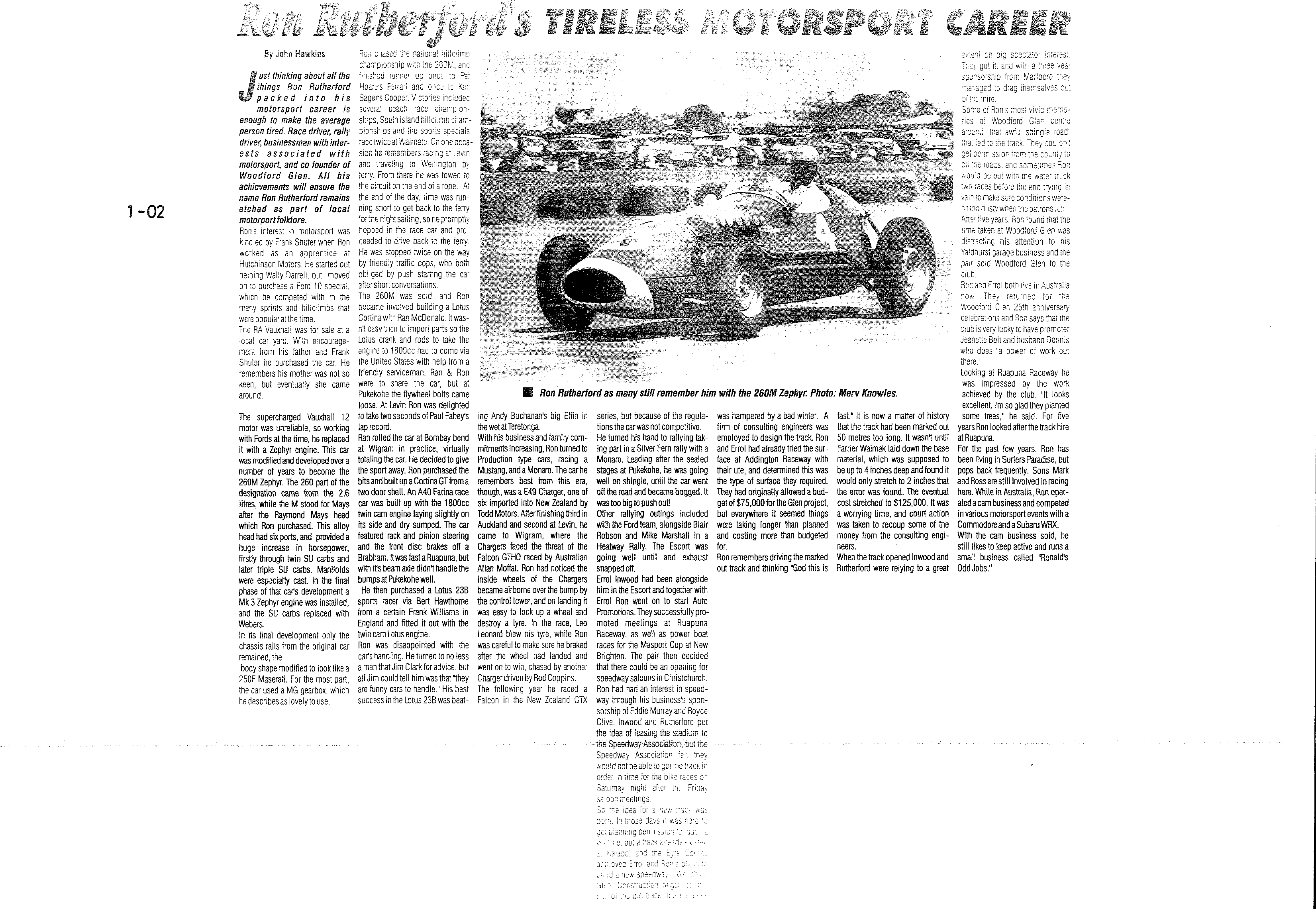
feature · Canterbury Racer · John HawkinsA tale of a motorsport career
Profile of Ron Rutherford, race driver, rally driver, businessman and co-founder of Woodford Glen, who is now in Surfers Paradise. His interest began through Frank Shuter at Hutchinson Motors; he built the 260M Zephyr from a supercharged Vauxhall (the M for Raymond Mays head), then built a Lotus Cortina-based car, an A40 Farina, bought a Lotus 23B from Frank Williams, raced a Mustang, Monaro and E49 Charger. At Wigram he beat Allan Moffat's Falcon GTHO by braking carefully after the control tower bump, while Leo Leonard blew a tyre. He later rallied, promoted races with Errol Inwood and built Woodford Glen, whose cost rose to $125,000.
Facts
- Ron Rutherford rolled his Lotus Cortina-based car at Bombay bend at Wigram in practice.
- The Woodford Glen track was marked out 50 metres too long, and its cost grew from a $75,000 budget to $125,000.
Photos
- Ron Rutherford as many still remember him with the 260M Zephyr. Photo: Merv Knowles
Read the OCR text
By John Hawk
packed into his
motorsport career is
enough to make the average
person tired. Race driver, rally
driver, businessman with interests associated with
motorsport, and co founder of
Woodford Gien. All his
achievements will ensure the
name Ron Rutherford remains
1-02 etched as part of local
motorport folkiore.
Rons interest in motorsport was
kindled by Frank Shuter wi
worked as an app
Hutchinsor Motors He
many Jarrel, bur mov
which he competed w
the tim
• Vauxhall was tor sale a
ar yard. With encourag
rather and Frank
sed the car. He
keen, but eventually
around.
The supercharged Vauxhall 12
motor was unreliable, so working
with Fords at the time, he replaced
it with a Zephyr engine. This car
was modified and developed over a
number of years to become the
260M Zephyr. The 260 part of the
designation came from the 2.6
fitres, while the M stood for Mays
after the Raymond Mays head
which Ron purchased. This alloy
head had six ports, and provided a
huge increase in horsepower,
firstly through twin SU carbs and
later triple SU carbs. Manifolds
were especially cast. In the final
phase of that car's development a
Mk 3 Zephyr engine was installed,
and the SU carbs replaced with
Webers.
1 its final development only the
hassis rails from the original car
dy shape modified to look like a
DF Maserati. For the most part.
car used a MG gearbox, which
describes as lovely to use.
iberfor
the circuit on the and
the end of the day, ime was running short to get back to the ferry
was stopped twice on the way
friepdly traffic cons. who both
e 260M was soid and R
Ived building a Lot
with Ran McDonald. It wa
then to import parts so t
ak and rods to take th
10 Come
the United States with
friendly serviceman. R
were to share the car, but at
Pukekohe the flywheel bolts came
loose. At Levin Ron was delighted
to take two seconds of Paul Fahey's
Ran rolled the car at Bombay bend
at Wigram in practice, virtually
totaling the car. He decided to give
the sport away. Ron purchased the
bits and built up a Cortina GT from a
two door shell. An A40 Farina race
car was built up with the 1800cc
twin cam engine laying slightly on
its side and dry sumped. The car
featured rack and pinion steering
and the front disc brakes off a
Brabham. It was fast a Ruapuna, but
with it's beam axie didn't handle the
bumps at Pukekohe well.
He then purchased a Lotus 23B
sports racer via Bert Hawthorne
from a certain Frank Williams in
England and fitted it out with the
twin car Lotus engine.
Ron was disappointed w
He tun
a man that Jim blark for advice, bu
all Jim could tell him was that "the
are funny cars to handie." His bes
success in the Lotus 23B was beat
TALE
OTORSPORT
CAREER
Ron Rutherford as many still remember him with the 260M Zephyr. Photo: Merv Knowles.
ing Andy Buchanan's big Elfin in
the wet at Teretonga.
With his business and family commitments increasing, Ron turned to
Production type cars, racing a
Mustang, and a Monaro. The carhe
remembers best from this era,
though, was a E49 Charger, one of
six imported into New Zealand by
Todd Motors. After finishing third in
Auckland and second at Levin, he
came to Wigram, where the
Chargers faced the threat of the
Falcon GTHO raced by Australian
Allan Moffat. Ron had noticed the
inside wheels of the Chargers
became airborne over the bump by
the control tower, and on landing it
was easy to lock up a wheel and
destroy a tyre. in the race, Leo
Leonard biew his tyre, while Ron
was careful to make sure he brakes
after the wheel had landed and
went on to win, chased by anothe
Charger driven by Rod
The following year
NE W
series, but because of the reg
tions the car was not competitiv
He tured his hand to railying taking part in a Silver Fern rally with a
Monaro. Leading after the sealed
stages at Pukekohe, he was going
well on shingle, until the car went
off the road and became bogged. It
was too big to push out!
Other rallying outings included
with the Ford team, alongside Blair
Robson and Mike Marshall in a
Heatway Rally. The Escort was
going well until and exhaust
snapped off.
Errol inwood had been alongside
him in the Escort and together with
Errol Ron went on to start Auto
ions. Iney successiully pro
moted meetings at Ruapuna
Raceway, as well as power boat
races for the Masport Cup at New
Brighton. The pair then decided
that there could be an opening to
speedway saloons in Christchurch
Ron had had an interest in speed
way through his business's spon
sorship of Eddie Murray and Royc
Clive. Inwood and Rutherford pu
the idea of leasing the stadium t
the Speedway Association, but th
Speedway Association felt ine
was hampered by a bad winter. A
firm of consulting engineers was
empioyed to design the track. Ron
and Errol had already tried the surface at Addington Raceway with
their ute, and determined this was
the type of surface they required.
They had originaily allowed a budget of $75,000 for the Gien project,
but everywhere it seemed things
were taking longer than planned
and costing more than budgeted
for.
Ron remembers driving the marked
out track and thinking "God this is
fast." It is now a matter of history
that the track had been marked out
50 metres too long. It wasn't until
Farrier Waimak laid down the base
material, which was supposed to
be up to 4 inches deep and found it
would only stretch to 2 inches that
the error was found. The eventual
cost stretched to $125,000. It was
a worrying time, and court action
was taken to recoup some of the
money from the consulting engi-
neers.
When the track opened inwood and
Rutherford were relying to a great
d to the track
with the water truck
ake sure conditions w
ve years. mon round mar
aken at Woodiord Glen w
Woodtoro Glen to ti
a power of work
Looking a: Ruapuna Raceway he
was impressed by the work
achieved by the club. "it 10ok
i, im so glad they planted
rees," he said. For five
years Ron looked after the track hire
at Ruapuna.
For the past few years, Ron has
been living in Surfers Paradise, but
pops back frequently. Sons Mark
and Ross are still invoved in racing
here. While in Australia, Ran operated a cam business and competed
in various motorsport events with a
Commodore and a Subaru WRIX.
With the cam business sold, he
still likes to keep active and runs a
small business called "Ronald's
Odd Jobs."
Summaries and tables are machine-read from the scan and may contain errors: the scan is the record.