Read the OCR text
Wigr
by o
DAVE WILSON
reports on the
difficulties facing
two men who want
to turn Wigram into
a profit-making
facility.
OB Davidson and Dick
Ba coved to save Wigran sheton are the principais ir
group resolved to save Wigram
air base from dismemberment
after it is vacated by the Air
Force.
Officially, the RNZAF has not
yet decided to abandon Wigram,
but its core function - flying
training a is being moved elsewhere in five months, and a
viability study on the cost benefits of Wigram versus Woodbourne is almost complete.
When the paper is ready, the
Government will be asked
approve the closing of either
Wigram or Woodbourne. The
Minister of Defence, Mr Cooper,
and the Chief of Air Staff, Air
Vice Marshal John Hosie,
already on the record as saying
Wigram Looks like being
casualty in a Defence cost-saving
operation.**
This proposal was in the wind
almost two years ago when
Budget cuts to Defence spurred
the RNZAR's quest to find substantial economies in its activities.
Il was around this time, in late
1991, when Bob Davidson and
Dick Shelton entered the picture.
They proposed a rescue plan, a
joint ventute belween Defence
and the civilian aviation community, to share Wigram. Under
their original plan, the RNZAF
would find Its savings while remaining at Wigram, and various
aviation and related industries
would base themselves on the
247ha airfield.
Bob Davidson, is unsure of
precisely when it happened, but
some time after March last year,
the New Zealand Defence Force
quietly lost interest in discussing
the plan.
In October 1991 Mr Davidson's
Hedging wigram Consortium was
being actively encouraged by the
Chief of Defence Force, Vice
Admiral Somerford Teagle, to
discuss with the RNZAF a lease
or joint-use plan for Wigram.
Defence budget cuts that year
had the military looking for areas
in which to retrench. In a move
that shocked many, the RNZAF
announced that all flying training
would move from Wigram within
three years.
What if it could be shown that
the Air Force could make money
from Wigram, by sharing it with
civil aviation users? The consorlium was born from this idea, and
without any publicity rollowing swiftly
drew members in the
month.
By March last year, Mr
Davidson was able to tell Admiral
am
plan
frus
rated
ificial
foot-d
rag
ging
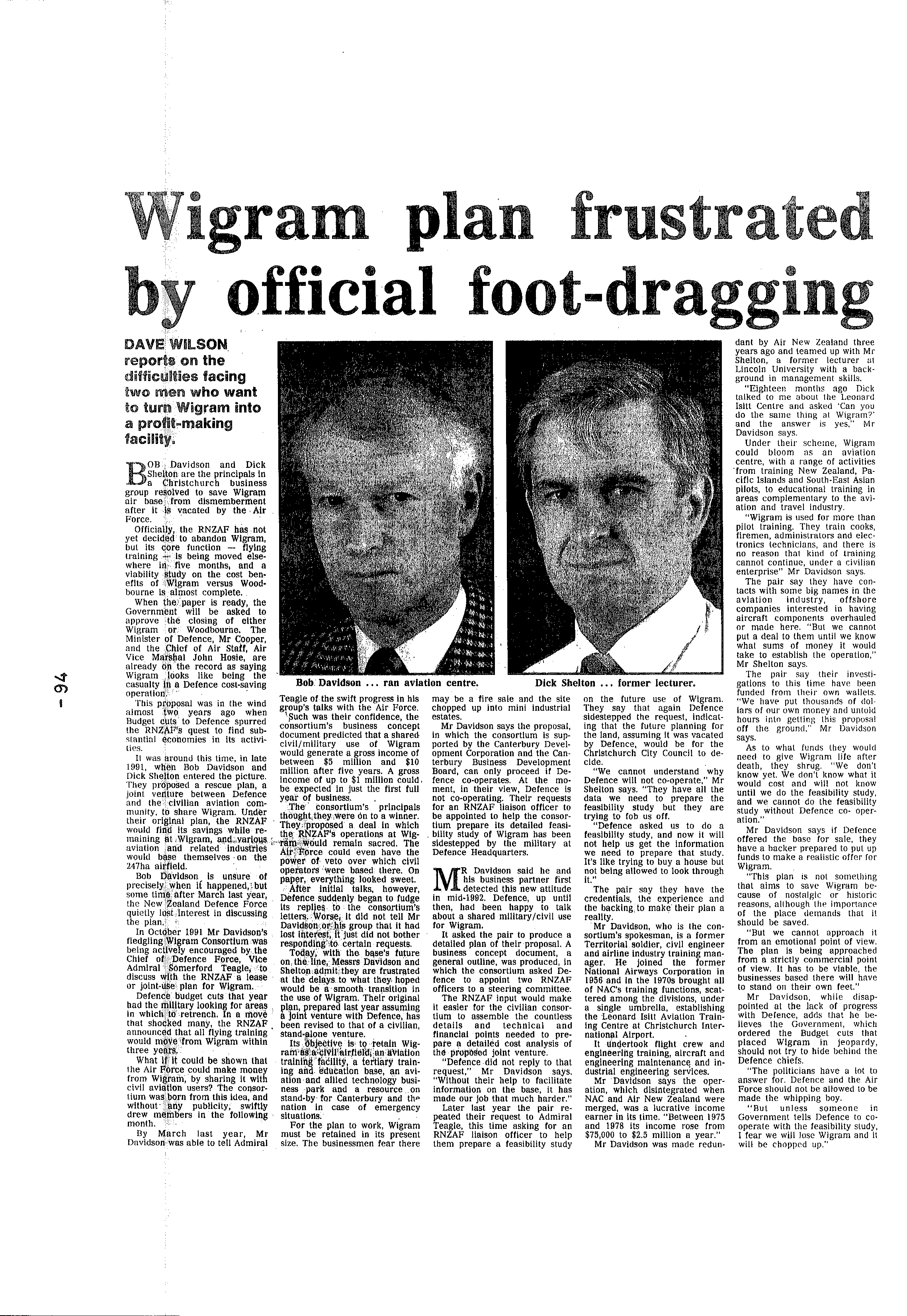
Dick Shelton ... former lecturer.
Teagle of the swift progress in his
group's talks with the Air Force.
Such was their confidence, the
consortium's business concept
document predicted that a shared
civil/military use of Wigram
would generate a gross income of
between million and $10
million after five years. A gross
income of up to $1 million could
be expected in just the first full
year or business.
The' consortium's principals
thought they were on to a winner.
They proposed a deal in which
the RNZAF's operations at Wigram would remain sacred. The
Alr Force could even have the
power of veto over which civil
operators were based there. On
paper, everything looked sweet.
After initial talks, however,
Defence suddenly began to fudge
its replies to the consortium's
letters Worse; It did not tell Mr
Davidson or his group that it had
lost interest, It just did not bother
responding to certain requests.
Today, with the base's future
on the line, Messrs Davidson and
Shelton admit they are frustrated
at the delays to what they hoped
would be a smooth transition in
the use of Wigram. Their original
plan, prepared last year assuming
& joint venture with Defence, nas
been revised to that of a civilian,
stand-alone venture.
Its objective is to retain wigram as a civil airfield, an aviation
training facility, a tertiary training and education base, an aviation and allled technology business park and a resource.. on
stand-by for Canterbury and the
nation case of emergency
situations.
For the plan to work, Wigram
must be retained in its present
size. The businessmen fear there
may be a fire sale and the site
chopped up into mini industrial
estates.
Mr Davidson says the proposal,
in which the consortium is supported by the Canterbury Development Corporation and the Canterbury Business Development
Board, can only proceed if Defence co-operates. At the moment, in their view, Defence is
not co-operating. Their requests
for an RNZAF liaison officer to
be appointed to help the consortium prepare its detailed feasibility study of Wigram has been
sidestepped by the military at
Defence Headquarters.
"R Davidson said he and
* his business partner first
• detected this new attitude
in mid-1992. Defence, up until
then, had been happy to talk
about a shared military/civil use
for Wigram.
It asked the pair to produce a
detailed plan of their proposal. A
business concept document, 8
general outline, was produced, in
which the consortium asked Defence to appoint two RNZAF
officers to a steering committee.
The RNZAF input would make
it easier for the civilian consortium to assemble the countless
details and technical and
financial points needed to prepare a detailed cost analysis of
the proposed joint venture.
"Defence did not reply to that
request," Mr Davidson says.
"Without their help to facilitate
information on the base, it has
made our job that much harder."
Later last year lhe pair repeated their request to Admiral
reagie, this time asking for an
RNZAF liaison officer to help
them prepare a feasibility study
on the future use of Wigram.
They say that again Defence
sidestepped the request, indicaling that the future planning for
the land, assuming it was vacated
by Defence, would be for the
Christchurch City Council to decide.
"We cannot understand why
Defence will not co-operate, " Mr
Shelton says. "They have all the
data we need to prepare the
feasibility study but they are
trying to fob us off.
"Defence asked us to do a
feasibility study, and now it will
not help us get the information
we need to prepare that study.
It's like trying to buy a house but
not being allowed to look through
The pair say they have the
credentials, the experience and
the backing to make their plan a
reality.
Mr Davidson, who is the consortium's spokesman, is a former
Territorial soldier, civll engineer
and airline industry training manager. He , joined the former
National Airways Corporation in
1956 and in the 1970s brought all
of NAC's training functions, scattered among the divisions, under
a single umbrella, establishing
the Leonard Isilt Aviation Training Centre at Christchurch International Airport.
It undertook flight crew and
engineering training, alrcraft and
engineering maintenance and industrial engineering services.
Mr Davidson says the operation, which disintegrated when
NAC and Air New Zealand were
mergea, was a lucrative income
earner in its time. "Between 1975
and 1978 its income rose from
$75,000 to $2.5 million a year."
Mr Davidson was made redun-
dant by Air New Zealand three
years ago and teamed up with Mr
Shelton, former lecturer at
Lincoln University with a background in management skills.
"Eighteen months ago Dick
talked to me about the Leonard
Isiti Centre and asked Can you
do the same thing at Wigram?'
and the answer is yes," Mr
Davidson says.
Under their scheine, Wigram
could bloom as an aviation
centre, with a range of activities
from training New Zealand, Pacific Islands and South-East Asian
pilots, to educational training in
areas complementary to the aviation and travel industry.
"Wigram is used for more than
pilot training. They train cooks,
firemen, administrators and electronics technicians, and there is
no reason that kind of training
cannot continue, under a civilian
enterprise" Mr Davidson says
The pair say they have contacts with some big names in the
aviation industry, offshore
companies interested in having
aircrait components overhauled
or made here. "But we cannot
put a deal to them until we know
what sums of money it would
take to establish the operation,"
Mr Shelton says.
The pair say their investigations to this time have been
funded from their own wallets.
"We have put thousands of dollars of our own money and untold
hours into getting this proposal
off the ground." Mr Davidson
says.
As to what funds they would
need to give Wigram life after
death, shrug "We don't
knot yet. We son know what it
would cost and will not know
until we do the feasibility study.
and we cannot do the feasibility
study
ation, Without Defence co-oper-
Mr Davidson says if Defence
offered the base for sale, they
have a backer prepared to put up
funds to make a realistic offer for
Wigram.
''This plan not something
that aims to save Wigram because of nostalgic historic
reasons, although the importance
of the place demands that it
should be saved.
"But we cannol approach it
from an emotional point of view
The plan is being approached
from a strictly commercial point
of view. It has to be viable, the
businesses based there will have
to stand on their own feet."
Mr Davidson, while disappointed at the lack of progress
with Defence, adds that he believes the Government, which
ordered the Budget cuts that
placed Wigram in jeopardy,
should not try to hide behind the
Defence chiefs.
"The politicians have a lot to
answer for. Defence and the Air
Force should not be allowed to be
made the whipping boy.
"But unless someone in
Government tells Defence to cooperate with ine teasibutty study
: fear we will lose Wigram and i
will be chopped up."
Summaries and tables are machine-read from the scan and may contain errors: the scan is the record.