letterWigram letters
Letters supporting Mayor Vicki Buck's fight against closing Wigram air base, from Denise McGregor, J. K. Moir and Maurice Jenner.
newsCouncil to consider airfield's future
A Christchurch City Council sub-committee will consider Wigram's future; the base's land will be available for sale in early 1996, with descendants of original owners and then Ngai Tahu having first claim. A consortium led by Bob Davidson is interested in an international aviation training centre.
Photos
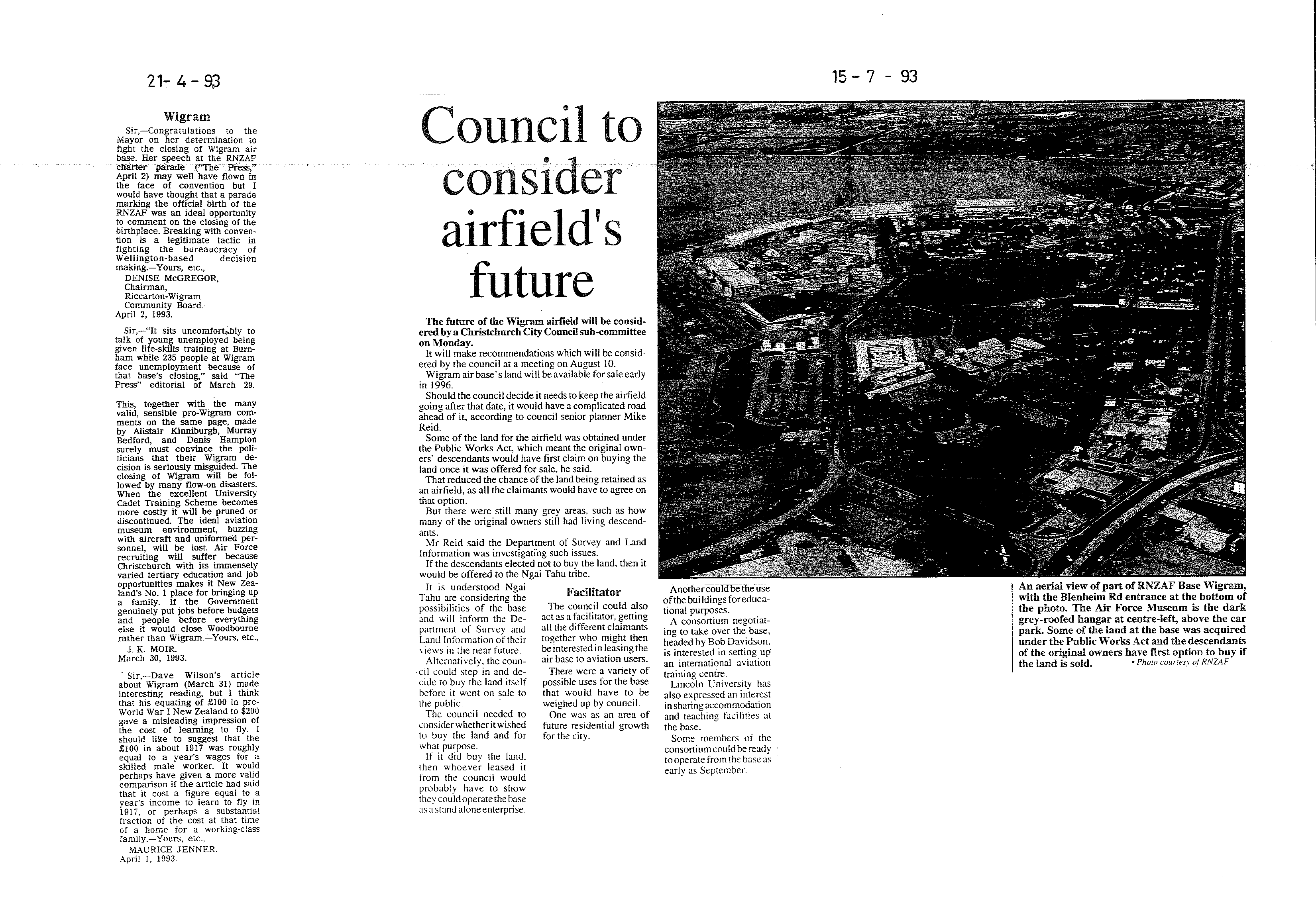
- An aerial view of part of RNZAF Base Wigram, with the Blenheim Rd entrance at the bottom of the photo. Photo: RNZAF
Read the OCR text
21-4-93 15 - 7 - 93
Wigram
Sir,-Congratulations to the
Mayor on her determination to
fight the closing of Wigram air
base. Her speech at the RNZAF
charter parade ("The Press,"
April 2) may well have flown in
the face of convention but I
would have thought that a parade
marking the official birth of the
RNZAF was an ideal opportunity
to comment on the closing of the
birthplace. Breaking with convention is a legitimate tactic in
fighting the bureaucracy of
Wellington-based decision
making.-Yours, etc.,
DENISE MCGREGOR,
Chairman,
Riccarton-Wigram
Community Board.
April 2, 1993.
Sir,-"It sits uncomfortably to
talk of young unemployed being
given life-skills training at Burnham while 235 people at Wigram
face unemployment because of
that base's closing," said "The
Press" editorial of March 29.
This, together with the many
valid, sensible pro-Wigram comments on the same page, made
by Alistair Kinniburgh, Murray
Bedford, and Denis Hampton
surely must convince the politicians that their Wigram
cision is seriously misguided. The
closing of Wigram will be followed by many flow-on disasters.
When the excellent University
Cadet Training Scheme becomes
more costly it will be pruned or
discontinued. The ideal aviation
museum environment, buzzing
with aircraft and uniformed personnel, will be lost. Air Force
recruiting will suffer because
Christchurch with its immensely
varied tertiary education and job
opportunities makes it New Zealand's No. 1 place for bringing up
a family. the Government
genuinely put jobs before budgets
and people before everything
else it would close Woodbourne
rather than Wigram.-Yours, etc.,
J. K. MOIR.
March 30, 1993.
Sir,-Dave Wilson's article
about Wigram (March 3l) made
interesting reading, but I think
that his equating of £100 in pre-
World War I New Zealand to $200
gave a misleading impression of
the cost of learning to fly. 1
should like to suggest that the
£100 in about 1917 was roughly
equal to a year's wages for a
skilled male worker. It would
perhaps have given a more valid
comparison if the article had said
that it cost a figure equal to a
year's income to learn to fly in
1917, or perhaps a substantia!
fraction of the cost at that time
of a home for a working-class
family.- Yours, etc.,
MAURICE JENNER.
April 1, 1993.
Council to
consider
airfield's
future
The future of the Wigram airfield will be considered by a Christchurch City Council sub-committee
on Monday.
It will make recommendations which will be considered by the council at a meeting on August 10.
Wigram air base's land will be available for sale early
in 1996.
Should the council decide it needs to keep the airfield
going after that date, it would have a complicated road
ahead of it, according to council senior planner Mike
Reid.
Some of the land for the airfield was obtained under
the Public Works Act, which meant the original owners' descendants would have first claim on buying the
land once it was offered for sale, he said.
That reduced the chance of the land being retained as
an airfield, as all the claimants would have to agree on
that option.
But there were still many
many of the original owner:
ants.
Mr Reid said the Departn
Information was investigati
If the descendants elected
would be offered to the Nga
It is understood Ngai
Tahu are considering the
possibilities of the base
and will inform the Department of Survey and
Land Information of their
views in the near future.
Altematively, the council could step in and decide to buy the land itself
betore it went on sale to
the public.
The council needed to
consider whether it wished
to buy the land and for
what purpose.
If it did buy the land.
then whoever leased it
from the council would
probably have to show
they could operate the base
as a stand alone enterprise.
grey areas, such as how
still had living descend-
ment of Survey and Land
ing such issues.
not to buy the land, then it
ai Tahu tribe.
Facilitator
The council could also
act as a facilitator, getting
all the different claimants
together who might then
be interested in leasing the
air base to aviation users.
There were a variety of
possible uses for the base
that would have to be
weighed up by council.
One was as an area of
future residential growth
for the city.
Another could be the use
of the buildings for educational purposes.
A consortium negotiating to take over the base,
headed by Bob Davidson,
is interested in setting up
an international aviation
training centre.
Lincoln University has
also expressed an interest
in sharing accommodation
and teaching facilities ai
the base.
Some members of the
consortium could be ready
to operate from the base as
early as September.
An aerial view of part of RNZAF Base Wigram,
with the Blenheim Rd entrance at the bottom of
the photo. The Air Force Museum is the dark
grey-roofed hangar at centre-left, above the car
park. Some of the land at the base was acquired
under the Public Works Act and the descendants
of the original owners have first option to buy it
the land is sold. • Photo courtesy of RNZAF
Summaries and tables are machine-read from the scan and may contain errors: the scan is the record.