Read the OCR text
bical
TOR tantalising
RNZAF Base Wigram
thought they had cheated the
axe. The rumour machine,
fuelled by some authoritative
nods from the men in the know,
indicated that post-1991 Budget
plans to close the historic air
1-12-92 base within three years had been
stymied.
Some sophisticated high-level
paper shuffling and whispered
deals about renting part of Wigram to civilian operators gave
rise to the belief that these
measures might satisty the
RNZAF's headlong drive to cut
Costs.
They have not, and any
maining illusions about Wigram's
chances of escaping a total shutdown have been dispelled by the
parameters of a new review of
air force real estate. Either Wigram or Woodbourne is to be
closed, as a cost-saving measure
The choice will come down to
which base's operations are the
cheapest to shift, and the outcome should be known early next
costings in a 1989
RNZAF bases
Woodbourne will be the survivor
Senior air force sources say the
figures may have changed since
the trend favouring
Woodbourne is the same
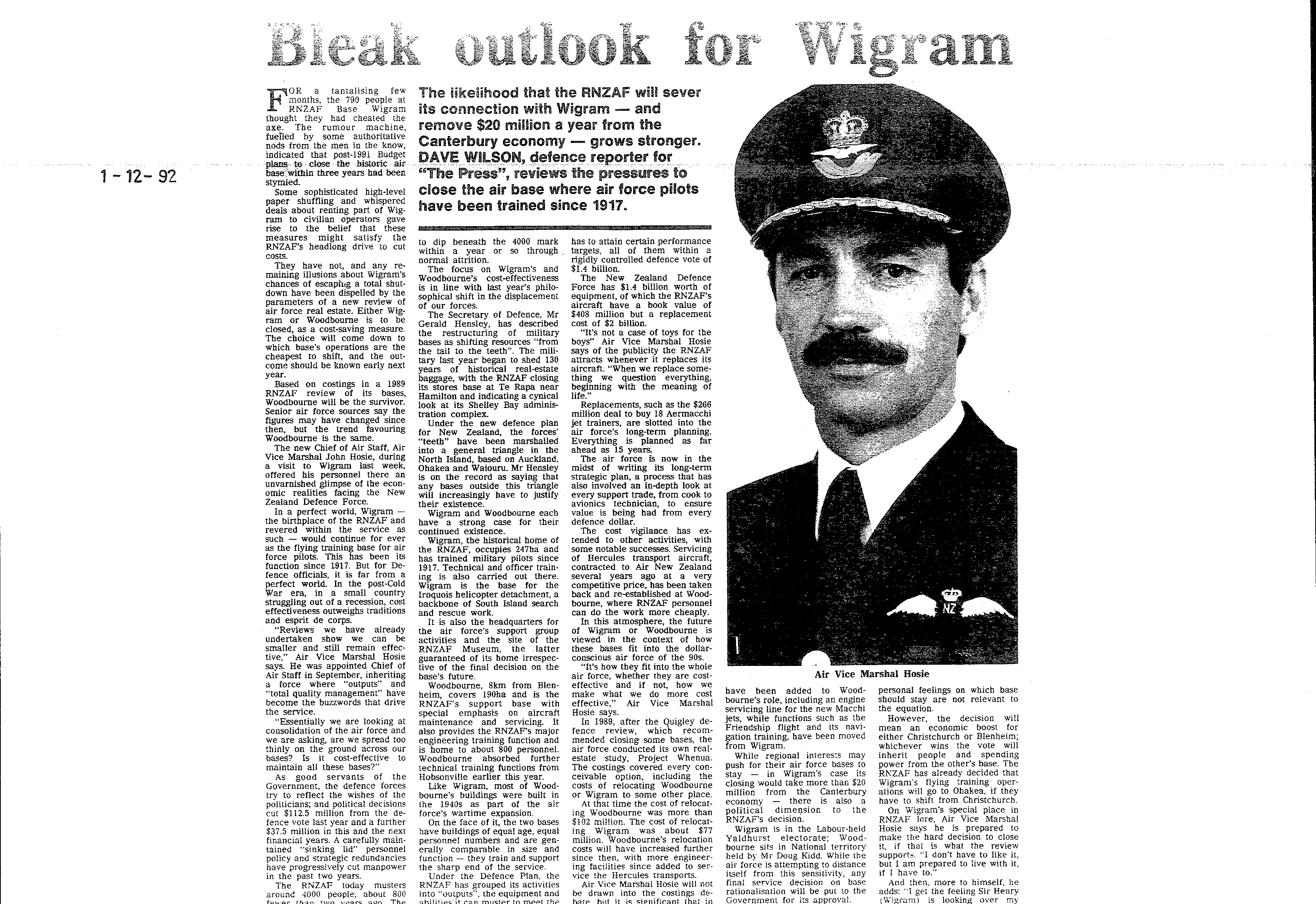
The new Chief of Air Staff, Air
Vice Marshal John Hosie, during
visit to Wigram
offered his personnel there an
unvarnished glimpse of the economic realities
Zealand Defence Force.
In a perfect world, Wigram the birthplace of the RNZAF and
revered within the service
such - would continue for ever
as the flying training base for air
force pilots. has been its
function since 1917. But for Deofficials, it is far from a
perfect world. In the post-Cold
era, in a small country
struggling out of a recession, cost
effectiveness outweighs traditions
and esprit de corps.
"Reviews we have already
undertaken show we can
smaller and still remain effective," Air Vice Marshal Hosie
says. He was appointed Chief of
a see in September inheriting "outputs"
"total quality management" have
become the buzzwords that drive
"Essentially we are looking at
consolidation of the air force and
we are asking, are we spread too
thinly on the ground across our
bases? cost-effective to
maintain all these bases?"
servants the
Government, the defence forces
try to reflect the wishes of the
politicians; and political decisions
cut $112.5 million from the defence vote last year and a further
$37.5 million in this and the next
financial years. A carefully maincained "sinking personnel
policy and strategic redundancies
have progressively cut manpower
in the past two years.
800
outlook fo
The likelihood that the ANZAF will sever
its connection with Wigram - and
remove $20 million a year from the
Canterbury economy - grows stronger.
DAVE WILSON, defence reporter for
"The Press", reviews the pressures to
close the air base where air force pilots
have been trained since 1917.
to dip beneath the 4000 mark
within year or so through
normal attrition.
The focus on Wigram's and
Woodbourne's cost-effectiveness
is in line with last year's philosophical shift in the displacement
of our forces.
The Secretary of Defence, Mr
Gerald Hensley, has described
the restructuring of military
bases as shifting resources "from
the tail to the teeth". The militears historian realestate years historical real-estate
baggage, with the RNZAF closing
its stores base at Te Rapa near
Hamilton and indicating a cynical
look at its Shelley Bay administration complex.
Under the new defence plan
for New Zealand, the forces'
"teeth" have been marshalled
into a general triangie in the
North Island, based on Aucklane
Ohakea and Waiouru. Mr Hensley
is on the record as saying that
any bases outside this triangle
will increasingly have to justify
their existence.
Wigram and Woodbourne each
Strong case for their
continued existence.
Wigram, the historical home of
the RNZAF, occupies 247ha and
has trained military pilots since
1917. Technical and officer training is also carried there.
Wigram is the base for the
Iroquois helicopter detachment, a
backbone of South Island search
and rescue work.
It is also the headquarters for
the air force's support group
activities and the site of the
RNZAF Museum, the latter
guaranteed of its home irrespective of the final decision on the
base's future.
Woodbourne, 8km from Blenheim, covers 190ha and is the
RNZAF's support base with
special emphasis aircraft
maintenance and servicing. It
also provides the RNZAF's major
engineering training function and
is home to about 800 personnel
Woodbourne absorbed further
technical training functions from
Hobsonville earlier this year.
Like Wigram, most of Woodbourne's buildings were built in
the 1940s as part of the
force's wartime expansion.
On the face of it, the two bases
have buildings of equal age, equal
personnel numbers and are generally comparable in size and
function - they train and support
the sharp end of the service.
Under the Defence Plan, the
into "outputs RNZAF has grouped its activities
* the equipment and
"hilitise it are mictarta moot tha
has to attain certain performance
largets, all of them within
rigidly controlled defence vote of
$1.4 billion.
The New Zealand Defence
Force has $1.4 billion worth of
equipment, of which the RNZAF'S
aircraft have a book value of
$408 million but a replacement
cost oi $2 billion.
"It's not a case of toys for the
boys" Air Vice Marshal Hosie
says of the publicity the RNZAF
attracts whenever it replaces its
aircraft. "When we replace something we question everything,
beginning with the meaning of
life."
Replacements, such as the $266
million deal to buy 18 Aermacchi
jet trainers, are slotted into the
air force's long-term planning.
Everything is planned as far
ahead as 15 years.
The air force is now in the
midst air strategic plan, a process that has writing its long-term
also involved an in-depth look at
every suppert trade, from cook to
avionics technician, to ensure
value is being had from every
defence dollar.
The vigilance has extended to other activities, with
some notable successes. Servicing
of Hercules transport aircraft,
contracted to Air New Zealand
several years ago at a very
competitive price, has been taken
back and re-established at Woodbourne, where RNZAF personnel
can do the work more cheaply.
In this atmosphere, the future
Wigram or Woodbourne is
viewed in the context of how
these bases fit into the dollarconscious air force of the 90s.
"It's how they fit into the whole
air force, whether they are costeffective and if not, how we
make what we do more cost
effective," Air Vice Marshal
Hosie says.
In 1989, after the Quigley defence review, which recommended closing some bases, the
air force conducted its own realestate study, Project Whenua.
The costings covered every conceivable option, including the
costs of relocating Woodbourne
or Wigram to some other place.
At that time the cost of relocating Woodbourne was more than
$102 million. The cost of relocating Wigram was about $77
million. Woodbourne's relocation
costs will have increased further
since then, with more engineering facilities since added to service the Hercules transports.
Air Vice Marshal Hosie will not
be drawn into the costings detato hut it is cionifiront that in
am
Air Vice Marshal Hosie
have been added to Woodbourne's role, including an engine
servicing line for the new Macchi
jets, while functions such as the
Friendship flight and its navigation training, have been moved
from Wigram.
While regional interests may
push for their air force bases to
stay - in Wigram's case its
closing would take more than $20
million from the Canterbury
economy - there is also a
political dimension to the
RNZAF's decision.
Wigram is in the Labour-held
Yaldhurst electorate; Woodbourne sits in National territory
held by Mr Doug Kidd. While the
air force is attempting to distance
itself from this sensitivity, any
final service decision base
rationalisation will be put to the
Government for its approval.
personal feelings on which base
should stay are not relevant to
the equation.
However, the decision will
mean an economic boost for
either Christchurch or Bienneim;
whichever wins the vote will
inherit people and spending
power from the other's base. The
RNZAF has already decided that
Wigram's flying training operations will go to Ohakea, if they
have to shift from Christchurch.
On Wigram's special place in
RNZAF lore, Air Vice Marshal
Hosie says he is prepared to
make the hard decision to close
it, if that is what the review
supports. "I don't have to like it,
but I am prepared to live with it,
if I have io."
And then. more to himself, he
adds: "I get the feeling Sir Henry
(Wigram) is looking over my
Summaries and tables are machine-read from the scan and may contain errors: the scan is the record.