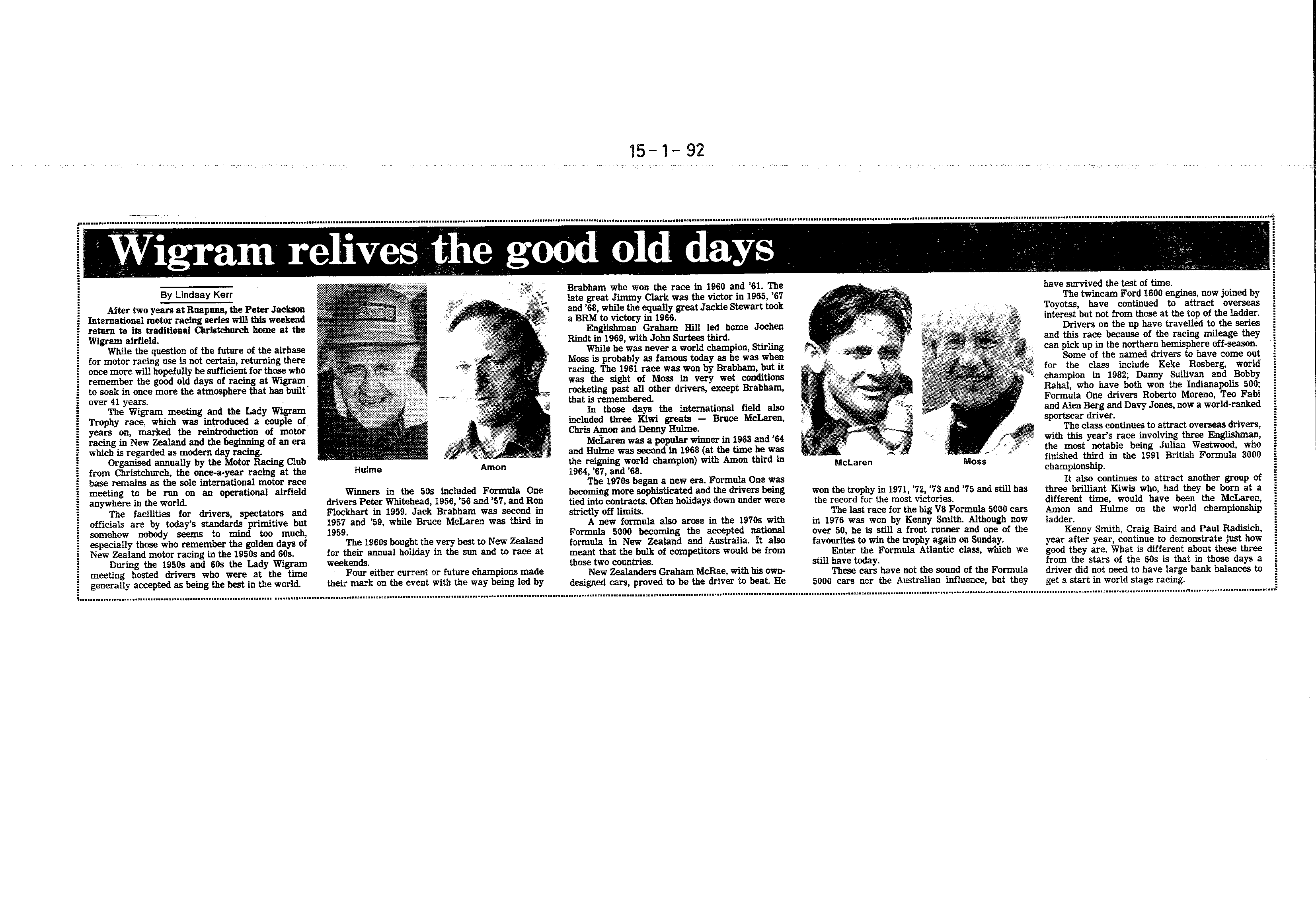
feature · Lindsay KerrWigram relives the good old days
After two years at Ruapuna, the Peter Jackson International series returns to Wigram for the 1992 Lady Wigram Trophy. The article reviews the race's history, from 1950s winners such as Peter Whitehead and Ron Flockhart and 1960s champions Brabham, Clark, Stewart and Hill, through Graham McRae's four wins in the Formula 5000 era to the Formula Atlantic class of today, with Kenny Smith, Craig Baird and Paul Radisich the local stars.
Facts
- The 1992 Peter Jackson series returned to Wigram after two years at Ruapuna; the Wigram meeting was then in its 41st year.
- The Lady Wigram meeting is organised annually by the Motor Racing Club from Christchurch and was described as the only international race meeting run on an operational airfield anywhere in the world.
- Graham McRae won the Lady Wigram Trophy in 1971, 1972, 1973 and 1975 and still held the record for most victories as of 1992.
- The last Formula 5000 Lady Wigram Trophy, in 1976, was won by Kenny Smith.
- Overseas Formula Atlantic visitors over the years included Keke Rosberg (1982 world champion), Danny Sullivan, Bobby Rahal, Roberto Moreno, Teo Fabi, Alen Berg and Davy Jones.
Photos
- Brabham, McLaren, Moss (photos of past Wigram stars)
Read the OCR text
15 - 1-92
Wigram relives the good old days
Brabham who won the race in 1960 and '61. The
By Lindsay Kerr late great Jimmy Clark was the victor in 1965, '67
After two years at Ruapuna, the Peter Jackson and '68, while the equally great Jackie Stewart took
International motor racing series will this weekend a BRM to victory in 1966.
return to its traditional Christchurch home at the Englishman Graham Hill led home Jochen
Wigram airfield. Rindt in 1969, with John Surtees third.
While the question of the future of the airbase While he was never a world champion, Stirling
for motor racing use is not certain, returning there Moss is probably as famous today as he was when
once more will hopefully be sufficient for those who racing. The 1961 race was won by Brabham, but it
remember the good old days of racing at Wigram was the sight of Moss in very wet conditions
to soak in once more the atmosphere that has built rocketing past all other drivers, except Brabham,
over 41 years. that is remembered.
The Wigram meeting and the Lady Wigram In those days the international field also
Trophy race, which was introduced a couple of included three Kiwi greats - Bruce McLaren,
years on, marked the reintroduction of motor Chris Amon and Denny Huime.
racing in New Zealand and the beginning of an era McLaren was a popular winner in 1963 and '64
which is regarded as modern day racing. and Hulme was second in 1968 (at the time he was
Organised annually by the Motor Racing Club Amon the reigning world champion) with Amon third in
from Christchureh, the once-a-year racing at the Hulme 1964, '67, and 68.
base remains as the sole international motor race The 1970s began a new era. Formula One was
meeting to be run on an operational airfield Winners in the 50s included Formula One becoming more sophisticated and the drivers being
anywhere in the world. drivers Peter Whitehead, 1956, '56 and '57, and Ron tied into contracts. Often holidays down under were
The facilities for drivers, spectators and Flockhart in 1959. Jack Brabham was second in strictly off limits.
officials are by today's standards primitive but 1957 and '59, while Bruce McLaren was third in A new formula also arose in the 1970s with
somehow nobody seems to mind too much, 1959. Formula 5000 becoming the accepted national
especially those who remember the golden days of The 1960s bought the very best to New Zealand formula in New Zealand and Australia. It also
New Zealand motor racing in the 1950s and 60s. for their annual holiday in the sun and to race at meant that the bulk of competitors would be from
During the 1950s and 60s the Lady Wigram weekends. those two countries.
meeting hosted drivers who were at the time Four either current or future champions made New Zealanders Graham McRae, with his owngenerally accepted as being the best in the world. their mark on the event with the way being led by designed cars, proved to be the driver to beat. He
RicLaren
Moss
won the trophy in 1971, '72, '73 and "75 and still has
the record for the most victories.
The last race for the big V8 Formula 5000 cars
in 1976 was won by Kenny Smith. Although now
over 50, he is still a front runner and one of the
favourites to win the trophy again on Sunday.
Enter the Formula Atlantic class, which we
still have today.
These cars have not the sound of the Formula
5000 cars nor the Australian influence, but they
have survived the test of time.
The twineam Ford 1600 engines, now joined by
Toyotas, have continued to attract overseas
interest but not from those at the top of the ladder.
Drivers on the up have travelled to the series
and this race because of the racing mileage they
can pick up in the northern hemisphere off-season.
Some of the named drivers to have come out
for the class include Keke Rosberg, world
champion in 1982; Danny Sullivan and Bobby
Rahal, who have both won the Indianapolis 500;
Formula One drivers Roberto Moreno, Teo Fabi
and Alen Berg and Davy Jones, now a world-ranked
sportscar driver.
The class continues to attract overseas drivers,
with this year's race involving three Englishman,
the most notable being Julian Westwood, who
finished third in the 1991 British Formula 3000
championship.
It also continues to attract another group of
three brilliant Kiwis who, had they be born at a
different time, would have been the Mclaren,
Amon and Huime on the world charpionship
ladder.
Kenny Smith, Craig Baird and Paul Radisich,
year after year, continue to demonstrate just how
good they are. What is different about these three
from the stars of the 6ûs is that in those days a
driver did not need to have large bank balances to
get a start in world stage racing.
Summaries and tables are machine-read from the scan and may contain errors: the scan is the record.