news · The PressLady Wigram back at base
Don Craighead, president of the Motor Racing Club, confirmed that the Lady Wigram Trophy race will definitely return to Wigram Air Base in January after two years away, following a meeting with Wing Commander Gordon Alexander. The base has a new $4.7m runway but is under a cloud after the Budget; the club suggests the runway be used for other motor racing too.
Facts
- The Lady Wigram Trophy race was confirmed in August 1991 to return to Wigram Air Base in January 1992 after two years at Ruapuna.
- Wigram Air Base had a new $4.7m runway completed in 1991.
news · The PressMotor Racing Club proposes Holden and Mazda RX7 handicap races
Brief item (partly cut off) saying the Motor Racing Club proposed combining Holden and Mazda RX7 register competitors, whose numbers had been impressive this season, into balanced fields for two handicap races at a Wigram meeting on January 18 and 19.
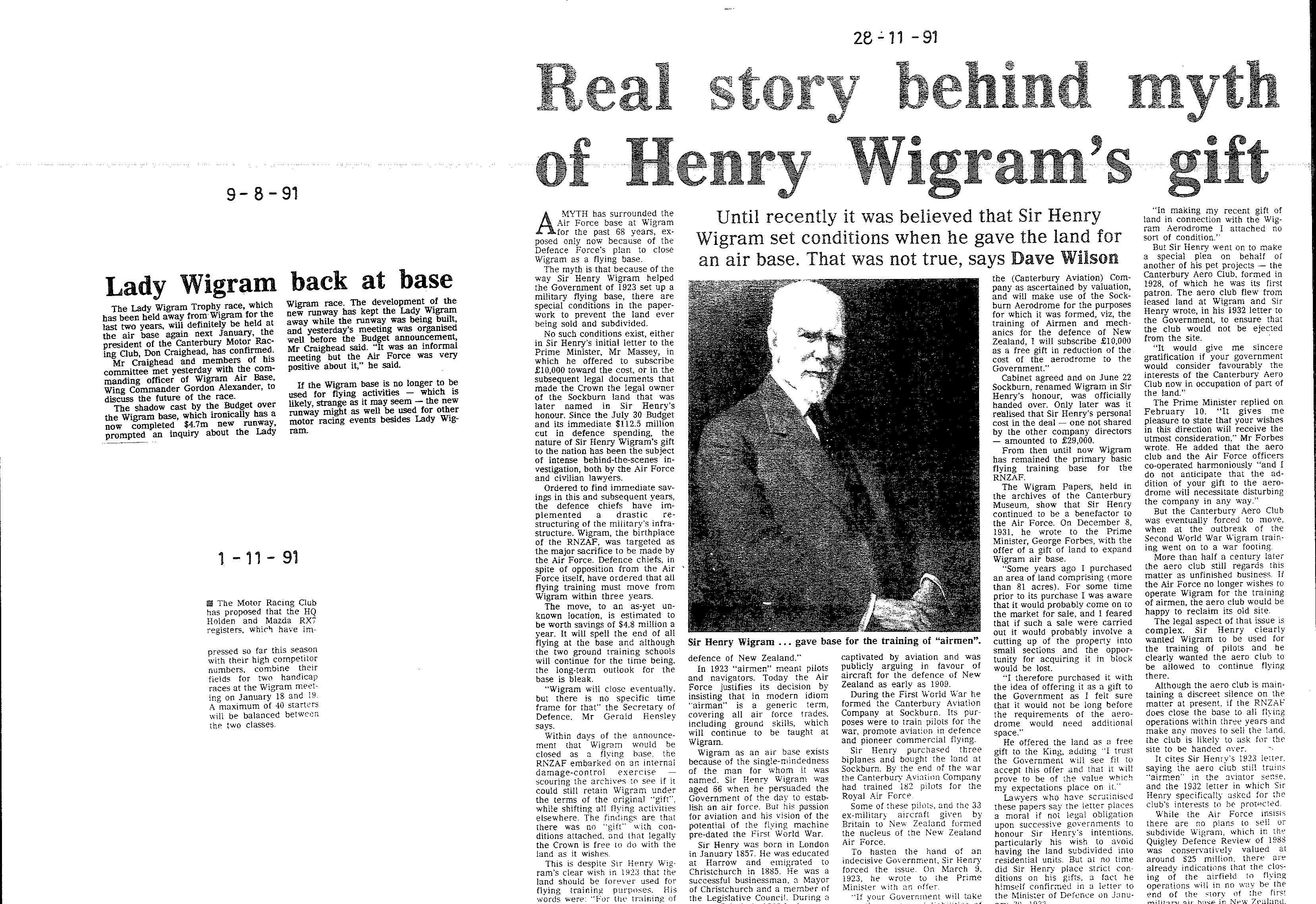
feature · The Press · Dave WilsonThe real story behind the myth of Sir Henry Wigram's gift
Feature explaining that no conditions were attached to Sir Henry Wigram's gift of the Sockburn aerodrome to the Government in 1923, despite a popular myth, as the Defence Force plans to close Wigram as a flying base. It traces Sir Henry's 1923 and 1931 letters, the Canterbury Aero Club's interest in reclaiming its site, and the July 1991 Budget defence cuts.
Facts
- On 9 March 1923 Sir Henry Wigram offered the Government the Sockburn aerodrome with £10,000 toward its cost; the site was renamed Wigram and handed over on 22 June 1923.
- The Canterbury Aviation Company trained 182 pilots for the Royal Air Force during the First World War.
- After the July 1991 Budget the Defence Force ordered all RNZAF flying training to leave Wigram within three years, saving an estimated $4.8m a year.
- Wigram was valued at about $25 million in the 1988 Quigley Defence Review.
Read the OCR text
28-11-91
9-8-91
Lady Wigram
The Lady Wigram Trophy race, which
has been held away from Wigram for the
last two years, will definitely be held at
the air base again next January, the
president of the Canterbury Motor Racing Club, Don Craighead, has confirmed.
Mr Craighead and members of his
committee met yesterday with the commanding officer of Wigram Air Base,
Wing Commander Gordon Alexander, to
discuss the future of the race.
The shadow cast by the Budget over
the Wigram base, which ironically has a $4.7m new runway,
now completed
prompted an inquiry about the Lady
1=11=
# The Motor Rac
has proposed that
Holden and Maz
registers, which h
pressed so far th
with their high co
numbers, combi
fields for two
races at the Wigr
ing on January 1
will be balanced
the two classes.
back at base
Wigram race. The development of the
new runway has kept the Lady Wigram
away while the runway was being built,
and yesterday's meeting was organised
well before the Budget announcement,
Mr Craighead said. "It was an informal
meeting but the Air Force was very
positive about it," he said.
If the Wigram base is no longer to be
used for flying activities - which is
likely, strange as it may seem — the new
runway might as well be used for other
motor racing events besides Lady Wigram.
91
cing Club
t the HQ
zaa Rxi
have im-
is season
mpetitor
ne l thei
handica!
am meet
8 and 19
+ starter
• betweei
Real
of H
MYTH has surrounded the
Air Force base at Wigram
posed only now because of the A for the past 68 years ex-
Defence Force's plan to close
Wigram as a flying base.
The myth is that because of the
way Sir Henry Wigram helped
the Government of 1923 set up a
military flying base, there are
special conditions in the paperwork to prevent the land ever
being sold and subdivided.
No such conditions exist, either
in Sir Henry's initial letter to the
Prime Minister, Mr Massey,
which he offered to subscribe
£10,000 toward the cost, or in the
subsequent legal documents that
made the Crown the legal owner
of the Sockburn land that was
later named in Sir Henry's
honour. Since the July 30 Budget
and its immediate $112.5 million
CUL in defence spending, the
nature of Sir Henry Wigram's gift
to the nation has been the subject
of intense behind-the-scenes investigation, both by the Air Force
and civilian lawyers.
Ordered to find immediate savings in this and subsequent years,
the defence chiefs have implemented a drastic re"
structuring of the military's infrastructure. Wigram, the birthplace
of the RNZAF, was targeted as
the major sacrifice to be made by
the Air Force. Defence chiefs, in
spite of opposition from the Air
Force itself, have ordered that all
flying training must move from
Wigram within three years.
The move, an as-yet unknown location, is estimated
be worth savings of $4.8 million a
year. It will spell the end of all
flying at the base and although
the two ground training schools
will continue for the time being.
the long-term outlook for the
base is bleak.
"Wigram will close eventually.
but there is no specific time
frame for that" the Secretary of
Defence, Mr Gerald Hensley
says.
Within davs of the announcement that Wigram would be
closed as a flying base, the
RNZAF embarked on an internal
damage-control exercise
scouring the archives in see if it
could still retain Wigram under
the terms of the original "gift"
white shifting all flying activities
elsewhere. The findings are that
there was no "gift" with conditions attached. and that legally
the Crown is free io do with the
land as it wishes.
This is despite Sir Henry Wig.
ram's clear wish in 1923 that the
land should be forever used for
flying training purposes. His
words were: "For the training of
story
beh
ind
myth
enry
Wig
ram's
Until recently it was believed that Sir Henry
Wigram set conditions when he gave the land for
an air base. That was not true, says Dave Wilson
Sir Henry Wigram... gave ba
defence of New Zealand."
In 1923 "airmen" meant pilots
and navigators. Today the Air
Force justifies its decision by
insisting that in modern idiom
"airman" is a generic term,
covering all air force trades,
including ground skills, which
will continue to be taught at
Wigram.
Wigram as an air base exists
because of the single-mindedness
of the man for whom it was
named. Sir Henry wigram was
aged 66 when he persuaded the
Government of the day to establish an air force. But his passion
for aviation and his vision of the
potential of the flying machine
pre-dated the First World War.
Sir Henry was born in London
in January 1857. He was educated
ai Harrow and emigrated
Chrisichurch in 1885. He was
successful businessman, a Mayor
of Christchurch and a member of
the Legislative Council. During a
se for the training of "airmen".
captivated by aviation and was
publiciy arguing in favour of
aircraft for the defence of New
Zealand as early as 1909.
During the First World War he
formed the Canterbury Aviation
Company at Sockburn. Its purposes were to train pilots for the
war, promote aviation in defence
and pioneer commercial flying.
Sir Henry purchased three
biplanes and bought the land at
Sockburn. By the end of the war
the Canterbury Aviation Company
had trained 182 pilots for the
Royal Air Force
Some of these pilois, and the 33
ex-military aircraft given by
Britain to New Zealand formed
the nucleus of the New Zealand
Air Force.
To hasten the hand of an
indecisive Government, Sir Henry
forced the issue. On March 9.
1923, he wrote to the Prime
Minister with an offer.
"If vour Government wil take
the (Canterbury Aviation) Company as ascertained by valuation, and will make use of the Sockburn Aerodrome for the purposes
for which it was formed, viz, the
training of Airmen and mechanics for the defence of New
Zealand, 1 will subscribe £10,000
as a free gift in reduction of the
cost of the aerodrome to the
Government."
Cabinet agreed and on June 22
Sockburn, renamed Wigram in Sir
Henry's honour, officially
handed over. Only later was it
realised that Sir Henry's personal
cost in the deal - one not shared
by the other company directors
- amounted to £29,000.
From then until now Wigram
has remained the primary basic
flying training base for the
RNZAF.
The Wigram Papers, held in
the archives of the Canterbury
Museum, show that Sir Henry
continued to be a benefactor to
the Air Force. On December 8,
1931, he wrote to the Prime
Minister, George Forbes, with the
offer of a gift of land to expand
Wigram air base.
"Some years ago I purchased
an area of land comprising (more
than 81 acres). For some time
prior to its purchase I was aware
that it would probably come on to
the market for sale, and I feared
that if such a sale were carried
out it would probably involve a
cutting up of the property into
small sections and the opportunity for acquiring it in block
would be lost.
"I therefore purchased it with
the idea of offering it as a gift to
the Government as I felt sure
that it would not be long before
the requirements of the aerodrome would need additional
space."
He offered the land as free
gift to the King, adding "1 trust
the Government will see fit 10
accept this offer and that it will
prove to be of the value which
my expectations place on it."
Lawyers who have scrutinised
these papers say the letter places
a mora! if not legal obligation
upon successive governments to
honour Sir Henry's intentions.
particularly his wish to avoid
having the land subdivided into
residential units. But ai no time
did Sir Henry place strict conditions on his gifts, a fact he
himself confirmed in a letter to
the Minister of Defence on Janu-
gift
"In making my recent gift of
land in connection with the Wig
ram Aerodrome I attached no
sort of condition."
But Sir Henry went on to make
a special plea behalf
another of his pet projects - the
Canterbury Aero Club, formed in
1928, of wnich ne was its first
patron. The aero club flew from
leased land at Wigram and Sir
Henry wrote, in his 1932 letter to
the Government, to ensure that
the club would not be ejected
from the site.
give me sincere
gratification if your government
would consider favourably the
interests of the Canterbury Aero
Club now in occupation of part of
the land"
The Prime Minister replied on
February 10. "It gives
pleasure to state that your wishes
in this direction will receive ine
utmost consideration," Mr Forbes
wrote. He added that the aero
club and the Air Force officers
co-operated harmoniously "and I
do not anticipate that the addition of your gift to the aerodrome will necessitate disturbing
the company in any way."
But the Canterbury Aero Club
was eventually forced to move.
when at the outbreak of the
Second World War Wigram training went on to a war footing
More than half a century later
the aero club still regards this
matter as unfinished business. If
the Air Force no longer wishes to
operate Wigram for the training
of airmen, the aero club would be
happy to reclaim its old site.
The legal aspect of that issue is
complex. Sir Henry clearly
wanted Wigram to be used for
the training of pilots and he
clearly wanted the aero club to
be allowed to continue flying
Although the aero club is maintaining a discreet silence on the
matter at present, if the RNZAH
does close the base to all fiving
operations within three years and
make any moves to sell the land,
the club is likely to ask for the
site to be handed nver.
It cites Sir Henry's 1923 leiter
saying the aero ciub stil! trains
'airmen" in the aviator sense.
and the 1932 letter in which Sir
Henry specifically asked for the
club's interests to be protected
While the Air Force insisis
there are no plans to sell or
subdivide Wigram, which in the
Quigley Defence Review of 1988
was conservatively valued at
around $25 million. there are
auready indicatine that the cho airfield flying
operations will in no way be the
end of the story of the firs!
Summaries and tables are machine-read from the scan and may contain errors: the scan is the record.