Wigram TrophyMotor racing at Wigram airfield · Christchurch · 1949–2000
Home › Archive › 1987 › Sports sedans an attraction
← 14 Jan 1987All 1987 pages14 Jan 1987 →
Scan of the clipping page, 14 January 1987
↗
Drag to move · scroll or pinch to zoom
preview · Lindsay Kerr

Sports sedans an attraction

The 1987 Lady Wigram meeting gave top billing to the new Handy Hire Exhaust Systems Trans Tasman Sports Sedan Challenge: two races between six Australian sports sedans and six New Zealand OSCA cars for a $10,000 purse ($6000 to the winning team). The Lady Wigram Trophy, round four of the Mita Copiers Grand Prix series, was seen as possibly the last Formula Pacific race in the country.

Facts

  • The 1987 Handy Hire Exhaust Systems Trans Tasman Sports Sedan Challenge at Wigram offered a $10,000 purse, $6000 to the winning team and $4000 to the losers.
  • The Wigram circuit was quoted as 3.44km in 1987.
  • The Open Saloon Car Association (OSCA) was in its 16th season in 1987.
  • In 1987 Group A racing was run only on North Island circuits.

Photos

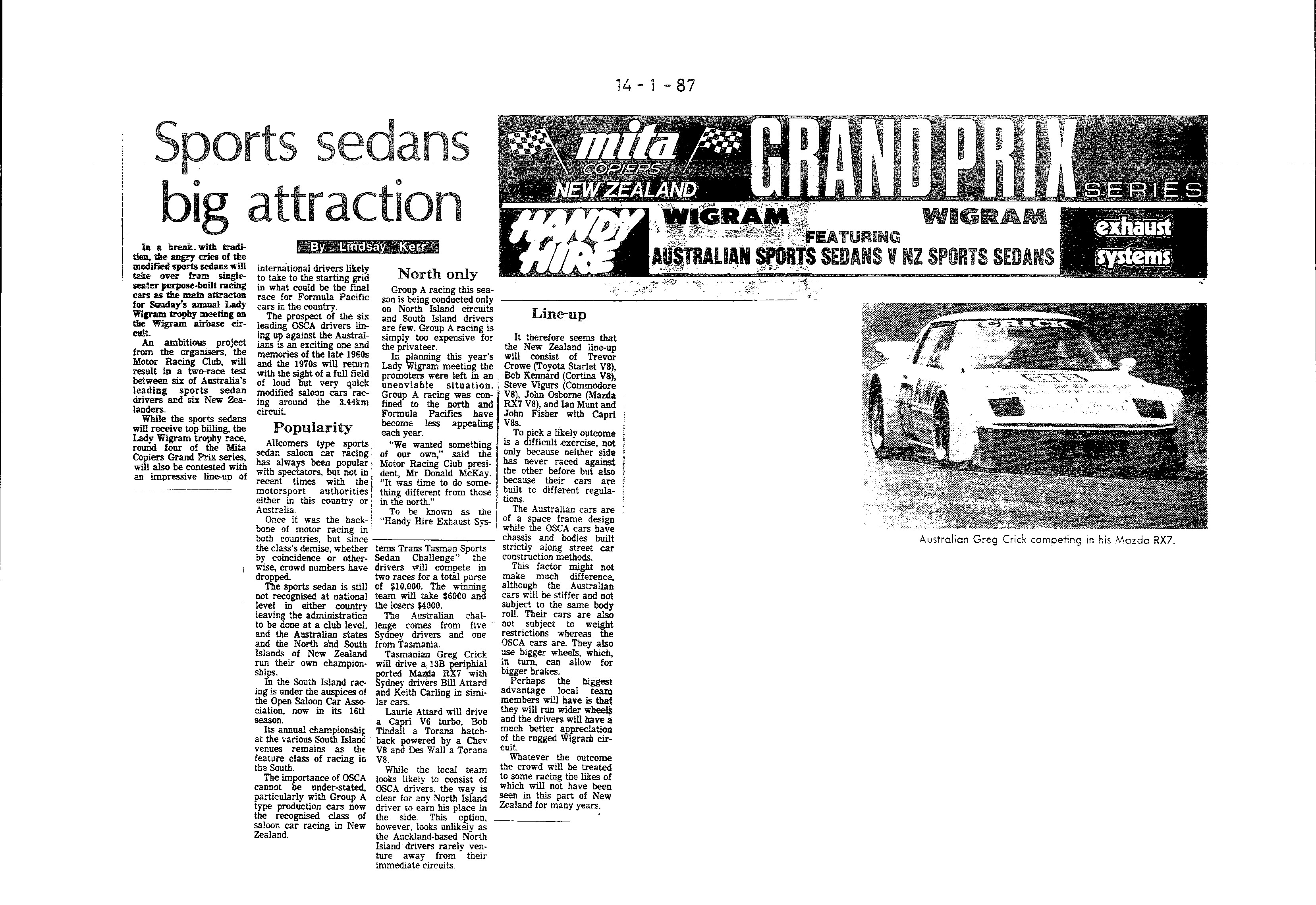
  • Australian Greg Crick competing in his Mazda RX7.
Read the OCR text
14=1-87 Sports sedans 8Ia In a break. with tradition, the angry cries oi the modified sports sedans wil take over from singleseater purpose-built racing cars as the main attracten for Sunday's annual Lady Wigram tropky meeting on Wigram airbase circuit. An ambitious project from the organisers, the Motor Racing Club, will result in a two-race test between six of Australia's leading sports sedan drivers and six New Zealanders. While the sports sedans will receive top billing, the Lady Wigram trophy race, round four of the Mita Copiers Grand Prix series, will also be contested with an impressive line-up of attraction By Lindsay Kerr international drivers likely to take to the starting grid in what could be the final race for Formula Pacific cars in the country. The prospect of the six leading OSCA drivers lining up against the Australians is an exciting one and memories of the late 1960s and the 1970s will return with the sight of a full field of loud but very quick modified saloon cars racing around the 3.44km circuit. Popularity Allcomers type sports sedan saloon car racing has always been popular with spectators, but not in recent times with motorsport authorities either in this country or Australia. Once it was the backbone of motor racing in both countries, but since the class's demise, whether by coincidence or otherwise, crowd numbers have tropped. The sports sedan is stil not recognised at national level in either country leaving the administration to be done at a club level, and the Australian states and the North and South Islands of New Zealand run their own championships. In the South Island racing is under the auspices of the Open Saloon Car Asso ciation, now in its 16tł season. its annual championshif at the various south isianc venues remains as the feature class of racing in the South The importance of OSCA cannot be under-stated, particularly with Group A type production cars now the recognised class of saloon car racing in New Zealand. North only Group A racing this season is being conducted only on North Island circuits and South Island drivers are few. Group A racing is simply too expensive for the privateer. In planning this year's Lady Wigram meeting the promoters were left in an unenviable situation. Group A racing was confined to the north and Formula Pacifies have become less appealing each year. "We wanted something of our own," said the Motor Racing Club president, Mr Donald Mckay. "It was time to do something different from those in the north." To be known as the "Handy Hire Exhaust Sys- tems Trans Tasman Sports Sedan Challenge" the drivers will compete in two races for a total purse of $10,000. The winning tear will take $6000 and the losers $4000. The Australian challenge comes from five Sydney drivers and one from Tasmania. Tasmanian Greg Crick will drive a 13B periphial ported Mazda RX7 with Sydney drivers Bill Attard and Keith Carling in similar cars. Laurie Attard will drive a Capri V6 turbo, Bob Tindall a Torana natchback powered by a Chev V8 and Des Wall a Torana V8. While the local team looks likely to consist of OSCA drivers, the way is clear for any North Island driver to earn his place in the side. This optior, however, looks unlikely as the Auckland-based North Island drivers rarely venture away from their immediate circuits. mila COPIERS NEW ZEALAND IRAI SERIES Line up It therefore seems that the New Zealand line-up will consist of Trevor Crowe (Toyota Starlet V8), Bob Kennard (Cortina V8), Steve Vigurs (Commodore v8), John Osborne (Mazda R$7 V8), and lan Munt and Joan Fisher with Capri V8s. To pick a likely outcome is a difficult exercise, not only because neither side has never raced against the other before but also because their cars are built to different regulations. The Australian cars are ; of a space frame design while the OSCA cars have chassis and bodies built strictly along street car construction methods. This factor might not make much difference, although the Australian cars will be stiffer and not subject to the same body roll. Their cars are also not subject to weight restrictions whereas the OSCA cars are. They also use bigger wheels, which, in turn, can allow for bigger brakes. Perhaps the biggest advantage local team members will have is that they wil run wider wheels and the drivers will have a much better appreciation of the rugged Wigrard circuit. Whatever the outcome the crowd will be treated to some racing the likes of which will not have been seen in this part of New Zealand for many years. WIGRAN FEATURING AUSTRALIAN SPORTS SEDANS V WIGRA NZ SPORTS SED M exhaust ANS systems Australian Greg Crick competing in his Mazda RX7.

Summaries and tables are machine-read from the scan and may contain errors: the scan is the record.