featureInternational flavour to series
History of the Tasman and Formula Pacific series leading to the Aurora AFX series. The Tasman Cup began in 1964 with Bruce McLaren winning and was won by Jim Clark, Jackie Stewart, Chris Amon, Graeme Lawrence and Graham McRae; it ended in the early 1970s, replaced from 1974 by the Peter Stuyvesant series, which was split in 1976 into a Rothmans series in Australia and a Stuyvesant series in New Zealand. The piece argues local drivers often provide the best competition against overseas visitors.
Facts
- The Tasman series began in 1964 when Bruce McLaren won it; winners included Jim Clark, Jackie Stewart, Chris Amon, Graeme Lawrence and Graham McRae.
- From 1974 the series became the Peter Stuyvesant Series; Peter Gethin won the first in a Chevron and Warwick Brown the 1975 series in a Lola.
- In 1976 the series was split into a four-race Rothmans series in Australia and a four-race Stuyvesant series in New Zealand.
- Overseas drivers who raced in the NZ series include Brian Redman, Peter Gethin, Teddy Pilette, Max Stewart, Tom Gloy, Danny Sullivan, Pierre Dieudonne, Ian Grob, Keke Rosberg and Bobby Rahal.
Photos
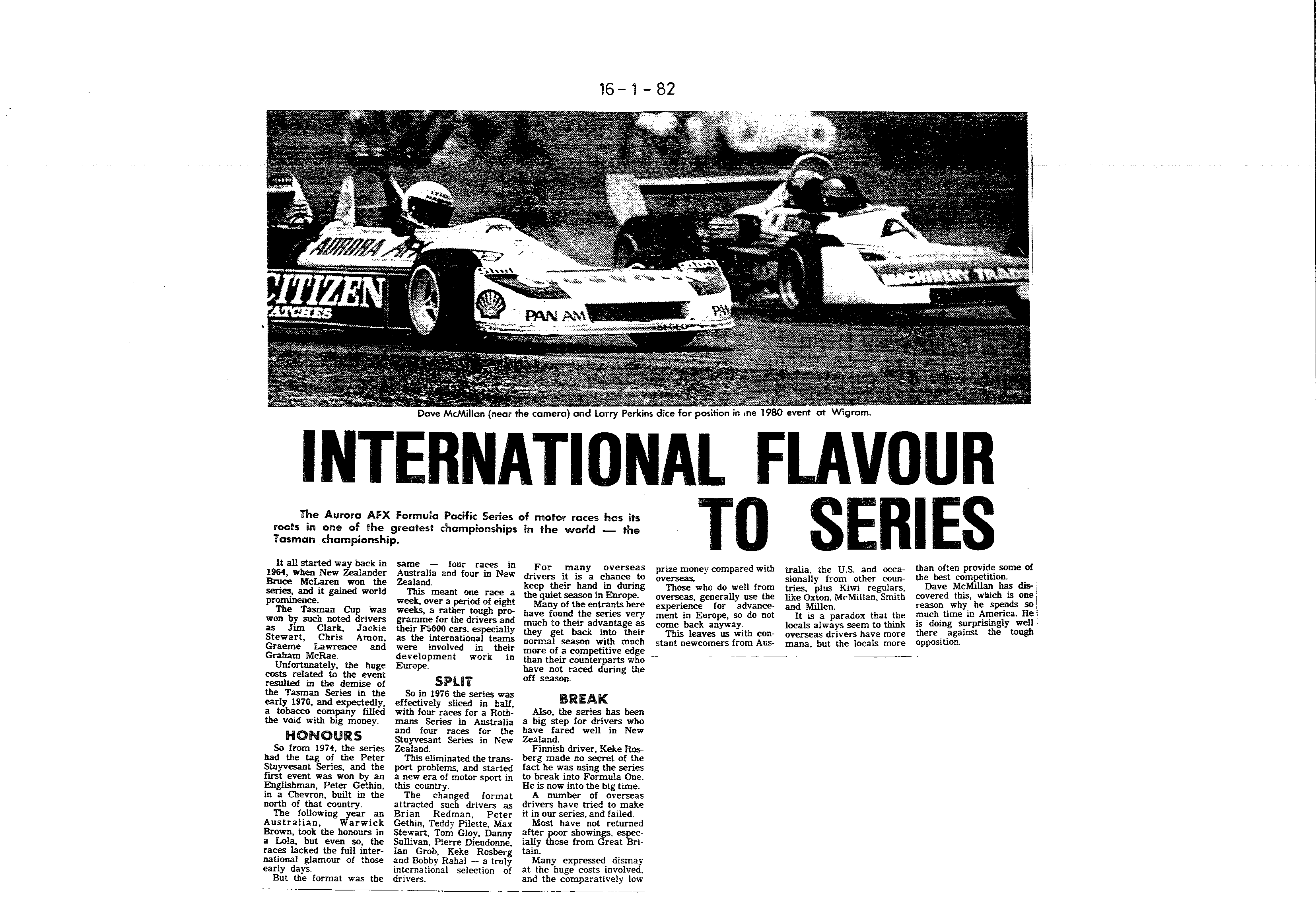
- Dave McMillan (near the camera) and Larry Perkins dice for position in the 1980 event at Wigram.
Read the OCR text
16-1-82
CITIZEN
ATCHES PAN AM
Dave McMillan (near the camera) and Larry Perkins dice for position in ine 1980 event at Wigram.
NTE
RNAT
NOU
The Aurora AFX Formula Pacific Series of motor races has its
Tosman champiohe greatest championships in the world — the Tosman championship.
It all started way back in
1964, when New Zealander
Bruce McLaren won the
series, and it gained world
prominence.
The Tasman Cup was
won by such noted drivers
as Jim Clark, Jackie
Stewart, _ Chris Amon,
Graeme Lawrence and
Graham McRae.
Unfortunately, the huge
costs related to the event
resulted in the demise of
the Tasman Series in the
early 1970, and expectedly,
a tobacco company filled
the void with big money.
HONOURS
So from 1974, the series
had the tag of the Peter
Stuyvesant Series, and the
first event was won by an
Englishman, Peter Gethin,
in a Chevron, built in the
north of that country.
The following year an
Australian, Warwick
Brown, took the honours in
a Lola, but even so, the
races lacked the full international glamour of those
early days.
But the format was the
same - four races in
Australia and four in New
Zealand.
This meant one race a
week, over a period of eight
weeks, a rather tough pro
gramme for the drivers and
iDeIr 15000 cars, especially
as the international teams
were involved in their
development work in
Europe.
SPLIT
So in 1976 the series was
effectively sliced in balf,
with four races for a Rothmans Series in Australia
and four races for the
Stuyvesant Series in New
Zealand.
This eliminated the transport problems, and started
a new era of motor sport in
this country.
The changed format
attracted such drivers as
Brian Redman, Peter
Gethin, Teddy Pilette, Max
Stewart, Tom Gloy. Danny
Sullivan, Pierre Dieudonne,
lan Grob, Keke Rosberg
and Bobby Rahal - a truly
international selection
drivers.
For many overseas
drivers it is a chance to
keep their hand in during
the quiet season in Europe.
Many of the entrants bere
have found the series very
much to their advantage as
they get back into their
normal season with much
more of a competitive edge
than their counterparts who
have not raced during the
off season.
BREAK
Also, the series has been
a big step for drivers who
have fared well in New
Zealand.
Pinnish driver, Keke Rosberg made no secret of the
fact he was using the series
to break into Formula One.
He is now into the big time.
A number of overseas
drivers have tried to make
it in our series, and failed.
Most have not returned
after poor showings, especially those from Great Britain.
Many expressed dismay
at the huge costs involved.
and the comparatively low
AL F
LAVO
TO SER
prize money compared with
overseas.
Those who do well from
overseas, generally use the
experience for advance
ment in Europe, so do not
come back anyway:
This leaves us with constant newcomers from Aus-
tralia, the U.S. and occasionally from other countries, pius Kiwi regulars,
like Oxton, McMillan, Smith
and Millen.
It is a paradox that the
locals always seem to think
overseas drivers have more
mana, but the locals more
UR
ES
than often provide some of
the best competition.
Dave McMillan has discovered this, which is one
reason why he spends so
much time in America. He
is doing surprisingly well
there against the tough
opposition.
Summaries and tables are machine-read from the scan and may contain errors: the scan is the record.