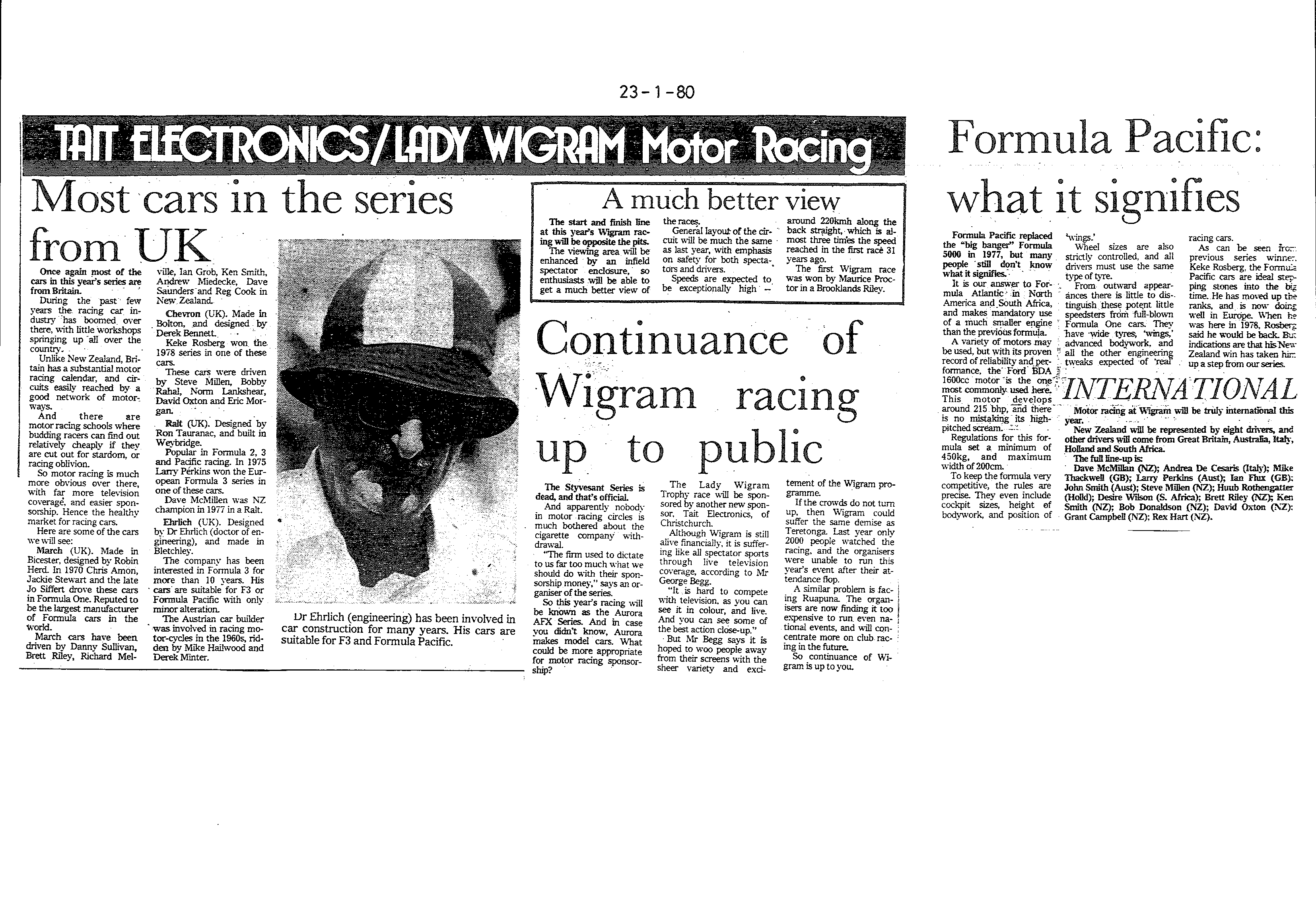
featureMost cars in the series from UK
Explains that most 1980 Aurora AFX series cars are British: March (Bicester, Robin Herd), Chevron (Bolton, Derek Bennett), Ralt (Weybridge, Ron Tauranac) and Ehrlich (Bletchley). It also covers circuit changes for 1980 and expected speeds of around 220 km/h on the back straight.
Lap times
Facts
- Keke Rosberg won the 1978 series in a Chevron; Larry Perkins won the 1975 European F3 series in a Ralt; Dave McMillan was NZ champion in 1977 in a Ralt.
- The first Wigram race (1949) was won by Maurice Proctor in a Brooklands Riley; speeds in 1980 were nearly three times those of the first race 31 years earlier.
- For 1980 the Wigram start-finish line was opposite the pits and an infield spectator enclosure was added.
featureContinuance of Wigram racing up to public
The Stuyvesant series was officially dead and the 1980 series was the Aurora AFX Series, with the Lady Wigram Trophy sponsored by Tait Electronics. George Begg warned Wigram could suffer the same demise as Teretonga, where only 2000 watched in 1979 and the 1980 meeting was cancelled; Ruapuna was also struggling.
Facts
- The Peter Stuyvesant series ended; the 1980 NZ Formula Pacific series was the Aurora AFX Series, sponsored by a maker of model cars.
- Only about 2000 people watched racing at Teretonga in 1979, and organisers were unable to run the 1980 event after the attendance flop.
- Formula Pacific replaced Formula 5000 in 1977; it uses Ford BDA 1600cc engines of about 215 bhp, minimum weight 450kg, maximum width 200cm.
previewInternational field
The full 1980 Wigram entry list: Dave McMillan, Andrea de Cesaris, Mike Thackwell, Larry Perkins, Ian Flux, John Smith, Steve Millen, Huub Rothengatter, Desiree Wilson, Brett Riley, Ken Smith, Bob Donaldson, David Oxton, Grant Campbell and Rex Hart, from NZ, GB, Australia, Italy, Holland and South Africa.
Facts
- Fifteen drivers were entered for the 1980 Lady Wigram Trophy, eight of them from New Zealand.
Read the OCR text
23-1-80
ТАП
Mos
ELEC
t cars
RONICS LADY WIGRAM
in the series
A
Motor
much bet
Racing
ter view
from UK
Once again most of the
cars in this year's series are
from Britain.
During the past few
years the racing car industry has boomed over
there, with little workshops
springing up all over the
country.
Unlike New Zealand, Britain has a substantial motor
racing calendar, and circuits easily reached by a
good network of motorways.
And there are
motor racing schools where
budding racers can find out
relatively cheaply if they
are cut out for stardom, or
racing oblivion.
So motor racing is much
more obvious over there,
with far more television
coveragé, and easier sponsorship. Hence the healthy
market for racing cars.
Here are some of the cars
we will see:
March (UK). Made in
Bicester, designed by Robin
Herd. In 1970 Chris Amon,
Jackie Stewart and the late
Jo Siffert drove these cars
in Formula One. Reputed to
be the largest manufacturer
of Formula cars in the
world.
March cars have been
driven by Danny Sullivan,
Brett Riley, Richard Mel-
Vile, lan Grob, Ken Smith,
Andrew Miedecke, Dave
Saunders and Reg Cook in
New Zealand.
Chevron (UK). Made in
Bolton, and designed by
Derek Bennett..
Keke Rosberg won the
1978 series in one of these
cars.
These cars were driven
by Steve Millen, Bobby
Rahal, Norm Lankshear,
David Oxton and Eric Morgan,
Rait (UK). Designed by
Ron Tauranac, and built in
Weybridge.
Popular in Formula 2, 3
and Pacific racing. In 1975
Larry Perkins won the European Formula 3 series in
one of these cars.
Dave McMillen was NZ
champion in 1977 in a Rait.
Ehrlich (UK). Designed
by Dr Ehrlich (doctor of engineering), and made in
Bletchley.
The company has been
interested in Formula 3 for
more than 10 years. His
cars are suitable for F3 or
Formula Pacific with only
minor alteration.
The Austrian car builder
was involved in racing motor-cycles in the 1960s, rid.
den by Mike Hailwood and
Derek Minter.
Dr Ehrlich (engineering) has been involved in
car construction for many years. His cars are
suitable for F3 and Formula Pacific.
The start and finish line
at this year's Wigram racing will be opposite the pits.
The viewing area will be
enhanced by an infield
spectator enclosure, SO
enthusiasts will be able to
get a much better view of
the races.
General layout of the circut wil be much the same
as last year, with emphasis
on safety for both specta.
tors and drivers.
Speeds are expected to.
be exceptionally high-
around 220kmh along the
back straight, which is almost three times the speed
reached in the first racè 31
years ago.
The first Wigram race
was won by Maurice Proctor in a Brooklands Riley.
Continuance of
Wigra
m ra
up to pub
The Styvesant Series is
dead, and that's official.
And apparently nobody
in motor racing circles is
much bothered about the
cigarette company withdrawal.
"The firm used to dictate
to us far too much what we
should do with their sponsorship money," says an organiser of the series.
So this year's racing will
be known as the Aurora
AFX Series. And in case
you didn't know, Aurora
makes model cars. What
could be more appropriate
for motor racing sponsorship?
The Lady Wigram
Trophy race will be sponsored by another new sponsor, Tait Electronics, of
Christchurch.
Although Wigram is still
alive financially, it is suffering like all spectator sports
through live television
coverage, according to Mr
George Begg.
"It is hard to compete
with television, as you can
see it in colour, and live.
And you can see some of
the best action close-up."
• But Mr Begg says it is
hoped to woo peopie away
from their screens with the
sheer variety and exci-
cing
lic
tement of the Wigram programme.
If the crowas do not tum
up, then Wigram could
suffer the same demise as
Teretonga. Last year only
2000 people watched the
racing, and the organisers
were unable to run this
years event after their attendance flop.
A similar problem is facing Ruapuna The organisers are now finding it too
expensive to run even national events, and will concentrate more on club. racing in the future
So continuance of Wigram is up to you.
Formula Pacific:
what it signifies
Formula Pacific repiaced
the "big banger" Formula
5000 in 1977, but many
people stil don't know
what it signifies..
It is our answer to Formula Atlantic in North
America and South Africa,
and makes mandatory use
of a much smaller engine
than the previous formula.
A variety of motors may
be used, but with its proven
record of reliability and performance, the Ford' BDA
1600cc motor 'is the one
most commoniy used here.
This motor develops
around 215. bhp, and there
is no mistaking its highpitched scream. **
Regulations for this formula set a minimum of
450kg, and maximum
width of 200cm.
To keep the formula very
competitive, the rules are
precise. They even include
cockpit sizes, height of
bodywork, and position of
Trings!
Wheel sizes are also
strictly controlled, and all
drivers must use the same
type of tyre.
From outward appearánces there is little to dis-.
tinguish these potent little
speedsters from full-blown
Formula One cars They
have wide tyres, "wings,"
advanced bodywork, and
ail the other engmeerng
weaks expected of real
INTERNA
racing cars.
As can be seen froz:
previous series winner.
Keke Rosberg, the Formula
Pacific cars are ideal stepping stones into the big
time. He has moved up the
ranks, and is now doing
well in Europe. When he
was here in 1978, Rosber;
said he would be back. Bu:
indications are that his New
Zealand win has taken her.
up a step from our series.
ATIONAL
Motor racing at Wigram will be truly international this
year.
New Zealand will be represented by eight drivers, and
other drivers will come from Great Britain, Australia, Italy,
Holland and South Africa.
The full line-up is:
Dave McMillan (NZ); Andrea De Cesaris (Italy); Mike
Thackwell (GB); Larry Perkins (Aust); lan Flix (GB);
John Smith (Aust); Steve Mitlen (NZ); Huub Rothengatter
(Holld); Desire Wilson (S. Africa); Brett Riley (NZ); Ken
Smith (NZ); Bob Donaldson (NZ); David Oxton (NZ):
Grant Campbell (NZ); Rex Hart (NZ).
Summaries and tables are machine-read from the scan and may contain errors: the scan is the record.